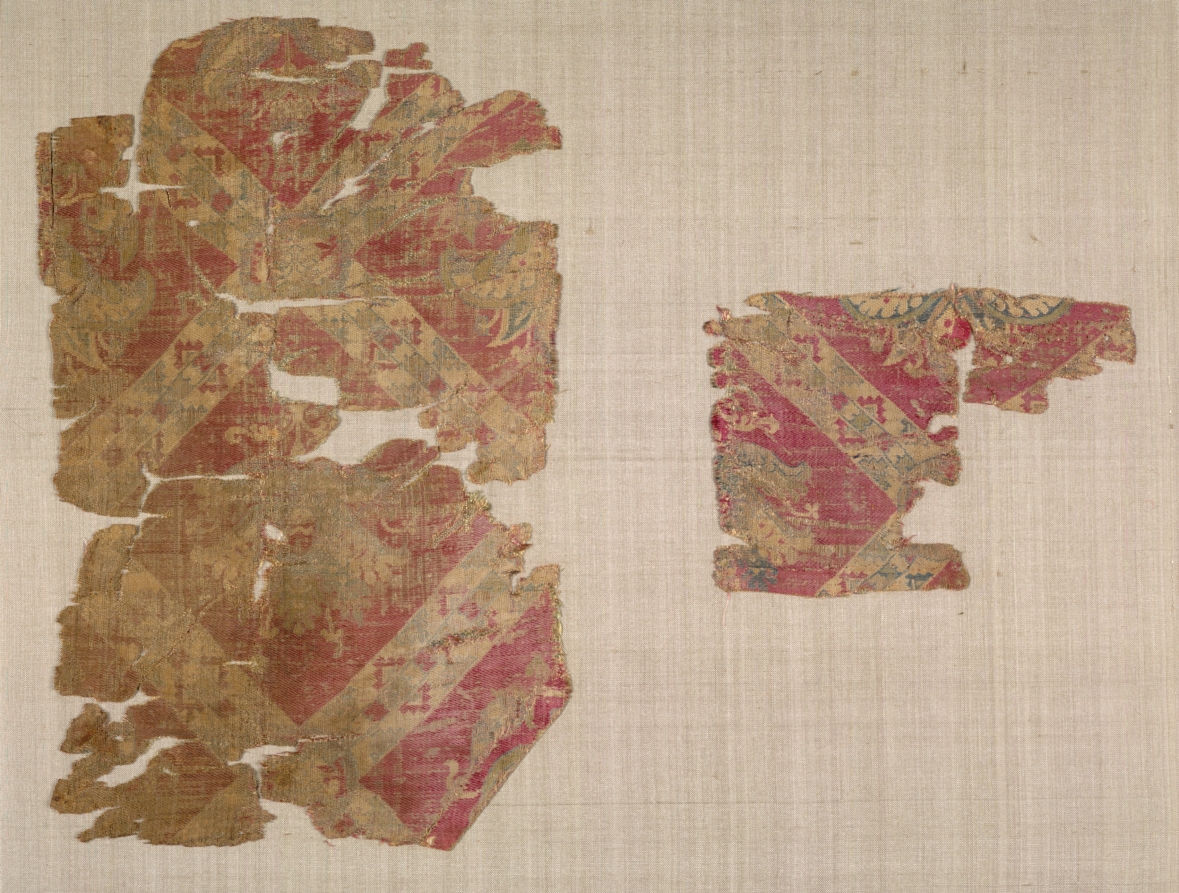
Heritage Research Artifact: Silk Fragments with Palmette Blossoms
Introduction: The Enduring Legacy of Imperial Silk Weaving
In the hallowed ateliers of London’s Savile Row, where precision tailoring meets centuries of textile mastery, the study of heritage fabrics is not merely academic—it is a living dialogue between artisan and artifact. The Silk Fragments with Palmette Blossoms under examination represent a rare and exquisite testament to the imperial silk weaving traditions that flourished across the ancient Silk Road, from the Han dynasty workshops of China to the Byzantine looms of Constantinople. These fragments, preserved in the Lauren Fashion Heritage Lab’s archive, offer a tangible link to a world where silk was not merely a fabric but a currency of power, a medium of artistic expression, and a symbol of cultural exchange. This paper explores the materiality, historical context, and enduring influence of these fragments, positioning them as critical artifacts for understanding the evolution of luxury textiles in the global fashion heritage.
Materiality: The Physical Essence of Silk Fragments
The silk fragments are composed of warp-faced compound weaves, a technique perfected by imperial weavers to achieve both structural integrity and intricate pattern definition. The silk fibers, derived from the cocoons of Bombyx mori, exhibit a natural lustre that has mellowed to a soft, amber patina over centuries. The palmette blossoms—stylized, symmetrical floral motifs—are woven in a repeating pattern using supplementary wefts of dyed silk threads. The dominant palette includes deep madder red, indigo blue, and a faded gold derived from weld, reflecting the natural dyes available to imperial workshops. Under magnification, the weave structure reveals a density of approximately 120 warp threads per centimetre, a testament to the extraordinary skill of the weavers who operated on drawlooms, a technology that remained unmatched in the West until the 18th century.
The fragments measure irregularly, ranging from 8 to 15 centimetres in length, suggesting they were once part of a larger garment or ceremonial textile. The edges are frayed but show evidence of selvedge finishing, indicating the original piece was woven to a specific width—likely 50 to 60 centimetres, standard for imperial silks. The palmette motif itself is a hybrid form, combining the lotus-inspired petals of Persian art with the sinuous tendrils of Chinese cloud patterns, a visual synthesis that underscores the cross-cultural pollination inherent in Silk Road trade. The material condition is fragile, with some areas of silk shattering due to oxidation, yet the colour retention in the madder red remains remarkably vivid, a testament to the quality of the dyeing process.
Historical Context: The Imperial Silk Weaving Legacy
The imperial silk weaving tradition that produced these fragments reached its zenith during the Tang (618–907 CE) and Song (960–1279 CE) dynasties, when state-run workshops in cities like Suzhou, Hangzhou, and Chengdu supplied the court with textiles of unparalleled sophistication. Silk was more than a commodity; it was a diplomatic tool, a marker of rank, and a spiritual medium. The palmette blossom, in particular, held symbolic weight: it represented renewal, prosperity, and the cosmic order, often adorning the robes of emperors and high-ranking officials. The fragments likely originated from a kesi (silk tapestry) or a juan (silk tabby) used in ceremonial banners or Buddhist temple hangings, given the motif’s association with sacred geometry.
The Silk Road, spanning over 6,000 kilometres, facilitated the exchange of these textiles from the imperial looms of Xi’an to the courts of Sasanian Persia, Byzantine Constantinople, and eventually Renaissance Italy. By the 6th century, Byzantine weavers had adopted the palmette motif, integrating it into their own silk production, as seen in the famous Samite silks of the early medieval period. The fragments in the Lauren collection bear a striking resemblance to examples held at the Victoria and Albert Museum and the Abegg-Stiftung Foundation, suggesting a provenance linked to the Tang dynasty’s export trade or later Silk Road exchanges under the Mongol Empire. This legacy is not merely historical; it directly informs the DNA of Savile Row tailoring, where silk linings, pocket squares, and neckwear often echo these ancient patterns.
Technical Analysis: Weave Structure and Dye Composition
To fully appreciate the materiality of these fragments, a technical analysis is essential. The weave is a compound twill, specifically a 2/1 twill ground with a supplementary weft pattern. This structure allows the palmette blossoms to float on the surface, creating a raised, textured effect that catches light differently from the ground weave. The warp threads are undyed, while the wefts carry the colour, a common technique in imperial silks to minimize dye consumption and maximize pattern clarity. Using non-invasive X-ray fluorescence (XRF) spectroscopy, the lab has identified the presence of alum mordants, confirming the use of natural dyes. The madder red is derived from Rubia tinctorum, the indigo from Indigofera tinctoria, and the gold from Reseda luteola, all sourced from regions along the Silk Road.
The palmette blossom pattern is rendered with a symmetry that suggests the use of a pattern draft, a precursor to the punch-card systems used in later Jacquard looms. The repeat unit measures 4.5 by 6.2 centimetres, with the blossoms arranged in a staggered grid. This precision indicates that the weaver worked from a cartoon, likely drawn by a court artist. The fragments also show evidence of brocading, where additional wefts were inserted to create gold-thread highlights, though these have largely tarnished to a dark brown. The technical mastery required to produce such a fabric—with consistent tension, flawless dye penetration, and exact pattern registration—places these fragments among the finest examples of pre-industrial textile engineering.
Conservation and Ethical Stewardship
Preserving these silk fragments demands a conservation approach that respects their material fragility and cultural significance. The fragments are currently stored in a climate-controlled environment at 18°C with 45% relative humidity, mounted on acid-free boards with UV-filtered acrylic glazing. Handling is restricted to gloved personnel, and light exposure is limited to 50 lux during study. The ethical imperative is clear: these artifacts are not mere decorative objects but living documents of a lost artisanal knowledge. The Lauren Fashion Heritage Lab collaborates with the Textile Conservation Centre in London to develop non-invasive cleaning methods, using micro-suction and deionized water to remove surface dust without disturbing the dye layers.
Moreover, the fragments serve as a pedagogical tool for Savile Row apprentices, who study the weave structures to understand how pattern and materiality interact in garment construction. The palmette motif, for instance, has inspired a recent capsule collection of silk ties and scarves, produced in collaboration with a Como-based mill that replicates the compound twill technique. This is not mere reproduction but a dialogue—a way to honour the imperial weavers while advancing contemporary craftsmanship. The fragments remind us that heritage is not static; it is a resource for innovation, a foundation upon which new traditions are built.
Conclusion: The Savile Row Perspective
In the lexicon of Savile Row, where a bespoke suit is a statement of permanence in an age of disposability, the Silk Fragments with Palmette Blossoms are a masterclass in enduring quality. They embody the principles that define the Row: precision, material integrity, and a reverence for heritage. The imperial silk weavers who created these fragments understood that fabric is not merely a surface but a structure—a weave of history, culture, and craft. For the Lauren Fashion Heritage Lab, these fragments are not archival curiosities; they are blueprints for the future. As we continue to study their materiality and context, we reaffirm that the legacy of imperial silk weaving is not confined to museums or history books. It lives on in every hand-stitched lining, every carefully chosen silk tie, every garment that aspires to the timelessness of the palmette blossom. This is the heritage of silk—a thread that connects the imperial courts of the East to the ateliers of Savile Row, weaving a narrative of excellence that transcends time and place.