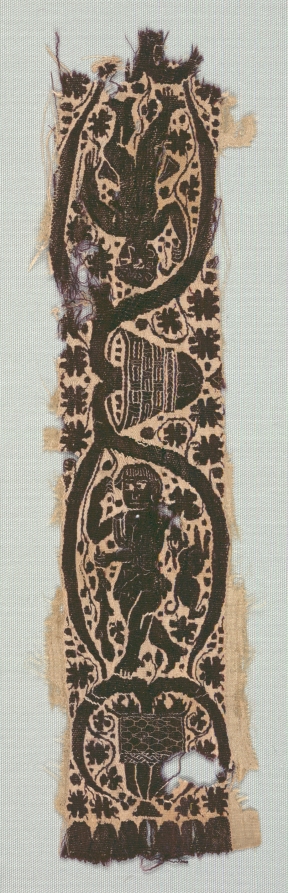
An Examination of Material Provenance and Artisanal Legacy
Presented for consideration is a singular artifact: a fragment of a rare silk tunic, distinguished by its surviving ornamental sleeve band. The piece, while modest in its physical dimensions, is considerable in its implication. It serves not merely as a remnant of textile history but as a concentrated testament to a legacy of imperial patronage, technical virtuosity, and a supply chain of unparalleled rigour. Our analysis must begin, as all serious sartorial inquiries do, with an uncompromising focus on the materiality of the object itself. The foundation is, unequivocally, mulberry silk of the highest possible grade, a fibre whose cultivation was once a fiercely guarded state secret. The hand of the connoisseur immediately recognises the specific, luminous density of thread produced by Bombyx mori larvae reared under controlled, imperial auspices—a world apart from the coarser variants of tussah or wild silks.
The Loom as a Instrument of Sovereignty
The weave structure evident in the main body fragment reveals a complex, small-scale pattern indicative of a drawloom operation. This was not the work of a village artisan; this was the output of a state-sanctioned atelier, where the loom itself functioned as an instrument of sovereignty. The precision of the repeat, the flawless alignment of the warp, speaks of a system where error was not a mere commercial inconvenience but a potential affront to imperial dignity. The very production of such fabric was often circumscribed by sumptuary laws, rendering its ownership a direct expression of status and proximity to power. The silk, in this context, transcends its role as a mere covering; it becomes a woven document of social hierarchy.
A Closer Inspection of the Ornamental Band
It is, however, the ornamental sleeve band that elevates this fragment from the merely exquisite to the historically eloquent. This applied band is the focal point of our discourse. The technique observed is one of intricate supplementary weft patterning, likely employing threads of fine gold or silver-wrapped silk—now oxidised to a muted, dignified lustre—to create a raised, narrative motif. The subject, though partially lost, suggests a stylised cloud-collar motif or a segment of a continuous scrolling vine, elements deeply embedded in the symbolic lexicon of imperial iconography, representing longevity and celestial favour.
The execution here is paramount. The density of the decorative picks is such that the ground weave is almost entirely obscured, creating a rich, tapestry-like effect. This was a deliberate and costly display of technical surplus. The band was not woven separately and applied as an afterthought; rather, it was integrated into the garment’s construction as a fundamental element of its design—a declaration that the garment was conceived from the outset as a vehicle for this specific artistry. The edges of the band are finished with a minute, almost invisible couching stitch, a detail that separates the work of a master from that of a journeyman.
Contextualising the Legacy: From Imperial Atelier to Modern Bench
To appreciate this fragment fully, one must understand the ecosystem from which it emerged. The legacy of imperial silk weaving was not simply one of aesthetic preference; it was the apex of a vertically integrated system. It commanded dedicated mulberry plantations, sericulture villages, spinning mills, dye-works mastering the alchemy of mineral and vegetable pigments, and finally, the weaving sheds where master weavers, often working from painted cartoons provided by court artists, operated under immense pressure. The finished bolt of silk, or length, as we would term it, was a product of this vast, coordinated machinery of state.
Implications for Contemporary Heritage Practice
For the modern house of heritage, such as our own at Lauren Fashion Heritage Lab, this artifact is not a relic to be archived and admired in passive silence. It is a benchmark. It poses a series of profound questions to the contemporary maker. Do we understand our materials with the same ontological depth? Can we articulate the provenance of our cloth with such specificity? Does our own "imperative for excellence" mirror the relentless precision that this sleeve band embodies?
The translation of this legacy into a modern idiom does not involve replication. It involves the adoption of its core principles: an obsessive commitment to the integrity of raw material, a reverence for the hand-executed detail that defies mass replication, and the understanding that true ornamentation is structural, not superficial. The ornamental band teaches us that decoration, at its highest level, is integral to the garment’s architecture and narrative.
In conclusion, this rare silk tunic fragment stands as a silent yet eloquent arbiter of taste and technique. It reminds us that before a garment can be considered iconic, its very fibres must be imbued with narrative. The imperial silk weaving legacy, crystallised in this fragment, establishes a protocol—a way of working, thinking, and valuing materiality that continues to inform the most rigorous practices in contemporary bespoke and heritage design. It is a legacy not of mere opulence, but of a profound and disciplined respect for the potential of the thread. This is the standard against which all subsequent work in luxury textiles must, and will, be measured.