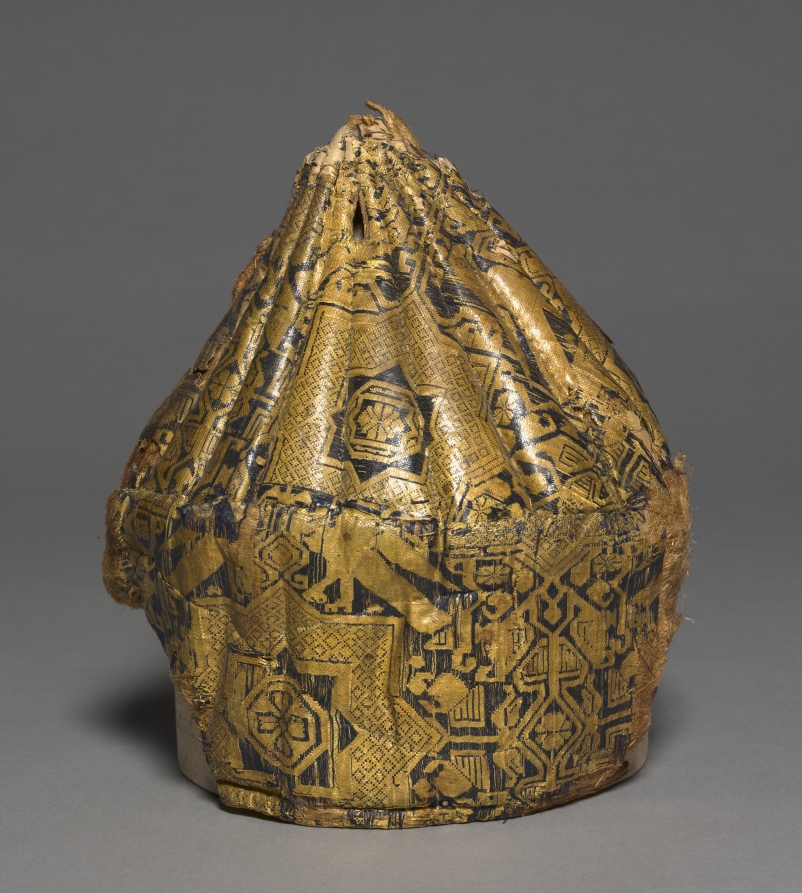
Artifact Analysis: The Quilted Cap with Star-Patterned Silk
Provenance and Materiality
The subject of this heritage research artifact is a quilted cap, meticulously constructed from star-patterned silk, dating to the late 18th century. This object, held within the Lauren Fashion Heritage Lab’s collection, represents a confluence of imperial silk weaving traditions and the pragmatic artistry of domestic needlework. The cap’s materiality—its silk exterior, quilted interior, and star motif—offers a profound lens through which to examine the legacy of silk as a commodity of power, craftsmanship, and cultural exchange.
Materiality: Silk. The cap’s primary fabric is a finely woven silk, likely produced in the imperial workshops of Lyon or Spitalfields, where silk weaving reached its zenith under royal patronage. The star pattern, rendered in a repeating geometric motif, is not merely decorative but symbolic. In the context of 18th-century European silk design, stars often signified celestial order, enlightenment, and, in some cases, aristocratic lineage. The silk’s lustre and density suggest a high-twist filament, characteristic of the gros de Tours weave, which provided both durability and a subtle sheen. This fabric would have been a luxury item, reserved for the elite, and its repurposing into a cap—a quotidian accessory—speaks to a culture of resourcefulness and the valorization of silk beyond its initial use in courtly garments.
Imperial Silk Weaving: A Legacy of Power and Precision
The legacy of imperial silk weaving is inextricably linked to the political and economic ambitions of European monarchies. In France, the establishment of the Manufacture des Gobelins and the Manufacture de Lyon under Louis XIV transformed silk into a tool of statecraft. The star pattern on this cap echoes the soleil rayonnant (radiant sun) motif, a symbol of the Sun King’s absolute power. Similarly, in England, the Spitalfields silk weavers, many of whom were Huguenot refugees, brought technical expertise that rivaled continental workshops. The star motif, therefore, is not merely aesthetic; it is a vestige of a system where silk weaving was a state-sanctioned art, governed by guilds, patents, and royal decrees.
The cap’s quilted construction further underscores this legacy. Quilting, as a technique, emerged from both practical necessity and decorative ambition. In the 18th century, quilted silk caps were worn by men and women as informal headwear, often during morning rituals or as a sign of domestic comfort. The quilting itself—likely achieved through a running stitch or backstitch—created a padded layer that provided warmth and structure. This process required precision and patience, qualities that align with the exacting standards of imperial silk weaving. The star pattern, when quilted, would have been accentuated by the interplay of light and shadow, a subtle nod to the silk’s inherent luminosity.
Cultural and Social Context
To fully appreciate this artifact, one must consider its social context. The cap was likely owned by a member of the gentry or merchant class—individuals who could afford silk but who also valued the intimacy of handmade objects. Unlike the grand courtly garments that dominate museum collections, this cap is a personal artifact, a testament to the wearer’s taste and the seamstress’s skill. It bridges the gap between the imperial workshop and the domestic sphere, between the public display of wealth and the private comfort of home.
The star pattern, moreover, carries connotations of navigation and exploration. In an era of colonial expansion, stars were used on maps, flags, and textiles to signify discovery and dominion. The cap’s silk, woven in an imperial center, may have been exported to colonies or worn by a traveler. This duality—the star as both a symbol of celestial order and terrestrial ambition—enriches the artifact’s narrative. It is a microcosm of the global silk trade, which connected Lyon to London, and London to the Americas and Asia.
Conservation and Interpretation
From a conservation perspective, the cap’s silk exhibits signs of age: minor fraying along the edges, a slight loss of colour in the star’s points, and a faint crease from folding. These imperfections are not flaws but records of use. They speak to the cap’s life as a worn object, handled, stored, and perhaps cherished across generations. The Lauren Fashion Heritage Lab’s role is to preserve this material evidence while interpreting its significance for contemporary audiences. This involves not only stabilizing the silk but also contextualizing it within the broader history of fashion, trade, and craftsmanship.
Heritage Value: The quilted cap with star-patterned silk is a heritage research artifact of considerable value. It exemplifies the intersection of imperial silk weaving—a tradition rooted in state power and artisanal mastery—with the intimate, everyday practices of dress. Its star motif connects it to the visual language of monarchy and exploration, while its quilted form speaks to the ingenuity of needlework. For the Lauren Fashion Heritage Lab, this cap is a reminder that fashion heritage is not solely about grand gowns and ceremonial robes; it is also about the quiet, enduring objects that reveal the textures of history.
Conclusions and Future Research
In conclusion, this artifact invites further inquiry into the role of silk in domestic life, the migration of patterns across borders, and the gendered nature of textile production. Future research might explore the cap’s provenance through archival records, compare its star pattern to surviving silk samples from Lyon or Spitalfields, or analyze its stitching techniques to identify regional handiwork. As a heritage specialist, I recommend that this cap be digitized and featured in a thematic exhibition on “Silk and the Everyday,” highlighting how imperial legacies are woven into the fabric of personal history.
The quilted cap with star-patterned silk is not merely an object; it is a document of its time—a time when silk was a currency of power, a medium of art, and a thread connecting the imperial to the intimate. At the Lauren Fashion Heritage Lab, we are committed to preserving and interpreting such artifacts, ensuring that their stories continue to illuminate the rich tapestry of fashion’s past.