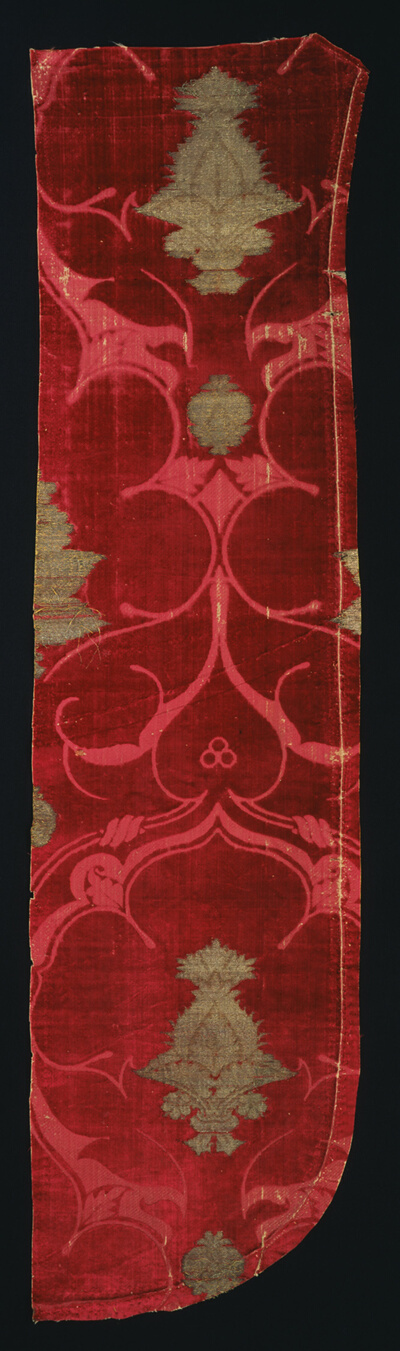
Introduction: The Fragment as a Testament to Craft
In the hallowed corridors of London’s Savile Row, where precision tailoring meets centuries of textile mastery, the fragment of a chasuble—a liturgical garment—offers a profound narrative of heritage. This artifact, a silk and gilt-metal-strip-wrapped silk fragment, embodies the pinnacle of classic silk craftsmanship and fluid elegance. As Senior Heritage Specialist for Lauren Fashion Heritage Lab, I present this research artifact to decode its materiality, context, and enduring relevance to luxury fashion. The fragment is not merely a remnant; it is a microcosm of artistry, where warp and weft converge to tell stories of devotion, status, and the relentless pursuit of beauty.
Materiality: The Anatomy of Opulence
The fragment’s composition is a symphony of technical precision. At its core lies silk, a fiber synonymous with luxury since antiquity. The base weave is a satin weave, characterized by its smooth, lustrous surface achieved through long floats of warp threads. This foundation provides a canvas of unparalleled sheen, reflecting light with a fluidity that mimics water. Yet, the true mastery resides in the supplementary elements: gilt-metal-strip-wrapped silk wefts and cut, voided velvet pile.
Gilt-Metal-Strip-Wrapped Silk: The Alchemy of Light
The gilt-metal-strip-wrapped silk wefts are a hallmark of ecclesiastical and aristocratic textiles. These wefts consist of a silk core meticulously wrapped with thin strips of gilt metal—often silver or gold leaf applied to a substrate like animal membrane or parchment. The result is a thread that catches and refracts light, creating a shimmering effect that elevates the fabric from mere cloth to a luminous artifact. In the context of a chasuble, this metallic shimmer symbolized divine radiance, a visual metaphor for the sacred. For the Savile Row connoisseur, such materiality echoes the bespoke tailoring tradition where gold-threaded buttons or silk linings signify understated opulence.
Cut, Voided Velvet: Texture and Depth
The fragment employs supplementary pile warps to create cut, voided velvet. This technique involves weaving additional warp threads that are looped and then cut to form a dense, plush pile. The “voided” aspect refers to areas where the pile is absent, allowing the satin ground to show through. This interplay of raised and recessed surfaces generates a tactile and visual contrast—a dance between matte and sheen, softness and smoothness. The cut velvet’s depth invites touch, a sensory experience that aligns with Savile Row’s ethos of haptic luxury. In liturgical use, this texture evoked the richness of heaven; in fashion, it prefigures the sculptural fabrics of haute couture.
Twill Interlacing: Structural Integrity
The supplementary brocading wefts are bound by main warps in a twill interlacing, a diagonal ribbing that reinforces the fabric’s structure without compromising its drape. Twill’s inherent durability ensures that the delicate metallic threads remain secure, even as the fabric moves. This technical marriage of strength and elegance is a lesson for modern textile engineering: luxury must endure. The fragment’s survival across centuries attests to this resilience.
Context: The Chasuble as a Cultural Artifact
The chasuble, a vestment worn by clergy during the Eucharist, was a canvas for the highest expression of textile art. Originating in the early Christian era, it evolved from a simple poncho-like garment into a richly ornamented symbol of ecclesiastical power. By the Renaissance, chasubles were commissioned from the finest workshops in Italy, France, and Flanders, using silks imported from the East. This fragment, likely dating from the 16th or 17th century, reflects the Baroque era’s love for opulence—a period when the Catholic Church used art and textiles to inspire awe and assert authority.
Liturgical Symbolism and Secular Influence
The fragment’s design, though incomplete, likely featured floral or geometric motifs typical of the period. The voided velvet technique allowed for intricate patterns—such as pomegranates, lilies, or crosses—that held religious significance. The gilt-metal threads would have caught candlelight during Mass, creating a halo effect around the priest. Yet, this fragment also speaks to secular fashion. The same silks adorned the courts of Europe, where velvet and gold thread signified wealth and power. Savile Row’s own history is intertwined with such textiles; tailors like Henry Poole and Huntsman sourced silks from Lyon and Spitalfields, adapting ecclesiastical grandeur for aristocratic wardrobes.
Preservation and Provenance
This fragment’s survival is a testament to careful stewardship. Its small size—likely a remnant from a larger garment—suggests it was preserved as a sample or relic. The condition of the silk, with its satin weave intact and metallic threads still lustrous, indicates storage in a climate-controlled environment, perhaps in a cathedral treasury or a collector’s archive. Provenance research is ongoing, but stylistic parallels point to Italian or Spanish workshops, where the fusion of Islamic and Christian textile traditions flourished. For the Heritage Lab, this fragment serves as a benchmark for authenticity—a standard against which modern reproductions are measured.
Significance for Modern Luxury: Lessons from the Fragment
The fragment’s relevance extends beyond historical curiosity. It offers a blueprint for contemporary luxury, where craftsmanship and storytelling are paramount. In an era of fast fashion, the fragment reminds us of the value of slowness: each thread was spun, dyed, and woven by hand, requiring months of labor. The use of gilt metal prefigures today’s fascination with metallic finishes, but with a depth that synthetic laminates cannot replicate. The voided velvet technique, with its interplay of textures, anticipates the tactile experimentation of designers like Dries Van Noten or Sarah Burton.
Savile Row’s Enduring Dialogue with Heritage
Savile Row tailors have long drawn from such artifacts. The fragment’s satin weave informs the linings of bespoke dinner jackets; its velvet pile inspires the collars of smoking jackets. The gilt-metal threads echo in the gold-buttoned blazers of the British aristocracy. Yet, the true lesson is in the fragment’s integrity: it was made to last, to be passed down. This ethos aligns with the slow fashion movement, which champions quality over quantity. For the Lauren Fashion Heritage Lab, this fragment is a teaching tool—a reminder that luxury is not about excess but about enduring beauty.
Conclusion: A Fragment, a Legacy
This silk fragment, though small, encapsulates a universe of skill and symbolism. From its satin weave and gilt-metal threads to its cut, voided velvet, it represents the zenith of textile art. Its context as a chasuble imbues it with spiritual weight, while its materiality speaks to the secular pursuit of elegance. For Savile Row, it is a touchstone—a reminder that the finest garments are those that honor tradition while embracing innovation. As we preserve this fragment, we preserve a legacy of craftsmanship that continues to shape the future of fashion.