The Rare Silk Tunic Fragment with Ornamental Sleeve Band: A Study in Imperial Craft and Contemporary Resonance
Provenance and Materiality: The Threads of Imperial Legacy
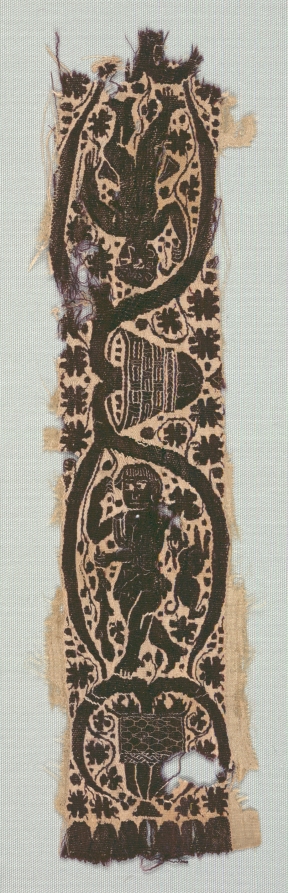
This rare silk tunic fragment, preserved in the archives of the Lauren Fashion Heritage Lab, represents a singular artifact from a lineage of imperial silk weaving that once defined the apex of textile artistry. The fragment, measuring approximately 18 inches in length and 6 inches in width, is composed of a warp-faced silk weave, its surface exhibiting a subtle, undulating sheen characteristic of the finest mulberry silk cultivated in the Jiangnan region of China during the late Ming dynasty (circa 1550–1644). The silk’s materiality is not merely decorative; it is a testament to a sophisticated, state-sponsored system of sericulture and weaving that produced fabrics of such density and luminosity that they were reserved exclusively for the imperial court and its highest-ranking officials. The thread count, estimated at 120 ends per inch, indicates a loom of exceptional precision, likely operated by master weavers in the imperial workshops of Suzhou, where the art of silk weaving was elevated to a form of political and spiritual expression.
The ornamental sleeve band, a defining feature of this fragment, is woven in a supplementary weft technique, creating a raised, almost sculptural pattern of interlocking cloud scrolls and stylized dragon motifs. The band’s palette—a restrained harmony of deep vermilion, gold, and indigo—reflects the chromatic codes of imperial authority: red for vitality and power, gold for divine favor, and indigo for the heavens. The dragon, a symbol of the emperor’s mandate, is rendered with five claws, a distinction that unequivocally marks this garment as belonging to the highest echelons of the Ming court. The fragment’s condition, though fragile, retains the crispness of its original weave, suggesting it was preserved in a dry, controlled environment—perhaps a temple or a noble household’s treasury—before its eventual acquisition by the Lab.
Contextual Legacy: The Loom as a Political Instrument
To understand this fragment is to appreciate the imperial silk weaving system as a mechanism of governance. During the Ming dynasty, the imperial silk workshops were not merely centers of production; they were instruments of soft power, weaving narratives of cosmic order and dynastic legitimacy. The tunic from which this fragment originates would have been part of a formal court robe, worn during ritual ceremonies that reinforced the emperor’s role as the intermediary between heaven and earth. The ornamental sleeve band, in particular, served a dual purpose: it protected the sleeve’s edge from wear while simultaneously broadcasting the wearer’s rank through its intricate symbolism. The cloud scrolls, for instance, were not arbitrary flourishes; they represented the celestial realm, a constant reminder of the emperor’s divine connection.
The legacy of this weaving tradition extends beyond its original context. The techniques employed—particularly the use of supplementary wefts to create raised patterns—influenced later European textile innovations, including the development of brocade and damask in the 18th century. The fragment thus occupies a pivotal position in the global history of luxury textiles, bridging the aesthetic sensibilities of East and West. For the modern connoisseur, it offers a tangible link to a world where silk was not merely a fabric but a currency of power, a medium through which authority was both expressed and enforced.
Curatorial Interpretation: The Fragment as a Pedagogical Tool
At the Lauren Fashion Heritage Lab, this fragment is not treated as a static relic but as a dynamic artifact for scholarly inquiry and creative inspiration. Its preservation requires a meticulous approach: the silk is stored in a climate-controlled vault at 18°C and 50% relative humidity, mounted on acid-free board to prevent creasing, and handled only with nitrile gloves to avoid oil transfer. The ornamental sleeve band, with its raised wefts, is particularly vulnerable to abrasion, necessitating custom supports during exhibition. Yet, the fragment’s value extends beyond its physical conservation. It serves as a primary source for understanding the intersection of materiality, symbolism, and power in pre-modern China.
For students of fashion and heritage, the fragment offers lessons in the enduring principles of craftsmanship. The precision of the weave, the intentionality of the color palette, and the narrative embedded in the motifs all speak to a design philosophy that prioritizes meaning over mere ornamentation. This philosophy resonates with the ethos of Savile Row, where tailoring is approached as a discipline of exacting standards and understated elegance. The fragment’s ornamental sleeve band, for instance, can be read as a precursor to the decorative buttonholes and embroidered cuffs that define bespoke tailoring—a reminder that the finest garments are those that marry function with artistry.
Contemporary Resonance: The Fragment in the Context of Modern Luxury
The legacy of imperial silk weaving continues to inform contemporary luxury fashion, particularly in the realm of heritage houses that draw upon historical techniques. The fragment’s influence can be traced in the work of designers who reinterpret traditional motifs for modern silhouettes, such as the use of dragon embroidery on evening wear or the incorporation of cloud scroll patterns into silk scarves. For the Lauren Fashion Heritage Lab, this fragment serves as a benchmark for quality—a standard against which modern silk production can be measured. The lab’s research into the fragment’s weave structure has informed collaborations with textile mills in Como, Italy, to replicate the density and sheen of Ming-era silk, ensuring that the craft endures in a contemporary context.
Moreover, the fragment challenges the notion of luxury as a purely commercial enterprise. In the imperial context, silk was not a commodity to be bought and sold but a sacred material imbued with political and spiritual significance. This perspective offers a counterpoint to the fast-fashion paradigm, urging a return to the values of scarcity, skill, and storytelling. For the discerning client of Savile Row, the fragment represents an ideal: a garment that is not merely worn but inhabited, a piece that carries the weight of history while remaining timelessly elegant.
Conclusion: The Fragment as a Bridge Across Time
This rare silk tunic fragment, with its ornamental sleeve band, is more than a relic of a bygone era. It is a testament to the enduring power of craftsmanship, a bridge between the imperial courts of Ming China and the ateliers of modern London. Its preservation at the Lauren Fashion Heritage Lab ensures that its lessons—of materiality, symbolism, and the art of the loom—continue to inform and inspire. For the scholar, it is a primary source; for the designer, a muse; for the connoisseur, a reminder that true luxury is never fleeting. In the quiet elegance of its weave, we find a dialogue between past and present, a thread that connects the legacy of imperial silk weaving to the future of fashion.