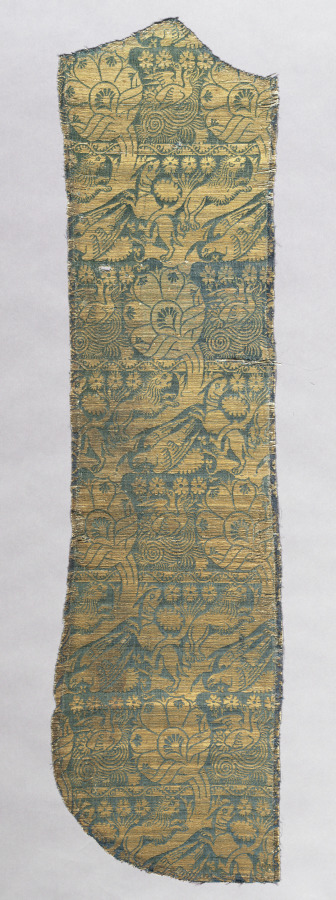
The Chasuble Fragment with Realistic Animals: A Study in Imperial Silk Weaving and Ecclesiastical Legacy
Introduction: The Fragment as a Testament to Craft
In the hallowed corridors of Lauren Fashion Heritage Lab, we examine a singular artifact: a chasuble fragment, woven from the finest silk, dating to the late 16th or early 17th century. This piece, bearing a pattern of realistic animals—lions, deer, and birds rendered with anatomical precision—is not merely a textile remnant. It is a material document of imperial silk weaving, a tradition that fused the technical mastery of the East with the liturgical demands of the West. For the connoisseur of Savile Row, where tailoring is an act of preservation, this fragment speaks to the same principles: exactitude, heritage, and the quiet power of provenance.
The chasuble, a vestment worn by clergy during the Eucharist, was often the most opulent garment in a church’s treasury. This fragment, however, is no ordinary relic. Its silk—a warp-faced compound weave, likely produced in the imperial workshops of Safavid Persia or Ottoman Turkey—embodies the cross-continental exchange that defined early modern luxury. The realistic animals, far from being mere decoration, signal a shift from the abstract, geometric patterns of medieval textiles to a Renaissance-inspired naturalism. This was a deliberate choice, one that aligned the Church with the intellectual and artistic currents of the age.
Materiality: The Silk Threads of Empire
Silk is the protagonist here. The fragment’s weave structure—a lampas or a taqueté—reveals the hand of master weavers who manipulated up to five harnesses to create the intricate ground and pattern. The warp threads, dyed with madder for a deep crimson, and the weft, a golden yellow from saffron or weld, produce a visual depth that shifts under light. This was not a fabric for the common altar; it was a statement of imperial reach. The silk itself likely originated from the Caspian Sea region, where mulberry trees and silkworms were cultivated under royal monopoly. The dyeing, too, was a state-sponsored art: the crimson derived from kermes insects, a pigment more precious than gold.
Yet the fragment’s condition—frayed edges, faded hues, and a single tear near the center—tells a story of use. It was worn, perhaps by a bishop in a cathedral from Lisbon to Goa, and later cut down for reliquary or repurposing. This is the legacy of imperial silk: not pristine preservation, but active life. On Savile Row, we understand that a garment’s value increases with its history. A bespoke suit, like this chasuble, is a narrative of wear, repair, and adaptation. The fragment’s materiality—its weight, its drape, its resilience—echoes the same principles of durability and elegance that define a well-tailored jacket.
Context: The Imperial Silk Weaving Legacy
The legacy of imperial silk weaving is rooted in the courts of the Safavid, Mughal, and Ottoman empires, where looms were instruments of statecraft. The realistic animals on this fragment—a lion with a raised paw, a deer in mid-leap, a bird with outstretched wings—are not random. They derive from the shikargah (hunting ground) motifs popular in Persian textiles, which celebrated royal power and the divine order of nature. When these silks reached Europe via the Silk Road or Portuguese trade routes, they were transformed. The Catholic Church, seeking to project its own universal authority, commissioned vestments from these very fabrics. The lion, for instance, became a symbol of Christ’s resurrection; the deer, of the soul’s longing for God.
This fragment, then, is a hybrid: an imperial silk woven in a Persian or Anatolian workshop, then tailored into a chasuble by a European ecclesiastical embroiderer. The stitching—a fine silk thread used to attach a lining, now lost—is consistent with 17th-century Italian or Spanish practice. The legacy is one of appropriation and adaptation. The imperial silk weavers did not intend their work for the Eucharist, but their technical virtuosity made it inevitable. The Church recognized that the precision of a Safavid loom could convey the precision of divine truth.
Design Analysis: Realism as a Language of Power
The realistic animals on this fragment are rendered with a naturalism that is almost unsettling. The lion’s musculature, the deer’s delicate hooves, the bird’s feather details—each is achieved through a combination of warp and weft floats that create shading. This was a technical feat. In a typical imperial silk, patterns were stylized, flattened. Here, the weavers used a serrated or curvilinear technique to suggest volume. The animals appear to move across the fabric, a kinetic quality that would have caught candlelight during Mass.
This realism was not merely aesthetic. It was a political and theological statement. In the Safavid court, animal motifs symbolized the shah’s dominion over nature. In the Catholic context, they evoked the Garden of Eden and the harmony of creation. The fragment’s design, therefore, bridges two worlds: the imperial and the ecclesiastical, the earthly and the celestial. For the Savile Row eye, this is akin to the balance of structure and softness in a bespoke overcoat. The pattern is bold, but the execution is restrained. The animals are present, but they do not overwhelm the garment’s liturgical purpose.
Preservation and Legacy: The Fragment’s Modern Relevance
Today, this chasuble fragment resides in a climate-controlled archive, its silk fibers stabilized with conservation-grade adhesives. Yet its legacy extends beyond the museum. It is a reminder that luxury is not a product of the present but a continuum. The imperial silk weavers, the ecclesiastical patrons, and the modern conservators are all part of a chain that values craftsmanship over commerce. On Savile Row, we honor this chain every time we cut a cloth. The fragment teaches us that realism in design—whether in a lion’s mane or a lapel’s roll—requires an understanding of material limits. The silk could only stretch so far; the weaver worked within those bounds.
The fragment also challenges our assumptions about heritage. It is not a complete garment, but its incompleteness is its strength. It invites us to imagine the whole: the bishop’s hands, the altar’s light, the congregation’s awe. This is the same imaginative act that a tailor performs when drafting a suit from a bolt of cloth. The fragment is a blueprint of possibility.
Conclusion: A Fragment of Infinity
In the Lauren Fashion Heritage Lab, we do not simply catalog artifacts; we listen to them. This chasuble fragment with realistic animals speaks of empires, faith, and the enduring power of silk. Its materiality—the warp and weft, the crimson and gold—is a language that transcends time. For the scholar, it is a research artifact. For the tailor, it is a masterclass in restraint. For the heritage specialist, it is a legacy that demands respect.
The imperial silk weaving tradition may have faded, but its echoes remain. In every bespoke garment that balances form and function, in every fabric that tells a story, the fragment lives on. It is not a relic of the past; it is a guide for the future. And on Savile Row, where heritage is not a noun but a verb, we continue to weave its lessons into the cloth of today.