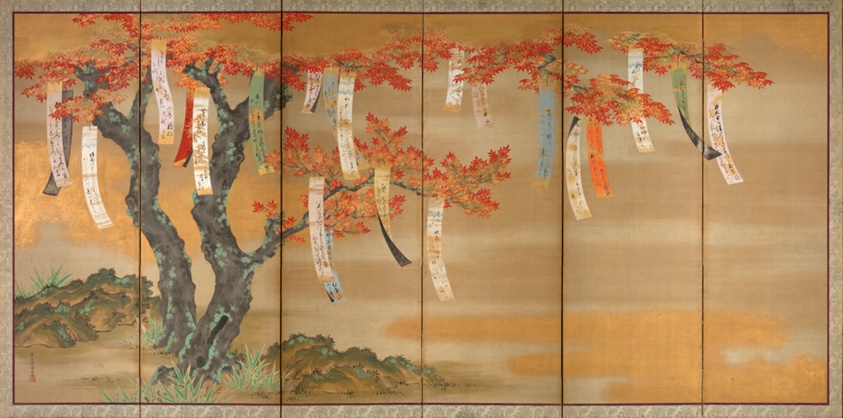
The Artifact as Archive: Decoding the Autumn Maples with Poem Slips Screen
Materiality and Provenance: The Silk Canvas
At the heart of this heritage research artifact lies a profound dialogue between medium and message. The Autumn Maples with Poem Slips screen, one of a pair, is executed on a silk ground—a material that, within the lexicon of luxury, commands the same reverence as a bolt of Huntsman’s worsted or a length of Anderson & Sheppard’s cashmere. Silk, in this context, is not merely a support; it is an active participant in the narrative. The six-panel format, a classic of Japanese byōbu, demands a fluid, almost architectural consideration of space. The use of ink, colors, gold leaf, and gold powder on silk speaks to a mastery of layering that parallels the bespoke tailoring process: each application is deliberate, each pigment chosen for its interaction with light and the passage of time.
The silk itself, likely a finely woven habutae or a variant of chirimen, provides a surface that is both absorbent and reflective. The gold leaf, applied in delicate sheets and powdered accents, catches the ambient light in a manner that shifts with the viewer’s position—much like the subtle sheen of a perfectly pressed silk lining. This is not a static image; it is a living surface, one that breathes with the humidity of the room and the angle of the afternoon sun. The materiality of the screen thus becomes a testament to the craftsmanship of the Edo period, where the line between fine art and functional luxury was deliberately blurred.
Iconography and Narrative: The Autumn Maples and Poem Slips
The subject matter—autumn maples interspersed with poem slips—is a deliberate invocation of mono no aware, the bittersweet awareness of transience. The maple leaves, rendered in gradients of vermilion, amber, and ochre, are not merely decorative; they are symbols of fleeting beauty, a reminder that the finest things in life are often the most ephemeral. This sensibility resonates deeply with the Savile Row ethos, where a bespoke garment is understood as a collaboration with time—a piece that will age, patina, and ultimately tell the story of its wearer.
The poem slips, or tanzaku, are scattered among the branches, their calligraphic inscriptions partially obscured by the foliage. This is a deliberate act of concealment and revelation. The viewer is invited to lean in, to decipher the poetry, and in doing so, to engage in a private dialogue with the artist. The poems themselves, likely classical waka or haiku, speak of autumn’s melancholy and the quiet beauty of decay. In the context of a luxury heritage artifact, these slips function as a bespoke monogram—a personal, intimate mark that elevates the object from mere decoration to a vessel of meaning.
Technical Mastery: The Gold Leaf and Powder Application
The application of gold leaf and gold powder on silk is a technique that demands both precision and patience. The gold leaf, hammered to a thickness of mere microns, is laid onto a prepared adhesive ground, often a mixture of animal glue and water. The result is a surface that shimmers with a warm, metallic glow, yet remains soft to the touch. The gold powder, or kinpun, is applied through a process of stenciling or freehand dusting, creating a subtle gradation of light that mimics the dappled effect of sunlight filtering through autumn leaves.
This technical mastery is akin to the hand-finishing of a Savile Row lapel—invisible to the untrained eye, yet essential to the garment’s drape and longevity. The gold accents on the screen are not merely decorative; they are structural, guiding the viewer’s eye across the six panels and creating a rhythm that mirrors the natural flow of the seasons. The gold leaf, when viewed from an angle, catches the light in a way that suggests movement—a leaf drifting, a poem slip fluttering in the breeze. This is the hallmark of a master artisan: the ability to imbue a static object with the illusion of life.
Context and Legacy: The Screen as a Cultural Artifact
This screen, likely produced in the late 17th or early 18th century, belongs to a tradition of Japanese folding screens that served both functional and ceremonial purposes. In the context of a samurai residence or a wealthy merchant’s home, such a screen would have been displayed during the autumn months, serving as a backdrop for tea ceremonies or poetry gatherings. The pairing of the screens—this being one of a pair—suggests a deliberate symmetry, a dialogue between two halves that together form a complete narrative.
In the world of luxury heritage, this artifact occupies a unique position. It is not a garment, yet it shares the same principles of material integrity, craftsmanship, and narrative depth that define the finest bespoke tailoring. The screen’s condition—the silk’s patina, the gold leaf’s gentle wear—speaks to a life well-lived, a history of careful handling and quiet admiration. For the collector or the curator, this is not merely an object of aesthetic pleasure; it is a research artifact that offers insights into the intersection of art, craft, and cultural identity.
Conclusion: The Screen as a Lesson in Luxury
The Autumn Maples with Poem Slips screen is a masterclass in the principles that underpin the world of luxury heritage. Its materiality—the silk, the gold, the ink—demands respect. Its iconography—the maples, the poem slips—invites contemplation. Its technical execution—the layering of pigments, the application of gold leaf—commands admiration. For the scholar, the collector, or the connoisseur, this screen is a reminder that true luxury is not about ostentation, but about the quiet, enduring beauty of craftsmanship. It is a lesson in patience, in the value of time, and in the profound power of a well-told story.
In the spirit of Savile Row, where every stitch is a decision and every fabric a legacy, this screen stands as a testament to the enduring allure of the handmade. It is, in every sense, a heritage artifact worthy of study, preservation, and reverence.