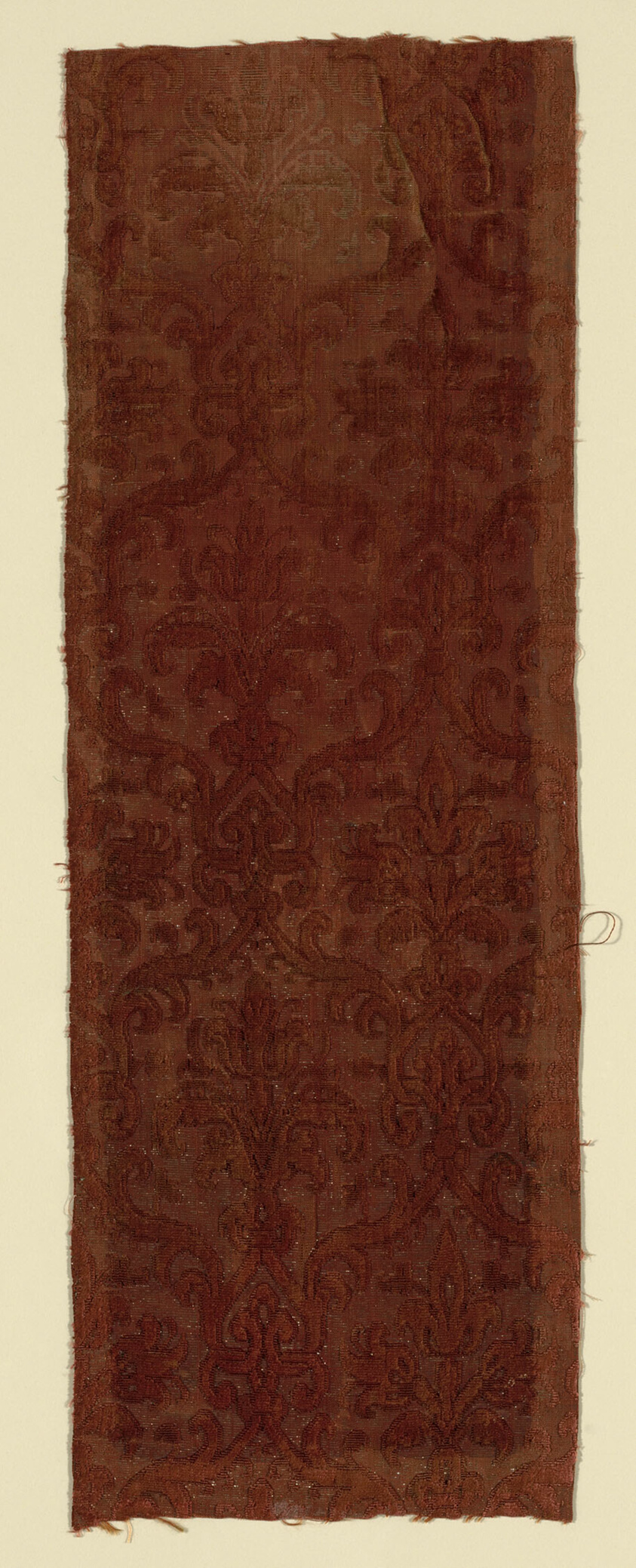
Heritage Research Artifact: The Fragment as a Testament to Silk Craftsmanship
Introduction: The Fragment’s Narrative Power
In the hallowed halls of Lauren Fashion Heritage Lab, we approach the fragment not as a remnant of loss, but as a concentrated archive of mastery. This particular artifact—a piece of silk, cut, uncut, voided velvet with additional patterning wefts in gold foil against a plain weave foundation—embodies the pinnacle of classic silk craftsmanship and fluid elegance. It is a whisper from the looms of history, a tangible echo of the meticulous artistry that defined London’s Savile Row and the grand ateliers of Europe. As Senior Heritage Specialist, I assert that this fragment is not merely a textile sample; it is a pedagogical tool, a material document of technique, and a symbol of enduring luxury.
Materiality and Construction: The Anatomy of Velvet
The foundation of this fragment is a plain weave silk, a structure of remarkable simplicity that belies the complexity of its adornment. The term voided velvet is critical here. It refers to a technique where the velvet pile—created through loops of cut and uncut silk—is deliberately absent in certain areas, forming a pattern against the flat ground weave. This interplay of texture and void is a hallmark of Renaissance and Baroque velvets, yet its execution here speaks to a refined, almost modern sensibility. The cut pile offers a dense, plush surface that catches light with a deep, absorbent richness, while the uncut pile—loops left intact—introduces a subtle, matte contrast. This dual-pile technique demands extraordinary precision: each warp thread must be lifted and cut individually, a process that requires the weaver to anticipate the design’s every contour.
The addition of patterning wefts in gold foil elevates this fragment from exquisite to opulent. Gold foil, typically applied as a thin strip wrapped around a silk core or laid flat as a supplementary weft, introduces a metallic shimmer that dances across the voided areas. This is not a garish gilding; it is a restrained, luminous accent that highlights the velvet’s sculptural qualities. The gold foil wefts are woven into the plain weave foundation, creating a subtle brocade effect that catches the eye without overwhelming the tactile richness of the velvet. This technique, known as lampas or brocatelle in historical contexts, requires the weaver to manage multiple warp and weft systems simultaneously—a feat of coordination that only the most skilled artisans could achieve.
Classic Silk Craftsmanship: The Savile Row Connection
To understand this fragment fully, one must place it within the lineage of classic silk craftsmanship that Savile Row has long revered. Savile Row, the epicentre of bespoke tailoring, has historically sourced its finest silks from mills in Spitalfields, Lyons, and Como. These silks were not mere yardage; they were investments in heritage. The voided velvet, with its interplay of cut and uncut pile, mirrors the tailor’s own craft: the precise cutting of cloth, the careful manipulation of structure to create form. The gold foil patterning wefts evoke the metallic threads used in ceremonial and court dress, a nod to the Row’s history of dressing royalty and aristocracy.
This fragment, however, is not a finished garment. It is a heritage research artifact—a sample, a swatch, perhaps a remnant from a master weaver’s studio. Its value lies in its incompleteness. The fragment allows us to study the weave structure, the tension of the warp, the density of the pile, and the application of gold foil without the distraction of a garment’s silhouette. It is a pure, unadulterated record of technique. In the context of Lauren Fashion Heritage Lab, such fragments are essential for training new generations of designers and conservators. They teach the eye to see the difference between a hand-loomed velvet and a machine-made imitation, between a gold foil that tarnishes with dignity and a synthetic metallic that flakes.
Fluid Elegance: The Aesthetic of Movement
The phrase fluid elegance is not merely poetic; it describes the physical behaviour of this silk velvet. Despite its dense pile and metallic accents, the fabric drapes with a surprising suppleness. This is due to the plain weave foundation, which provides a lightweight, flexible base. The voided areas, where the pile is absent, reduce the fabric’s weight and allow it to fall in soft, undulating folds. The gold foil wefts, being thin and flexible, do not stiffen the cloth but rather add a subtle weight that enhances its movement. When worn, this fabric would have shimmered with each step, the gold catching light in a cascade of highlights and shadows.
This fluidity is a hallmark of classic silk craftsmanship. The weaver’s skill lies not just in creating a pattern, but in ensuring that the pattern does not compromise the fabric’s drape. The cut pile, if too dense, can make the fabric rigid; the uncut loops, if too long, can snag. The voided areas must be precisely calibrated to maintain structural integrity. This fragment, with its balanced proportions, demonstrates a mastery of these variables. It is a textile that moves with the body, not against it—a quality that Savile Row tailors have prized for centuries.
Preservation and Interpretation: The Fragment’s Future
As a heritage artifact, this fragment requires careful stewardship. The silk foundation is vulnerable to light, humidity, and handling. The gold foil wefts, while durable, can become brittle over time. Our conservation protocols at Lauren Fashion Heritage Lab emphasize minimal intervention: we store the fragment in a climate-controlled environment, mounted on acid-free board, and document it with high-resolution imaging to capture the interplay of cut and uncut pile. The fragment is also digitized for virtual study, allowing scholars worldwide to examine its structure without physical contact.
Interpretation is equally vital. This fragment is not a relic to be admired from a distance; it is a tool for understanding the evolution of luxury textiles. By comparing it to similar fragments from the 17th, 18th, and 19th centuries, we can trace the development of velvet weaving techniques, the shifting tastes in pattern and colour, and the economic networks that brought silk from China to Europe. The gold foil wefts, for instance, may indicate a specific period of trade with the Ottoman Empire or a commission for a royal court. Each thread tells a story of commerce, artistry, and aspiration.
Conclusion: The Fragment as Legacy
In the world of heritage research, the fragment is a paradox: it is both incomplete and whole. This piece of silk, cut, uncut, voided velvet with gold foil patterning, is a testament to the enduring power of classic silk craftsmanship. It speaks of looms that hummed with precision, of hands that guided threads with unerring accuracy, and of a tradition that values fluid elegance above all. For Lauren Fashion Heritage Lab, this artifact is a cornerstone of our mission: to preserve, study, and inspire through the material culture of fashion. It is a fragment, yes, but it is also a legacy—a reminder that true craftsmanship never fades; it only waits to be rediscovered.