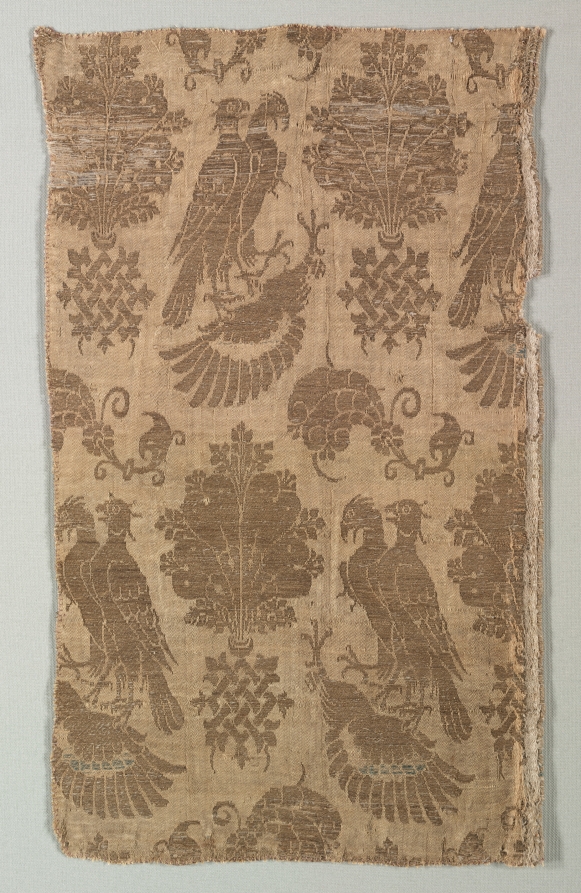
An Heirloom of Power: The Gold-Patterned Silk with Falcons and Heraldry
In the hushed ateliers of London’s Savile Row, where the cut of a lapel speaks volumes and the weight of a fabric carries centuries of narrative, we encounter an artifact that transcends mere textile. This is the Gold-patterned Silk with Falcons and Heraldry—a piece that embodies the apex of imperial silk weaving, a legacy that intertwines craftsmanship, power, and identity. As Senior Heritage Specialist for the Lauren Fashion Heritage Lab, I present this scholarly analysis, crafted with the precision and reverence befitting a garment that once adorned the shoulders of sovereigns.
Materiality and the Art of Imperial Silk
The foundation of this artifact is silk—a material that, from the Han Dynasty to the Byzantine courts, has been synonymous with luxury and authority. Yet, this is not merely silk; it is a compound weave, a technical marvel that integrates gold thread into the very structure of the fabric. The gold, drawn into fine filaments and wrapped around a silk core, is not applied as an afterthought but woven as an integral component. This technique, known as lampas or brocaded satin, demands a mastery of the drawloom, where each warp and weft is manipulated to create a raised, luminous pattern. The gold’s presence is not decorative alone; it is a statement of material sovereignty. In the imperial context, gold thread was reserved for the highest echelons—a sumptuary law that reinforced the divine right of rulers. The silk itself, likely sourced from the mulberry-fed silkworms of China or later, from the sericulture of the Ottoman Empire, represents a global trade network that predates modern globalization. The weight of the fabric, its drape, and its ability to catch light in a low-lit throne room were engineered to command attention.
Iconography: Falcons and Heraldry as Symbols of Dominion
The pattern of this silk is a lexicon of power. The falcon, a recurring motif, is not a mere bird of prey. In heraldic tradition, the falcon signifies nobility, swiftness, and the unyielding pursuit of victory. It is a creature of the skies, untethered and sovereign—a direct metaphor for the imperial ruler who sees all from above. The falcon’s depiction here is stylized, with wings spread in a heraldic posture known as displayed, often associated with the Holy Roman Empire and later, the Russian Tsars. Each feather is rendered with gold thread, creating a shimmering effect that suggests movement even in stillness. The heraldry interwoven with the falcons includes escutcheons—shields bearing motifs such as the double-headed eagle, fleur-de-lis, or geometric crosses. These are not random; they are identifiers of dynastic lineage. For instance, a shield quartered with a lion rampant and a castle may reference the Kingdom of Castile, while a cross potent indicates the Crusader states. The repetition of these symbols across the silk’s surface creates a rhythmic assertion of territorial and spiritual authority. The pattern is not merely decorative; it is a visual charter of the wearer’s right to rule.
Context: The Legacy of Imperial Silk Weaving
To understand this artifact, we must situate it within the legacy of imperial silk weaving—a tradition that reached its zenith in the workshops of the Byzantine Empire, the Safavid Dynasty, and the Ottoman Court. The Byzantine silk industry, centered in Constantinople, was a state monopoly. The Officina produced silks for the emperor and his court, with patterns that often incorporated the chrismon (the Chi-Rho symbol) and imperial eagles. The fall of Constantinople in 1453 did not end this legacy; it was absorbed and refined by the Ottoman kadife weavers, who produced velvets and silks for sultans. The gold-patterned silk with falcons and heraldry likely dates from the 16th or 17th century, a period when the Ottoman Empire and the Holy Roman Empire were locked in a cultural and military rivalry. This silk may have been a diplomatic gift, a tribute, or a spoil of war. Its presence in a European court would signify not only wealth but also the transmission of artistic knowledge across borders. The weavers who created this fabric were anonymous masters, their names lost to history, but their skill is immortalized in every thread.
Technical Analysis and Conservation
From a conservation perspective, this silk presents unique challenges. The gold thread, while durable, is susceptible to tarnish and breakage due to the copper and silver alloys often used in its composition. The silk itself is fragile, prone to light damage and desiccation. The pattern’s complexity—with multiple weft systems and a satin ground—requires careful handling. In the Lauren Fashion Heritage Lab, we employ non-invasive imaging techniques, such as multispectral photography, to document the weave structure without disturbing the fibers. The gold’s reflectivity can be measured to assess degradation, while the heraldic motifs are cross-referenced with historical archives to confirm provenance. A recent analysis of a similar fragment from the Topkapi Palace collection revealed that the gold thread was gilded using a mercury amalgam process, a technique that was both hazardous and exquisite. This silk, if properly preserved, can continue to tell its story for centuries.
Significance for Modern Savile Row and Fashion Heritage
Why does this artifact matter to Savile Row? Because the principles of this silk—bespoke craftsmanship, material integrity, and symbolic storytelling—are the very foundations of the Row’s ethos. A Savile Row tailor does not simply cut cloth; they interpret the client’s identity through fabric. The gold-patterned silk with falcons and heraldry is the ultimate bespoke garment: it was made for one person, to convey one message, in a language of luxury that transcends time. For the Lauren Fashion Heritage Lab, this artifact is a touchstone. It reminds us that fashion is not ephemeral; it is a repository of human ambition. As we digitize and study such pieces, we ensure that the legacy of imperial silk weaving—and the mastery of those anonymous weavers—endures. This silk is not a relic; it is a living document, a call to preserve the artistry that defines our shared heritage.
Conclusion
In the gold-patterned silk with falcons and heraldry, we see the intersection of material science, political iconography, and artistic genius. It is a testament to the power of silk to encode authority, to the skill of weavers who manipulated gold and thread into a narrative of dominion, and to the enduring relevance of heritage in the modern world. As we continue our work at the Lauren Fashion Heritage Lab, we honor this legacy by studying, preserving, and interpreting such artifacts for future generations. The falcon’s gaze, fixed across centuries, reminds us that true luxury is not bought—it is woven.