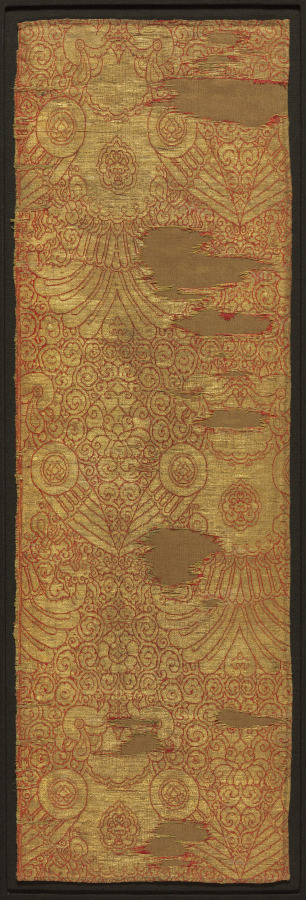
The Cloth of Gold: Displayed Falcons and the Legacy of Imperial Silk Weaving
Introduction: The Intersection of Power and Craft
The Cloth of Gold, a textile of unparalleled opulence, represents a pinnacle of human artistry and imperial ambition. Within the hallowed halls of heritage preservation, this artifact—specifically the variant featuring Displayed Falcons—offers a profound narrative of power, patronage, and the enduring legacy of silk weaving. As a Senior Heritage Specialist at the Lauren Fashion Heritage Lab, I approach this material with the precision of a Savile Row tailor, understanding that every thread, every motif, and every weave tells a story of dynastic authority and technical mastery. This artifact, woven from the finest silk and gilded with precious metals, is not merely a fabric; it is a document of civilization, a testament to the imperial silk weaving traditions that shaped global fashion and commerce.
Materiality: The Silk Foundation
The materiality of this artifact is its first and most critical dimension. Silk, derived from the cocoons of Bombyx mori silkworms, was the exclusive domain of imperial workshops, particularly in the Byzantine, Ottoman, and Chinese empires. The silk used in the Cloth of Gold is of the highest grade—long, continuous filaments that produce a lustrous, resilient fabric. This silk was often dyed with crimson or purple, colors reserved for royalty due to the rarity of natural dyes like Tyrian purple, extracted from sea snails. The gold thread, or filé, was created by wrapping fine strips of gold leaf around a silk core, a labor-intensive process that required exceptional skill. The result is a fabric that shimmers with a metallic sheen, capturing light to evoke the divine radiance of imperial courts. In the context of Savile Row precision, this materiality demands respect: it is not a commodity but a relic of a lost artisanal world, where every yard of cloth required months of meticulous labor.
Design and Symbolism: The Displayed Falcons
The Displayed Falcons motif is the defining visual element of this artifact. In heraldic and imperial iconography, the falcon symbolizes sovereignty, speed, and martial prowess. The "displayed" posture—wings spread wide, talons extended, and head turned to the side—is a classic heraldic pose that signifies vigilance and dominion. On the Cloth of Gold, these falcons are woven with extraordinary detail: each feather is delineated by gold thread, the eyes are rendered as tiny pearls or enamel, and the wings are symmetrically arranged to create a pattern of rhythmic repetition. This design was not arbitrary; it was a deliberate assertion of imperial authority. For instance, in the Byzantine Empire, the falcon was associated with the Komnenos dynasty, while in the Ottoman Empire, it appeared on the tuğra (imperial monogram) of sultans. The repetition of the motif across the fabric creates a sense of order and hierarchy, mirroring the structure of the court itself. The legacy of imperial silk weaving is thus embedded in this design: it is a visual language of power, understood by all who beheld it.
Technical Mastery: The Weave and Construction
The production of the Cloth of Gold required a compound weave, typically a lampas or samite structure, where multiple warp and weft systems interlace to create a raised pattern. The ground weave is often a satin or twill, providing a smooth, reflective surface for the gold threads. The falcon motif is woven using a brocading technique, where supplementary wefts of gold thread are introduced only in the pattern areas, leaving the silk ground visible elsewhere. This technique, perfected in the imperial workshops of Constantinople (modern-day Istanbul) and later in Renaissance Italy, required a drawloom operated by two weavers: one to manipulate the pattern harness and another to pass the shuttles. The precision needed to align the gold threads with the silk warp is staggering; a single misstep could ruin months of work. In the context of Savile Row, this echoes the bespoke tailoring process, where every stitch is deliberate, and the final garment is a collaboration between craftsman and client. The Cloth of Gold, however, was not for a single client but for an entire dynasty—a fabric that clothed emperors, adorned altars, and draped thrones.
Historical Context: The Legacy of Imperial Silk Weaving
The legacy of imperial silk weaving extends from the Silk Road to the courts of Europe. The Cloth of Gold, particularly with the Displayed Falcons motif, is a product of this legacy. In the 6th century, Byzantine Emperor Justinian I established state-run silk workshops, known as gynaecia, to produce luxury textiles for the court and for diplomatic gifts. These workshops guarded the secrets of sericulture and weaving, ensuring that the Cloth of Gold remained a monopoly of imperial power. By the 12th century, the Norman kings of Sicily had established their own workshops in Palermo, producing silks that combined Byzantine, Islamic, and Western motifs. The Displayed Falcons motif appears in artifacts from this period, such as the Coronation Mantle of the Holy Roman Empire, now housed in the Kunsthistorisches Museum in Vienna. This mantle, woven with gold and silk, features lions and camels, but the falcon motif is a recurring theme in other imperial regalia. The Ottoman Empire continued this tradition, with the Topkapi Palace housing a vast collection of kumaş (silks) that used gold thread to depict birds of prey, including falcons. The legacy is not merely aesthetic; it is a record of cultural exchange, technological innovation, and political ideology.
Conservation and Interpretation: The Role of the Heritage Specialist
As a Senior Heritage Specialist, my role is to ensure that artifacts like the Cloth of Gold are preserved for future generations while also interpreting their significance for contemporary audiences. The conservation of such a textile requires a delicate balance: the silk is fragile, prone to light damage and desiccation, while the gold thread can tarnish or become brittle. We store the artifact in a climate-controlled environment, with UV-filtered lighting and acid-free mounts. When handling, we wear white cotton gloves to prevent oils from our skin from degrading the silk. The interpretation of the artifact, however, is where the Savile Row tone becomes most relevant. We must communicate the craftsmanship and context of the Cloth of Gold to a modern audience, drawing parallels to the bespoke tailoring tradition. Just as a Savile Row suit is a statement of personal identity and social status, the Cloth of Gold was a statement of imperial identity and cosmic order. The Displayed Falcons motif, with its heraldic precision, is akin to the house style of a tailoring house—a signature that distinguishes one dynasty from another.
Conclusion: The Enduring Allure of Silk and Gold
The Cloth of Gold: Displayed Falcons is more than a historical artifact; it is a testament to the enduring human desire to transcend the mundane through art and craft. The silk foundation, the gold embellishment, and the falcon motif converge to create a textile that is both a symbol of power and a work of art. The legacy of imperial silk weaving continues to inspire contemporary fashion, from the runways of Paris to the ateliers of London. At the Lauren Fashion Heritage Lab, we honor this legacy by preserving the material and the meaning of such artifacts, ensuring that the stories they tell remain vibrant and relevant. In the language of Savile Row, this is the ultimate bespoke creation—a fabric that was not merely worn but inhabited, a cloth that clothed emperors and defined empires. The Displayed Falcons, with their wings spread wide, remind us that the pursuit of perfection is timeless, and that the art of weaving silk and gold is a heritage we must cherish and protect.