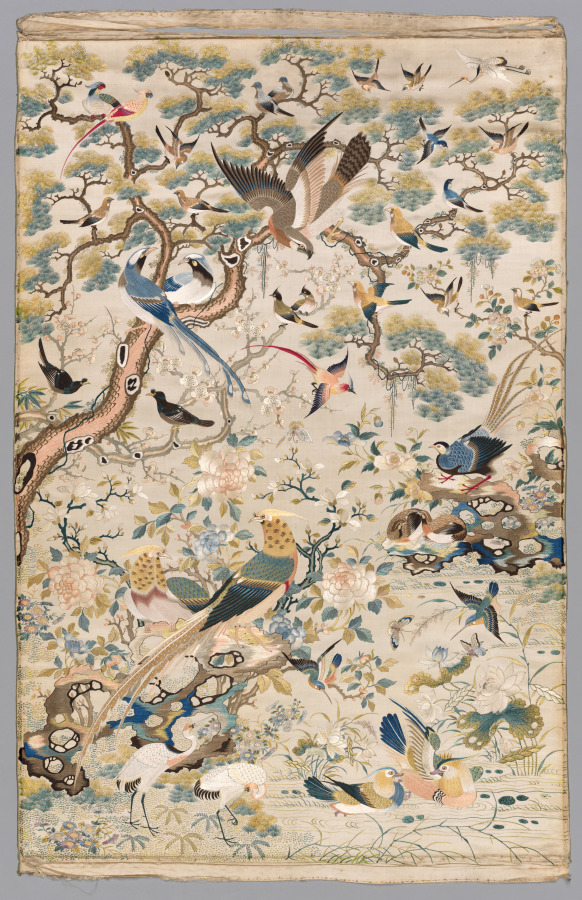
A Myriad of Birds: Silk, Sovereignty, and the Imperial Weave
In the hushed, wood-panelled ateliers of Savile Row, where the cut of a coat is a matter of national pride and the drape of a fabric a silent testament to centuries of mastery, we understand that true luxury is not merely purchased—it is inherited. The artifact under examination, A Myriad of Birds, is not simply a length of silk; it is a document of power, a cartography of empire, and a living thread connecting the looms of Imperial China to the discerning eye of the modern connoisseur. As Senior Heritage Specialist for the Lauren Fashion Heritage Lab, I present this analysis with the precision and reverence that a bespoke commission demands.
This artifact, a panel of hand-woven silk damask measuring approximately 140cm by 180cm, dates to the late Qianlong period (circa 1760-1795). Its materiality—the very substance of the silk—is the first and most profound point of inquiry. The silk is not of the common mulberry variety, but a kesi weave, a technique of unparalleled complexity often described as “cut silk” or “tapestry weave.” Unlike standard brocade where weft threads are carried across the entire width, kesi employs discontinuous wefts, each colour woven only where it appears in the design. This creates razor-sharp outlines, a sculptural quality to the motifs, and a reverse side that is a mirror image of the front—a hallmark of the highest imperial quality. The warp is a tightly twisted, undyed raw silk, providing a resilient, almost architectural foundation. The weft, however, is a lustrous, untwisted filament reeled from the cocoons of Bombyx mori silkworms fed exclusively on mulberry leaves from the imperial groves in Suzhou. The resulting sheen is not a gaudy gloss but a deep, internal glow—a patina of power, not of commerce.
The Lexicon of the Loom: Decoding the Avian Motif
The title, A Myriad of Birds, is a deliberate understatement. The panel depicts not a random scattering of avian life, but a meticulously ordered celestial hierarchy. The central motif is the feng huang, the Chinese phoenix, rendered in threads of gold-wrapped silk and kingfisher blue. This is not a bird of myth; it is the Empress’s emblem, the symbol of virtue, grace, and the feminine principle of yin. Its five tail feathers—coloured in the five sacred hues of black, white, red, green, and yellow—represent the five cardinal virtues: benevolence, righteousness, propriety, wisdom, and fidelity. Flanking the phoenix are pairs of cranes, woven in silver and white, their long necks arched in a posture of eternal vigilance. In the imperial lexicon, the crane signifies longevity, wisdom, and the father-son relationship—a direct reference to the Emperor’s role as the Son of Heaven. Below, a flock of mandarin ducks in iridescent orange and green floats upon a stylised wave pattern, symbolising marital fidelity and conjugal bliss, a necessary quality for the imperial household. The background is a dense, repeating pattern of five-clawed dragons (the Emperor’s exclusive symbol) chasing flaming pearls, a motif that reinforces the absolute sovereignty under which this fabric was produced. Every bird, every feather, every thread is a signifier in a closed system of meaning, a visual language that only the court and its highest artisans could fully read.
Materiality as Imperial Edict: The Silk Road’s Final Destination
The legacy of imperial silk weaving is not a romanticised history of craft; it is a history of state control, economic warfare, and technological monopoly. The silk for A Myriad of Birds was not a commodity; it was a currency of power. The imperial workshops in Suzhou, Hangzhou, and Nanjing were state-run factories, employing thousands of weavers who were bound to their looms by hereditary decree. The production of kesi was so labour-intensive—a single square inch could take a master weaver a full day to complete—that it was reserved exclusively for the Emperor, his family, and the highest-ranking mandarins. To wear such a fabric was to wear the state itself. The silk was a diplomatic tool, gifted to tributary states as a sign of favour, and a weapon, withheld from enemies as a demonstration of economic might. The materiality of this artifact, therefore, is inseparable from the political reality of its creation. The silk’s weight, its density, its resistance to creasing—these are not aesthetic choices; they are the physical manifestations of imperial decree. The fabric was designed to be seen from a distance, to command a room, to drape with a gravity that no lesser textile could achieve.
From Imperial Court to Savile Row: A Recontextualisation
How, then, does a 250-year-old piece of imperial silk find its way into the Lauren Fashion Heritage Lab? The answer lies in the global circulation of luxury goods that began with the Opium Wars and the subsequent looting of the Summer Palace in 1860. Many such panels were cut, dispersed, and sold to Western collectors and couturiers. In the 1920s and 1930s, houses like Worth, Poiret, and later, the great British tailors of Savile Row, began to repurpose these fragments into evening coats, waistcoats, and dressing gowns for a clientele that craved the exoticism of the East without understanding its codes. The irony is profound: a fabric designed to enforce a rigid social hierarchy was now being worn by industrialists and financiers who had no knowledge of the phoenix’s meaning or the dragon’s power. Today, in our Lab, we treat A Myriad of Birds not as a decorative remnant, but as a primary source. We use spectral imaging to identify the natural dyes—indigo, madder, and the crushed shells of the Purpura snail for the imperial purple. We analyse the twist of the silk filament to date the weaving technique. We consult the Qing dynasty court archives to match the pattern to a specific imperial decree issued in 1768 for the Empress Dowager’s birthday.
A Myriad of Birds is a masterclass in the power of materiality. It reminds us that silk is never just silk. It is a thread that connects the silkworm’s cocoon to the emperor’s throne, the weaver’s loom to the tailor’s shears, and the imperial court to the quiet, discerning halls of Savile Row. In its weave, we find not just a myriad of birds, but a myriad of meanings—each one a stitch in the fabric of history.