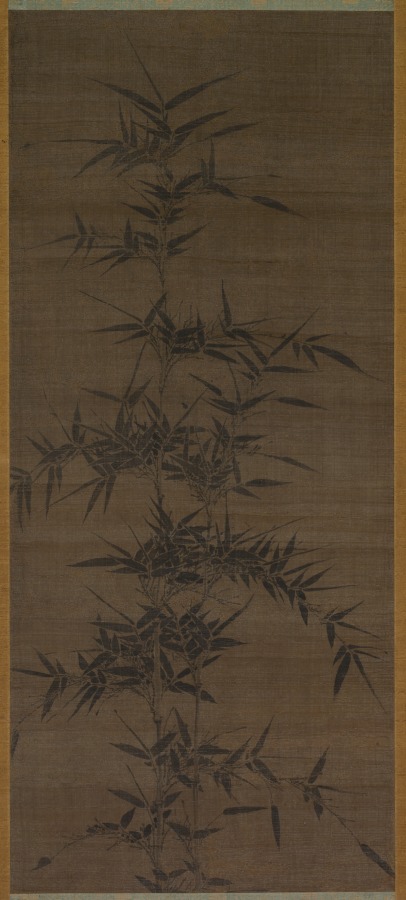
On the Material Confluence of Ink Bamboo and Imperial Silk
To comprehend the subject at hand—the rendering of Ink Bamboo upon silk of an imperial grade—one must first appreciate the profound dialogue it represents. This is not merely a decorative motif applied to a luxurious ground. It is, rather, a confluence of two distinct yet parallel lineages of elite discipline: the scholar's philosophical abstraction meeting the weaver's technical sovereignty. The legacy of imperial silk weaving provides not just the medium, but the essential context of sanctioned excellence, against which the bamboo's monochrome statement gains its full, resonant power.
The Ground: A Regime of Thread
Imperial silk was never simply cloth. It was a manifestation of authority, a controlled substance in the most literal sense. The state-administered workshops, with their hierarchies of master weavers and guarded pattern ledgers, operated on principles not dissimilar to a modern bespoke atelier of the highest calibre: absolute precision, relentless quality control, and a client whose taste was law. The silks produced—particularly those for the court—were exercises in technical supremacy. We speak of kesi, the cut-silk tapestry technique, allowing for curvilinear, painterly effects without the compromise of a floating weft. We speak of complex satin grounds, their high sheen a calculated stage for light to play upon.
This was a material culture built upon constraint to achieve brilliance. The palette, though sometimes exuberant, was governed by codified symbolism. The patterns—dragons, phoenixes, clouds—were heraldic, denoting rank and aspiration. The very hand of the silk, its weight and drape, communicated status before a word was spoken or a brushstroke seen. To receive a length of such silk was to be acknowledged within a rigid system of value. It was, in essence, the ultimate bespoke fabric: measured, commissioned, and imbued with intention far beyond the sartorial.
The Motif: The Bamboo, Reduced to Essence
In stark contrast to this polychrome world of imperial iconography stands the Ink Bamboo. This is the domain of the literati, the scholar-official who cultivated an aesthetic of refined austerity. To paint bamboo in ink alone is an act of distillation. It rejects the obvious green of the living plant in favour of its essential character: its structural integrity, its resilience in the wind, its graceful segmentation. The brushstroke itself becomes metaphor—the joint of the stalk a deliberate pause, the leaf a swift, decisive taper.
The Ink Bamboo is not a portrait of a plant. It is a treatise on principle. Its monochrome palette is a deliberate renunciation of superficial allure, a statement that truth and virtue are found in essence, not adornment. It speaks of flexibility without compromise, of hollow modesty (the bamboo's hollow stem), and of uprightness. This was art as personal cultivation, often created in private study rather than imperial workshop, valued for its expressive spontaneity and the hand of the master that made it.
The Confluence: A Statement of Unassailable Refinement
Herein lies the profound tension and genius of our artifact: the application of the Ink Bamboo motif onto the very apex of imperial silk. This is not a contradiction, but a masterful synthesis. Consider the implications.
To execute Ink Bamboo in silk, particularly through a technique like kesi, is to subject its celebrated spontaneity to the most disciplined of mediums. The painter's fluid, impulsive brushstroke must be translated, stitch by infinitesimal stitch, by a weaver of peerless skill. The gradations of ink wash—from the deepest black to the faintest whisper of grey—must be achieved through the meticulous blending of thread colours. What was once the work of a moment in the scholar's studio becomes a labour of weeks or months at the loom. The idea of the bamboo is preserved, even elevated, through a process that is its antithesis in method yet parallel in its pursuit of perfection.
The resulting artifact occupies a unique plane of prestige. It carries the unimpeachable authority of the imperial textile—its cost, its rarity, its technical magnificence—while simultaneously projecting the intellectual and ethical virtues of the literati tradition. It is, if you will, a double-breasted suit in a room of dinner jackets: it observes the highest codes of formal luxury while quietly asserting a more profound, philosophical lineage. The silk provides the gravitas of the establishment; the bamboo provides the soul of the individual connoisseur.
Legacy and Resonance
The legacy of this confluence is a standard of quiet, authoritative taste. It demonstrates that true luxury is not the absence of constraint, but the sublime mastery within it. The imperial weavers, bound by palace decrees and technical manuals, achieved artistry. The literati painters, bound by philosophical codes and aesthetic minimalism, achieved profound expression. Together, in an artifact of Ink Bamboo on silk, they achieve a timeless statement.
For the modern sensibility, this serves as an enduring lesson. It champions the virtue of the superlative ground—the finest silk, the most precise cut—as the necessary foundation for meaningful expression. It argues that the most powerful statements are often those made with restraint, where a single, perfectly rendered motif carries more weight than a field of clutter. And above all, it confirms that heritage, when properly understood, is not a museum piece. It is a living language of material, motif, and making, speaking always to the dialogue between impeccable form and resonant substance. The bamboo may bend, but it does not break; the silk may shimmer, but its strength is legendary. Together, they are an artifact of unshakeable refinement.