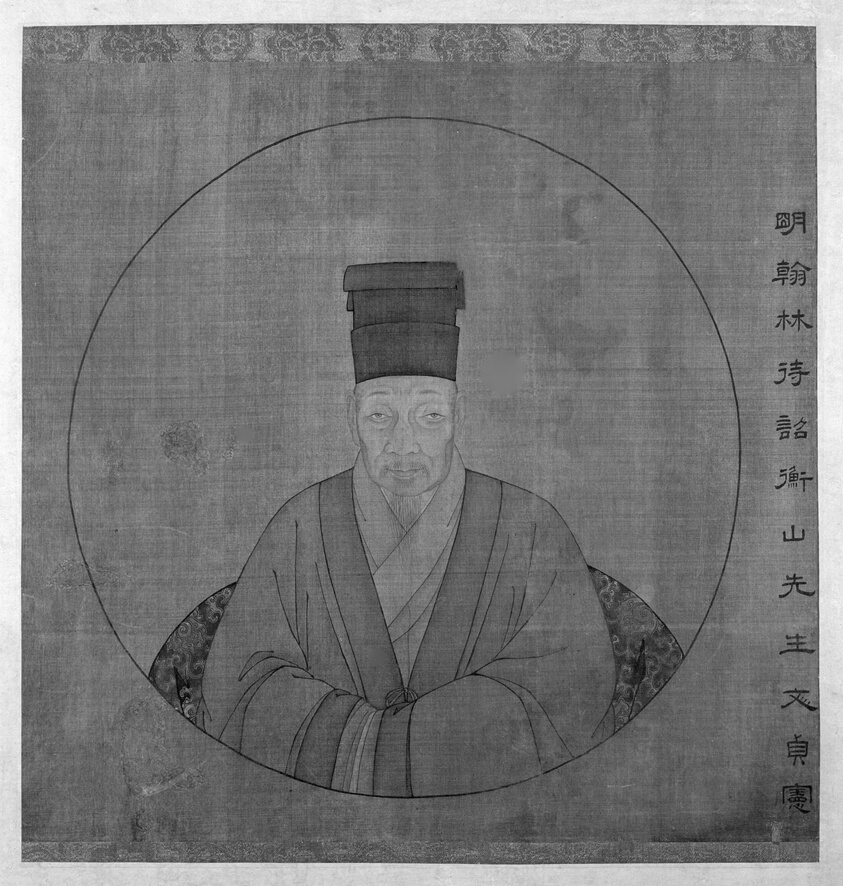
The Artifact as Testament: A Study of Wen Zhengming’s Album Leaf
Within the hallowed archives of the Lauren Fashion Heritage Lab, we encounter an object of profound cultural and material significance: a portrait of the Ming Dynasty scholar-artist Wen Zhengming. Executed as an album leaf in ink and light color on silk, this artifact is not merely a representation of a historical figure; it is a masterclass in the interplay between materiality and artistic expression. The silk support, a product of centuries of refined craftsmanship, serves as both a canvas and a collaborator, its very fibers dictating the fluid elegance that defines the work. For the connoisseur of heritage and the student of luxury, this album leaf offers a singular lesson in how materiality elevates the mundane into the transcendent.
Materiality: The Silk Substrate as a Living Medium
The choice of silk is not incidental. In Ming Dynasty China, silk was the quintessential medium for scholarly painting—a material that demanded respect and technical mastery. Unlike paper, which absorbs ink with a certain immediacy, silk presents a more resistant surface. The warp and weft of the fabric create a subtle grid, a micro-architecture that the artist must navigate with precision. The ink and light color applied here do not merely rest upon the silk; they interact with its weave, pooling in the interstices and diffusing along the threads. This creates a characteristic softness, a diffusion of line and wash that lends the portrait its ethereal quality. The fluid elegance of Wen Zhengming’s likeness is not solely the product of the artist’s hand; it is a dialogue between brush and textile, a negotiation of absorbency and resistance.
Consider the technical implications. The silk used for this album leaf is likely a fine, plain-weave variety, possibly a luo or juan silk, known for its even texture and durability. The application of light color—perhaps a wash of ochre or a faint verdigris—would have required a delicate touch, as silk’s capillary action can easily lead to bleeding or uneven saturation. The artist’s restraint is evident: the color is used sparingly, as an accent to the ink, never overwhelming the inherent luminosity of the silk. This is a hallmark of the literati tradition, where subtlety and suggestion are prized over overt display. The silk, in turn, rewards this restraint by allowing the pigment to glow with an inner light, a quality that no modern synthetic surface can replicate.
Context: The Scholarly Ideal and the Craft of Self-Presentation
Wen Zhengming (1470–1559) was a paragon of the Ming literati—a painter, calligrapher, poet, and scholar-official. His portrait, likely executed by a contemporary or a later admirer, captures not just his physical visage but the cultural archetype of the cultivated gentleman. The album leaf format is significant: it is an intimate object, meant to be held, viewed at close range, and passed among a circle of peers. This is not a public monument but a private meditation, a token of friendship and intellectual kinship. The silk, with its tactile softness and subtle sheen, enhances this intimacy. It invites touch, even as it demands reverence.
From a heritage perspective, the album leaf embodies the Ming Dynasty’s sophisticated understanding of luxury as restrained opulence. The silk is precious, but it is not ostentatious. The ink and color are applied with economy, yet the effect is one of profound depth. This aligns with the Confucian ideal of wen—refinement through learning and moral cultivation. The portrait is not about wealth or status; it is about the inner life of the subject, his wisdom, and his quiet dignity. The silk, as a material, becomes a metaphor for this ethos: strong yet supple, luminous yet understated.
Comparative Analysis: Silk in the Global Luxury Lexicon
To appreciate the singularity of this artifact, we must place it within a broader context of silk craftsmanship. On London’s Savile Row, silk is often associated with linings, scarves, and the occasional bespoke waistcoat—a material of luxury, but one that is typically subordinate to wool or cashmere. In Ming China, silk was the primary medium for the highest forms of artistic expression. The difference is not merely cultural but philosophical. Savile Row silk is about structure and drape, about how a garment conforms to the body. The silk of Wen Zhengming’s portrait is about surface and absorption, about how a material receives and transforms the artist’s intent.
Consider the technical mastery required. The ink lines in this portrait are executed with a precision that suggests a brush of exceptional quality, likely a hu brush made from goat or weasel hair. The ink, ground from a solid inkstick, would have been mixed with water to achieve a range of tones, from the deepest black to the palest gray. On silk, these tones do not remain static; they shift with the light, revealing different nuances as the viewer moves. This is a dynamic quality that no print or digital reproduction can capture. The light color—perhaps a wash of cinnabar for the lips or a faint blue for the robe—adds a subtle chromatic dimension, but it is the silk that gives these pigments their life.
Preservation and Legacy: The Responsibilities of Heritage
As a heritage artifact, this album leaf presents unique conservation challenges. Silk is hygroscopic, sensitive to humidity, light, and temperature. The ink and color, while stable under ideal conditions, can fade or become brittle if exposed to environmental stress. The Lauren Fashion Heritage Lab’s approach to preserving such an object is rooted in a philosophy of active stewardship: we do not merely store the artifact; we study it, document it, and ensure its material integrity for future generations. This involves climate-controlled storage, minimal handling, and the use of archival-grade materials for any mounting or framing.
Yet preservation is not solely a technical endeavor. It is also an act of interpretation. By understanding the silk’s role in the portrait’s creation, we gain insight into the Ming Dynasty’s aesthetic values—their reverence for craftsmanship, their belief in the unity of art and life. This album leaf is not a relic of a bygone era; it is a living document, a testament to the enduring power of materiality to convey meaning. For the student of fashion and luxury, it offers a profound lesson: that true elegance is not about excess but about the perfect alignment of material, technique, and intention.
Conclusion: The Silk as a Mirror of Civilization
In the portrait of Wen Zhengming, we see not just a man but a civilization. The silk, with its fluid elegance and refined craftsmanship, is the medium through which this civilization speaks to us across centuries. It reminds us that luxury is not a commodity but a relationship—between the artist and the material, the object and the viewer, the past and the present. As we continue to explore the intersections of heritage and fashion, let us carry forward this lesson: that the most enduring artifacts are those that honor the integrity of their materials, and that true craftsmanship is a form of reverence.
This album leaf, preserved within our lab, stands as a benchmark for what heritage research can achieve: a deep, respectful engagement with the past that informs and enriches our understanding of the present. It is, in every sense, a masterpiece of silk and spirit.