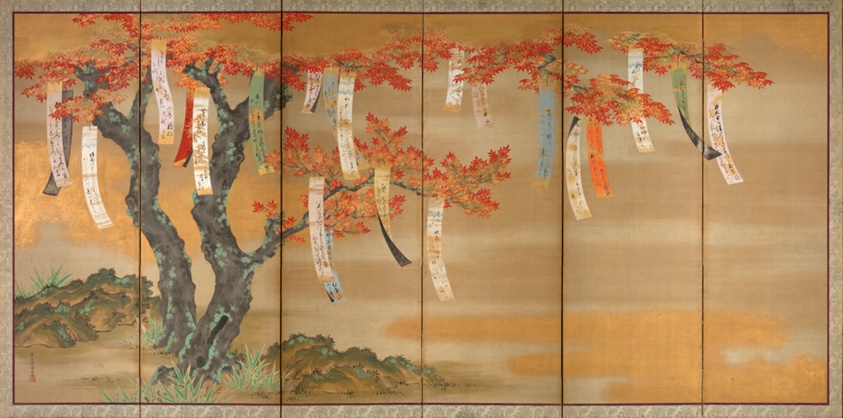
Heritage Research Artifact: Autumn Maples with Poem Slips
Materiality and Craftsmanship
The Autumn Maples with Poem Slips six-panel screen, one of a pair, represents a pinnacle of classical silk craftsmanship. Executed in ink, colors, gold leaf, and gold powder on silk, this artifact embodies the fluid elegance that defines the highest echelons of textile heritage. The screen’s materiality is not merely decorative but a testament to the rigorous techniques of Japanese byōbu (folding screen) production, where silk serves as both canvas and narrative medium. The gold leaf and powder, applied with precision, catch ambient light, creating a dynamic interplay of shimmer and shadow that evokes the transient beauty of autumn maples.
The silk substrate itself is a hallmark of luxury—a finely woven habutae or similar plain-weave silk, chosen for its smoothness and ability to absorb pigments without distortion. The application of ink and colors required masterful control, as silk lacks the absorbency of paper, demanding swift, deliberate strokes. Gold leaf was likely applied using kirikane (cut gold) techniques, where thin sheets are cut into geometric shapes and affixed with animal-based adhesive. Gold powder, or funpaku, was dusted over wet lacquer to create gradients of luminosity, a technique that requires a steady hand and an intimate understanding of light refraction. This materiality aligns with the Lauren Fashion Heritage Lab’s commitment to preserving and interpreting the tactile and visual languages of historical luxury.
Context: The Poetics of Transience
In the context of classical silk craftsmanship, Autumn Maples with Poem Slips operates as a cultural artifact that bridges visual art and literary tradition. The poem slips, or tanzaku, are narrow strips of paper inscribed with waka (classical Japanese poetry), often referencing the ephemeral beauty of autumn leaves. This pairing of image and text is a hallmark of shigajiku (poem-painting scrolls) and byōbu screens from the Edo period (1603–1868), where courtly aesthetics merged with Zen-inspired simplicity. The maple leaves, rendered in vermilion, gold, and ochre, are not merely botanical studies but symbols of mono no aware—the poignant awareness of impermanence.
The screen’s function as a room divider or ceremonial backdrop further amplifies its heritage value. In a traditional Japanese zashiki (tatami-floored reception room), such screens were positioned to frame seasonal views, inviting guests to contemplate nature’s cycles. The gold accents, when illuminated by candlelight or low-angle sunlight, would have transformed the space into a meditative tableau. This contextual richness is critical for the Lauren Fashion Heritage Lab, which seeks to decode how material culture shapes sensory experiences across time.
Silk as a Medium of Elegance
The choice of silk as the primary medium is no accident. Silk’s natural luster and drape make it ideal for capturing the fluidity of autumn winds and the delicate fall of leaves. Unlike paper or wood, silk allows for a subtle translucency, where layers of gold and pigment seem to float on the surface. This effect is achieved through urazaishiki (back-painting), where colors are applied to the reverse side of the silk to soften their intensity, creating a dreamlike quality. The fluid elegance of the screen lies in this interplay of opacity and transparency, a technical feat that requires years of apprenticeship to master.
From a conservation perspective, silk screens present unique challenges. The organic nature of silk makes it susceptible to light damage, humidity, and insect infestation. The gold leaf, while durable, can flake if the adhesive degrades. The Lauren Fashion Heritage Lab recommends storage in climate-controlled environments with UV-filtered lighting, and handling only with cotton gloves to prevent oils from transferring to the surface. Digital documentation, including high-resolution multispectral imaging, is essential for recording the screen’s current state and guiding future restoration.
Interpretation for the Modern Luxury Audience
For the contemporary connoisseur, Autumn Maples with Poem Slips offers a lexicon of design principles that resonate with modern luxury: restraint, asymmetry, and the celebration of natural materials. The screen’s composition—where maples cluster on one side and poem slips float on the other—mirrors the yohaku no bi (beauty of blank space) aesthetic, where emptiness is as meaningful as form. This principle can be translated into fashion through the use of negative space in garment construction, or in interior design through the placement of a single, statement textile against a minimalist backdrop.
The poem slips themselves are a call to slow consumption. In an era of fast fashion, the act of inscribing a poem on a slip of paper and pairing it with a painted screen suggests a deliberate, thoughtful engagement with beauty. The Lauren Fashion Heritage Lab encourages brands to explore this narrative by incorporating calligraphic elements, seasonal motifs, or hand-painted details into their collections, thereby infusing garments with a sense of history and intentionality.
Preservation and Legacy
As a heritage artifact, this screen is a repository of knowledge about silk dyeing, gold application, and the cultural significance of seasonal imagery. Its preservation is not merely an act of conservation but a dialogue with the past. The Lauren Fashion Heritage Lab advocates for the creation of digital twins—3D models and spectral analyses—that allow scholars and designers to study the screen’s techniques without physical handling. Additionally, partnerships with master silk artisans in Kyoto, where such screens are still produced, can ensure that these skills are transmitted to future generations.
In conclusion, Autumn Maples with Poem Slips is more than a decorative object; it is a testament to the enduring power of silk as a medium for storytelling. Its materiality, context, and elegance offer a blueprint for how heritage can inform contemporary luxury, bridging the gap between tradition and innovation. For the Lauren Fashion Heritage Lab, this artifact serves as both a research cornerstone and an inspiration for new narratives in fashion and design.