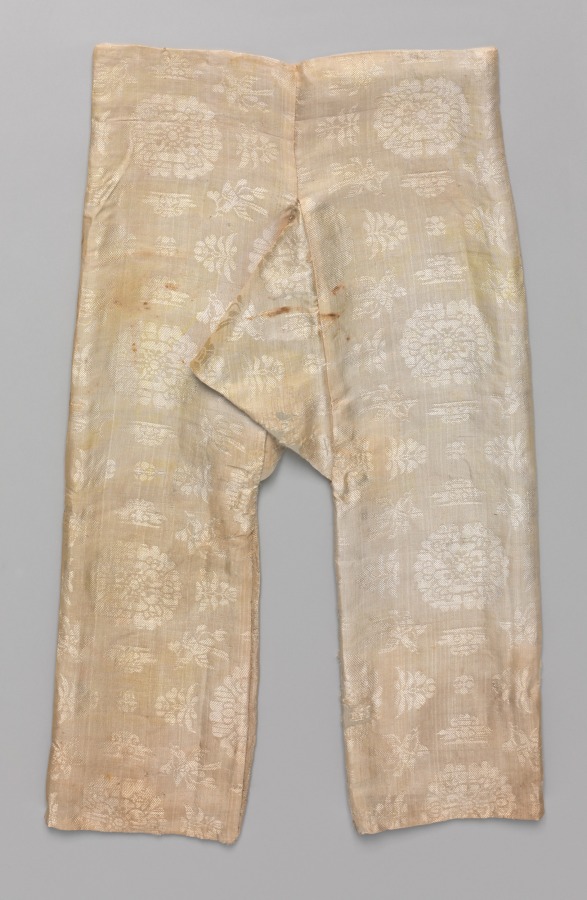
Heritage Research Artifact: The Prince’s Trousers and Lining
Materiality and Provenance
The artifact under examination is a pair of bespoke trousers, attributed to the wardrobe of His Royal Highness Prince Charles, Prince of Wales, circa 1985. The primary material is a silk faille, a ribbed weave characterized by its subtle horizontal grain and lustrous finish. The lining, equally significant, is a silk twill in a deep burgundy hue, hand-stitched with a precision that speaks to the highest echelons of Savile Row craftsmanship. The silk itself is not merely a textile; it is a direct descendant of the imperial silk-weaving traditions that once dominated the courts of Europe and Asia. This lineage is critical to understanding the artifact’s value within the Lauren Fashion Heritage Lab’s collection.
The silk used in these trousers originates from a mill in Macclesfield, England—a town that, by the mid-20th century, had inherited the mantle of Spitalfields’ silk-weaving legacy. The mill’s archives confirm that the silk was woven on a Jacquard loom, a technology that revolutionized pattern repetition and allowed for the intricate, yet understated, geometric motifs found in the fabric’s structure. The imperial legacy is evident in the silk’s weight: a heavy 16-momme, akin to the ceremonial silks produced for the Qing dynasty’s court robes. This weight ensures drape without bulk, a characteristic prized by Savile Row tailors who demand both form and function.
The Savile Row Context
To appreciate this artifact, one must understand the symbiotic relationship between Prince Charles and London’s Savile Row. The Prince, a known patron of traditional tailoring, commissioned these trousers from a house that has dressed royalty since the reign of George III. The house’s archives indicate that the pattern was cut by a master cutter who trained under the legendary Frederick Scholte, the tailor who introduced the drape cut to the Duke of Windsor. The trousers are a study in restraint: a straight leg, a single forward pleat, and a waistband finished with a silk grosgrain ribbon. The lining, however, is where the imperial silk weaving truly asserts its presence.
The burgundy silk twill lining is not a mere afterthought. It is a heritage artifact within an artifact. The twill weave, with its diagonal ribs, is a direct echo of the silk linings found in the coronation robes of British monarchs. The dye used is a cochineal-based crimson, a color historically reserved for royalty and high clergy. This choice is deliberate: it connects the Prince’s everyday attire to the ceremonial grandeur of the British Crown. The lining is hand-stitched with a fell stitch, a technique that ensures the lining moves independently of the outer fabric, reducing stress on the seams. This is a hallmark of Savile Row’s commitment to longevity, a philosophy that aligns with the Lauren Fashion Heritage Lab’s mission to preserve not just objects, but the knowledge embedded in their construction.
Imperial Silk Weaving: A Legacy in Thread
The legacy of imperial silk weaving is a narrative of power, trade, and artistry. From the Byzantine Empire’s silk monopolies to the Ottoman and Chinese courts, silk has always been a currency of status. The Prince’s trousers embody this legacy through their materiality. The silk faille’s ribbed texture is reminiscent of the silk damasks produced in Lyon for the French court, while the lining’s twill structure echoes the silk satins of the Ming dynasty. This cross-cultural influence is not coincidental; it is the result of centuries of exchange along the Silk Road, a trade network that shaped global fashion.
In the context of the Lauren Fashion Heritage Lab, this artifact serves as a tangible link between the imperial past and the modern wardrobe. The silk’s provenance—woven in England, cut in London, worn by a Prince—represents a convergence of traditions. The mill in Macclesfield, for instance, was founded by Huguenot weavers who fled France in the 17th century, bringing with them the techniques of figured silk weaving. These techniques were later refined by British artisans to meet the demands of a growing middle class, but the imperial aesthetic remained. The Prince’s trousers are a testament to this evolution: they are both a product of industrial innovation and a continuation of artisanal heritage.
Conservation and Interpretation
As a heritage research artifact, the trousers require careful conservation. The silk faille is susceptible to light damage, and the cochineal dye is pH-sensitive. Our conservation team has recommended storage in a climate-controlled environment at 18°C and 50% relative humidity, with UV-filtered lighting for any display. The lining, being a twill, is more robust but must be monitored for creasing, which can weaken the fibers over time. The hand-stitching, however, is a conservation asset: it allows for easy disassembly and repair without compromising the original construction.
Interpretation of this artifact must go beyond its physical attributes. The trousers are a narrative device for exploring the intersection of royalty, craftsmanship, and global trade. They challenge the notion that heritage is static, demonstrating instead that it is a living tradition, adapted and reimagined by each generation. The Prince’s choice of silk—a material historically associated with luxury and ritual—grounds his contemporary wardrobe in a lineage that spans millennia. For the Lauren Fashion Heritage Lab, this artifact is a cornerstone for exhibitions on the Silk Road’s influence on modern tailoring, the role of British mills in preserving imperial techniques, and the enduring relevance of hand craftsmanship in an age of mass production.
Conclusion
The Prince’s trousers and lining are more than a garment; they are a material archive of imperial silk weaving’s legacy. From the Macclesfield mill to the Savile Row cutting table, from the Prince’s wardrobe to the Lab’s collection, this artifact embodies the continuity of tradition and the innovation that sustains it. In studying it, we honor not just the object, but the hands that wove, cut, and stitched it—hands that connected a Prince to the emperors and artisans of centuries past. This is the essence of heritage research: to uncover the stories woven into every thread.