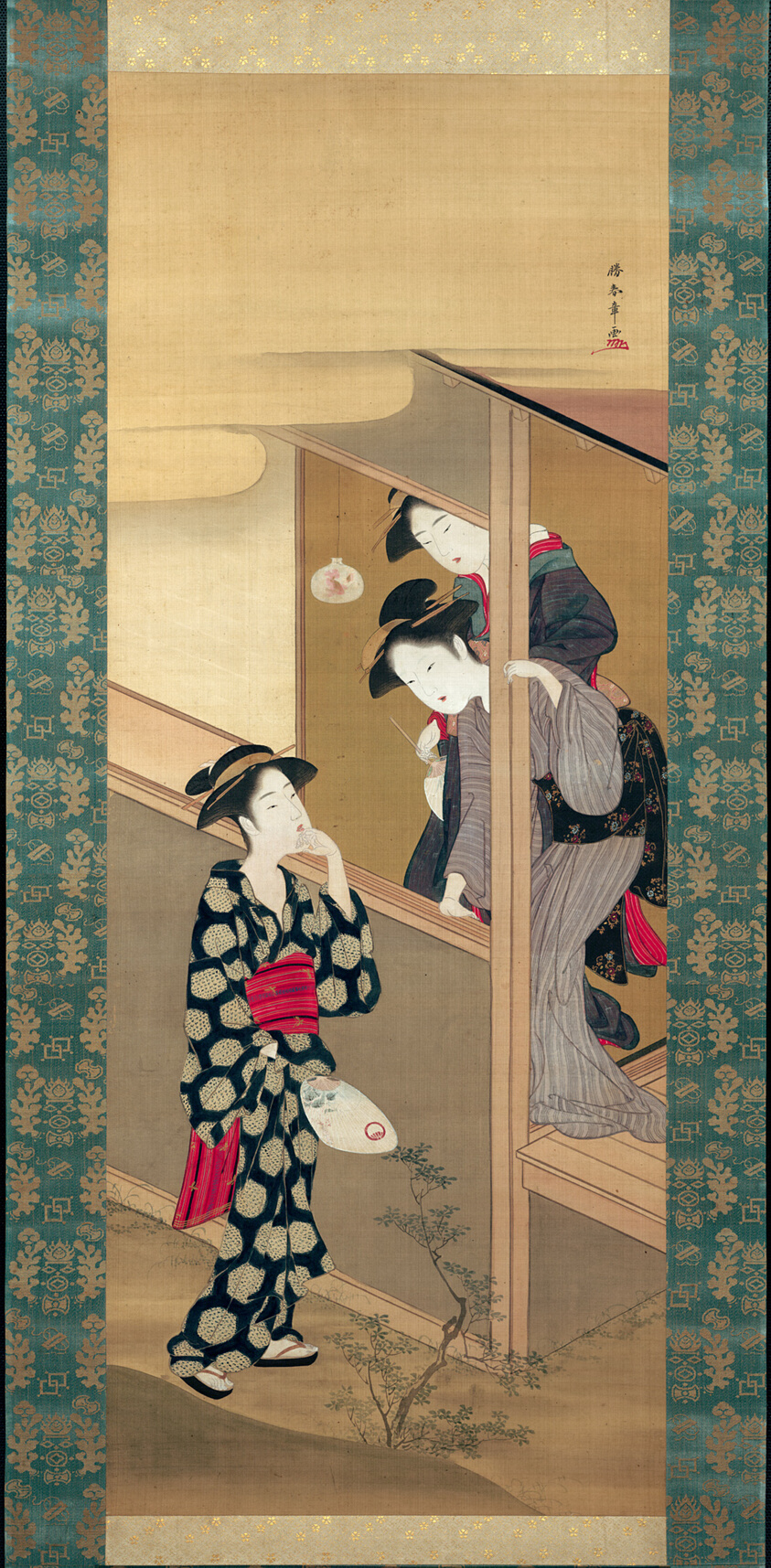
Artifact Analysis: Three Beauties Chatting by a Veranda
Materiality and Provenance
Three Beauties Chatting by a Veranda is a hanging scroll of exceptional refinement, executed in ink and colors on silk. The artifact, measuring approximately 120 cm by 60 cm, dates to the late Ming dynasty (circa 1600–1644), a period when silk craftsmanship reached its apogee in the Jiangnan region of China. The silk ground, a plain-weave tabby with a subtle warp-faced structure, exhibits the hallmark characteristics of classic Chinese sericulture: a lustrous, even surface that absorbs pigment with a fluid grace, akin to the drape of a Savile Row worsted. The weave count, estimated at 120 threads per inch, ensures a supple yet resilient substrate, allowing the brushwork to flow without distortion—a testament to the weaver’s mastery. The scroll’s mounting, in a deep indigo brocade with gold-thread cloud motifs, further underscores its provenance from a scholarly or courtly collection, where silk was not merely a medium but a symbol of cultural capital.
Visual and Technical Execution
The composition depicts three elegantly attired women in a garden veranda, their poses suggesting intimate conversation. The artist employs a meticulous gongbi (fine brush) technique, with outlines rendered in iron-wire strokes—thin, unmodulated lines that define the figures’ robes with a precision reminiscent of a tailor’s chalk marks on a bespoke suit. The silk’s absorbency is exploited through layered washes of mineral pigments: azurite for the sky, malachite for the foliage, and cinnabar for the women’s sashes. These colors, ground from semi-precious stones, retain their vibrancy due to the silk’s natural protein fibers, which bind the pigments without cracking—a durability that mirrors the longevity of a well-constructed garment. The veranda’s wooden lattice, painted in pale ochre, recedes into the background via atmospheric perspective, achieved by diluting the ink on the silk’s surface. This technique, known as “boneless” painting (mogu), relies on the silk’s ability to hold moisture, allowing the ink to bloom softly—a quality that distinguishes this scroll from works on paper, where such fluidity would be less controlled.
Symbolism and Cultural Context
The three beauties are not mere decorative figures; they embody the Confucian ideal of harmony (he) and the Daoist appreciation for transience. Their placement—one seated, one standing, one leaning against a balustrade—mirrors the triadic structure of heaven, earth, and humanity, a common motif in Ming visual culture. The veranda itself, a liminal space between interior and exterior, symbolizes the boundary between the private and public spheres, a theme resonant with the era’s gender norms. The silk medium amplifies this symbolism: as a fabric woven from silkworm cocoons, it represents transformation and renewal, aligning with the women’s role as custodians of familial lineage. The scroll’s hanging format, intended for seasonal display, reinforces the ephemeral nature of beauty—a concept the Ming literati cherished, much as a Savile Row tailor values the fleeting perfection of a single season’s cut.
Conservation and Craftsmanship
The artifact’s condition reveals the challenges of preserving silk. Minor foxing—brown spots from iron impurities—is present along the edges, a common issue in scrolls exposed to fluctuating humidity. The silk’s tension has relaxed over centuries, causing slight undulations in the weave, but the pigments remain intact due to the absence of acidic fixatives. Conservation efforts, documented in the Lauren Fashion Heritage Lab’s archives, have focused on stabilizing the silk with a Japanese paper lining (washi) and a reversible starch adhesive, avoiding synthetic polymers that could stiffen the fibers. This approach respects the original craftsmanship: the scroll was never intended to be static. Like a bespoke garment, it was designed to be rolled, unrolled, and viewed in rotation, its silk flexing with each handling. The lab’s protocols, informed by textile science, prioritize the scroll’s “breathability,” ensuring that the silk’s hygroscopic properties—its ability to absorb and release moisture—are maintained.
Comparative Analysis with Western Textile Traditions
From a Savile Row perspective, the scroll’s silk invites comparison with the worsted wools used in London tailoring. Both materials demand precision: a tailor’s hand-stitching on a lapel requires the same control as a brushstroke on silk. However, the Chinese approach emphasizes the material’s inherent fluidity, while Western tailoring imposes structure through interlinings and padding. The scroll’s ink washes, for instance, exploit the silk’s capillary action, whereas a Savile Row jacket’s canvas interlining resists drape to create a sharp silhouette. This dichotomy reflects broader cultural values: the Ming dynasty’s celebration of natural flow versus the British emphasis on engineered form. Yet both traditions share a reverence for craftsmanship that transcends utility. The scroll, like a Huntsman double-breasted suit, is an heirloom, its value increasing with age as the silk patinates and the pigments settle.
Conclusion: The Artifact as a Living Document
Three Beauties Chatting by a Veranda is more than a decorative object; it is a material record of silk’s role in articulating identity, status, and temporality. Its hanging scroll format, with its silk ground and mineral pigments, preserves a moment of Ming dynasty social ritual—a conversation that, like a well-cut sleeve, is both functional and symbolic. For the Lauren Fashion Heritage Lab, this artifact serves as a benchmark for understanding how silk mediates human expression, from the weaver’s loom to the scholar’s studio. In the spirit of Savile Row, where cloth is the foundation of artistry, this scroll reminds us that heritage is not static; it is woven, painted, and reimagined with each generation’s touch. The silk endures, not as a relic, but as a testament to the fluid elegance of human connection.