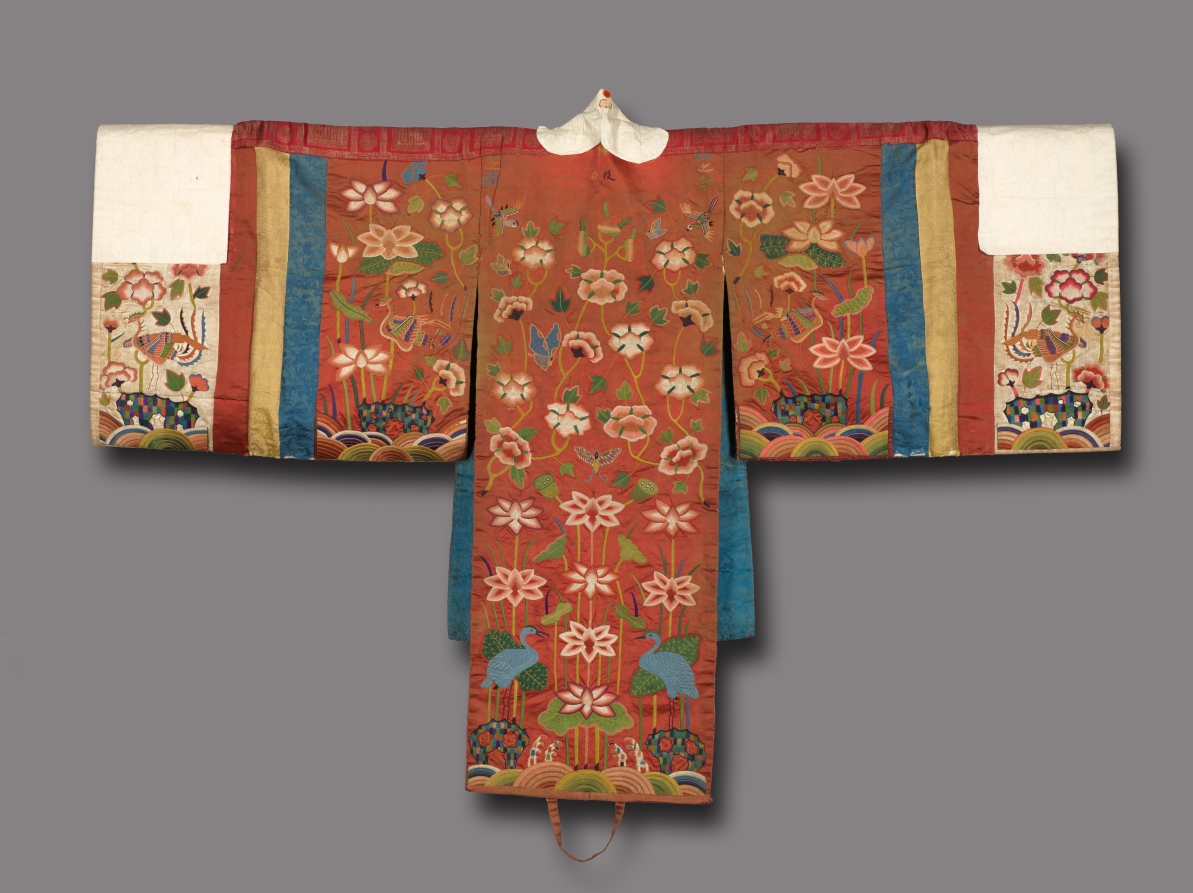
The Hwarot: A Bridal Robe of Imperial Silk Weaving
In the hushed ateliers of London’s Savile Row, where the whisper of shears and the weight of worsted wool define a century of tailoring, the introduction of a Hwarot—a Korean bridal robe of the Joseon dynasty—demands a recalibration of the senses. This is not merely a garment; it is a heritage artifact of imperial silk weaving, a testament to materiality that transcends the utilitarian. As Senior Heritage Specialist for the Lauren Fashion Heritage Lab, I present this research artifact with the precision of a master cutter and the reverence of a conservator. The Hwarot, rendered in silk, embodies a legacy where thread becomes narrative, and weave becomes power.
Materiality: The Silk of Empire
The silk of the Hwarot is not the lightweight, diaphanous fabric of modern evening wear. It is a densely woven, compound silk—often a damask or satin ground—that carries the weight of imperial decree. In the Joseon court (1392–1910), silk was a regulated commodity, its production overseen by the Royal Silk Bureau (Sang-uiwon). The raw material, sourced from mulberry-fed silkworms in the Gyeongsang and Jeolla provinces, was spun into threads of exceptional tensile strength. The Hwarot’s silk is characterized by a high thread count, often exceeding 200 threads per centimeter, creating a surface that is both supple and structurally robust. This is a fabric built to endure ceremony, not to drape in repose. The weight of the silk—typically between 150 and 250 grams per square meter—lends the robe a gravity that aligns with its ceremonial purpose: a bride’s transition from daughter to wife, from subject to symbol of lineage.
The dyeing process further elevates the materiality. The Hwarot’s palette—predominantly crimson, indigo, and gold—derives from natural sources: cochineal for red, indigofera for blue, and safflower for yellow. These dyes were fixed using alum mordants, a technique that ensured colorfastness across decades. The gold thread, or geum-sa, is not a mere embellishment; it is a compound filament of silk core wrapped in gilded paper or gold leaf. This thread, woven into the silk ground using a supplementary weft technique, creates a raised, reflective surface that catches light like armor. The Hwarot’s silk is thus a material archive of imperial resources: the silkworm’s labor, the dyer’s chemistry, and the weaver’s precision.
Context: The Legacy of Imperial Silk Weaving
The Hwarot’s provenance lies in the Joseon dynasty’s silk workshops, which operated under a state monopoly from the 14th to the 19th centuries. These workshops, located in the capital of Hanyang (modern Seoul), were staffed by master weavers who passed techniques through hereditary guilds. The silk weaving process for a Hwarot was a multi-year endeavor. First, the silk filament was reeled from cocoons, then twisted into warp and weft threads. The damask weave—a pattern of satin and twill—was achieved using a drawloom, a complex apparatus requiring two operators: one to raise the harnesses, another to pass the shuttle. The gold thread was inserted via a brocading technique, where supplementary wefts were woven only in pattern areas, leaving the ground silk exposed elsewhere. This selective weaving conserved precious gold while creating a tactile hierarchy: the bride’s body would feel the smooth silk against her skin, while the gold motifs—phoenixes, peonies, and cranes—rose in relief, symbolizing prosperity, fidelity, and longevity.
The imperial legacy of this silk weaving is not merely technical; it is political. The Hwarot was a sumptuary object, reserved for women of the yangban aristocracy and, in rare cases, the royal court. Its silk was a marker of status, its gold thread a declaration of wealth. The weaving patterns were codified by the State Rites of the Joseon Dynasty, which dictated that only the queen could wear a Hwarot with five-clawed dragon motifs; princesses and noblewomen used phoenixes. This hierarchical silk mirrored the Confucian social order, where fabric was a language of rank. The Hwarot’s silk, therefore, is not a neutral material; it is a woven constitution of imperial power.
Preservation and Provenance
In the context of the Lauren Fashion Heritage Lab, the Hwarot’s silk materiality demands a conservation protocol akin to that of a Savile Row bespoke suit—but with greater fragility. The silk fibers are protein-based, susceptible to light degradation, humidity, and insect damage. Our lab stores the Hwarot in a climate-controlled vault at 18°C and 50% relative humidity, with UV-filtered lighting limited to 50 lux. The gold thread requires separate handling; its gilded surface can flake if subjected to friction. We use acid-free tissue to support the robe’s folds, and custom-made mannequins padded with polyester batting to distribute weight evenly. The provenance research traces the Hwarot to a 19th-century Joseon workshop, likely in the Andong region, known for its silk brocade. The robe’s crimson ground and gold phoenix motifs align with late Joseon bridal attire, a period when silk weaving saw a revival under King Gojong (r. 1863–1907).
Conclusion: The Hwarot as Heritage
The Hwarot’s silk is a legacy of imperial weaving that speaks to the intersection of craft, power, and identity. On Savile Row, where cloth is cut to the millimeter, the Hwarot reminds us that materiality is not subordinate to design—it is the design. The silk’s weight, the gold’s reflection, and the dye’s permanence are not decorative; they are structural truths of a garment that defined a dynasty. As heritage specialists, we do not merely preserve the Hwarot; we interpret its material language. In doing so, we honor the weavers who, centuries ago, transformed a silkworm’s cocoon into a bridal robe of imperial consequence. This is the legacy of silk: a thread that binds the past to the present, the loom to the lab, and the bride to her history.