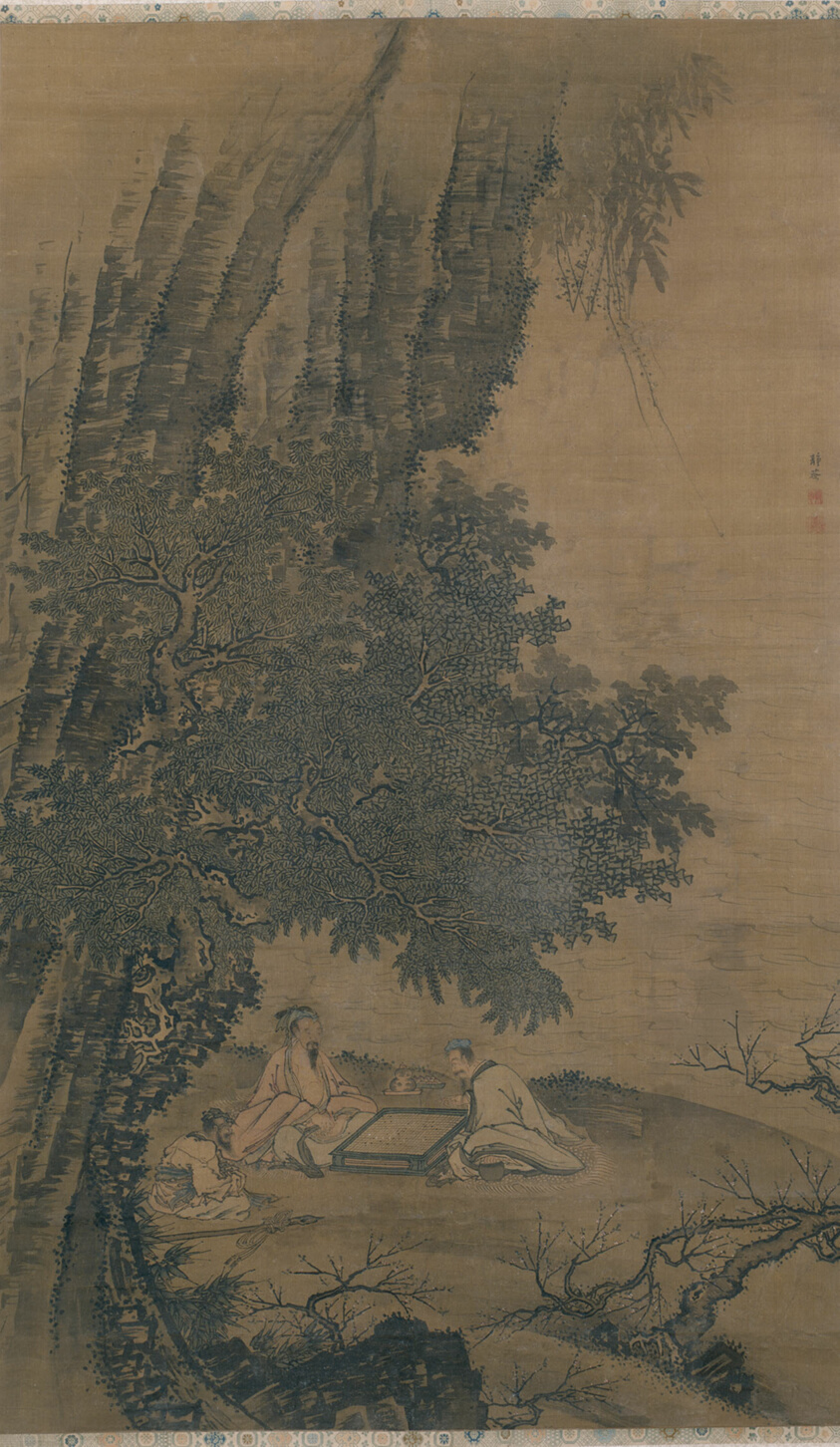
Heritage Artifact Analysis: Landscape with Daoist Immortals Playing Weiqi
Materiality and Craftsmanship: The Silk Canvas
The artifact under examination, a hanging scroll titled Landscape with Daoist Immortals Playing Weiqi, is rendered in ink and colors on silk. This material choice is not merely functional but deeply symbolic within the context of Chinese heritage. Silk, as a medium, embodies a paradox of strength and delicacy—a quality that resonates with the ethos of London’s Savile Row, where the finest tailoring marries robust construction with an air of effortless elegance. The silk used here, likely a hand-woven tabby or satin weave, was produced through a meticulous process of sericulture and loom work that dates back millennia. Its surface, smooth yet absorbent, allows for the precise application of ink and mineral pigments, creating a luminosity that paper cannot replicate. The scroll format, designed for vertical display, further emphasizes the fluidity of the composition, guiding the viewer’s eye upward as if ascending a mountain path.
In the context of classic silk craftsmanship, this artifact represents a pinnacle of technical achievement. The warp and weft threads, often derived from the cocoons of Bombyx mori, are degummed and dyed before weaving, ensuring that the fabric retains its natural sheen. The artist’s use of “boneless” painting techniques—where outlines are omitted in favor of washes and gradations—exploits the silk’s capacity to hold color without bleeding. This is analogous to the Savile Row tailor’s mastery of a fine worsted wool, where the fabric’s drape and texture dictate the cut. The scroll’s mounting, typically involving a silk brocade border and a wooden roller, further underscores the artifact’s status as a luxury object, intended for the connoisseur’s private contemplation.
Iconography and Narrative: Daoist Immortals at Play
The central motif—Daoist immortals engaged in a game of weiqi (known in the West as Go)—is a profound allegory for the interplay of cosmic forces. Weiqi, with its 361 intersections and black-and-white stones, mirrors the Daoist concept of yin and yang, where balance and strategy determine the outcome. The immortals, often depicted as eccentric sages with flowing robes and serene expressions, are not merely playing a game; they are enacting a microcosm of the universe’s order. In this landscape, they are seated on a rocky outcrop, surrounded by mist-shrouded peaks and ancient pines. The composition adheres to the “three distances” principle of Chinese landscape painting: the foreground with the figures, the middle ground with waterfalls and bridges, and the distant mountains fading into the void. This spatial hierarchy invites the viewer to traverse the painting mentally, much like a Savile Row suit invites the wearer to move with confidence and grace.
The choice of weiqi as a subject is particularly resonant. Unlike chess, which emphasizes hierarchical power, weiqi is a game of territorial acquisition and strategic patience—qualities that align with the Daoist ideals of wu wei (effortless action) and harmony with nature. The immortals, by engaging in this game, demonstrate a detachment from worldly concerns, embodying the “spirit of the Dao”. Their presence in the landscape suggests that enlightenment is not found in isolation but through interaction with the natural world. The artist likely intended this scene as a visual meditation, encouraging the viewer to reflect on the balance between action and stillness.
Context and Provenance: A Scholar’s Treasure
This scroll would have been created during a period of heightened Daoist influence, possibly the Ming or Qing dynasty, when literati culture flourished. It was not a public artwork but a private treasure, displayed in a scholar’s studio or a temple hall. The hanging scroll format allowed for rotation, enabling the owner to change the artwork according to season or mood—a practice that echoes the Savile Row tradition of seasonal wardrobe curation. The use of silk, rather than paper, indicates a patron of considerable means, as silk was a costly material reserved for ceremonial or high-status objects. The colors, likely derived from mineral sources such as azurite (blue) and malachite (green), have retained their vibrancy over centuries, a testament to the quality of the pigments and the care in storage.
The provenance of such artifacts often traces back to imperial collections or aristocratic families. The scroll may have been part of a larger set, perhaps depicting the Eight Immortals or scenes from the Classic of Mountains and Seas. Its survival is remarkable, given the fragility of silk and the vicissitudes of history. Today, it serves as a bridge between the past and present, offering insights into the spiritual and aesthetic values of pre-modern China. For the modern curator or collector, it represents an opportunity to engage with a worldview that prioritizes balance, longevity, and the subtle interplay of forces—a philosophy that resonates with the timeless elegance of Savile Row tailoring.
Preservation and Legacy: The Art of Endurance
Preserving a silk scroll requires a deep understanding of its material vulnerabilities. Light, humidity, and handling can all cause irreversible damage. The silk fibers, if exposed to ultraviolet light, will weaken and fade; the mineral pigments, if not stabilized, may flake. Conservation practices for such artifacts involve controlled environments, acid-free storage, and minimal intervention—a philosophy that mirrors the Savile Row approach to garment care, where a bespoke suit is maintained through careful pressing and rotation rather than aggressive cleaning. The scroll’s mounting, often replaced over centuries, must be executed with precision to avoid distorting the original artwork. This respect for the original materiality ensures that the artifact remains a living document of its era.
The legacy of Landscape with Daoist Immortals Playing Weiqi extends beyond its aesthetic value. It is a testament to the enduring human fascination with the intersection of art, philosophy, and craftsmanship. In a world increasingly dominated by digital ephemera, this scroll reminds us of the power of tangible objects to convey complex ideas. Its silk surface, bearing the marks of brush and time, invites us to slow down, to observe, and to play the game of life with the same strategic grace as the immortals. For the Lauren Fashion Heritage Lab, this artifact is not merely a historical curiosity but a source of inspiration—a reminder that true elegance, whether in a garment or a painting, lies in the harmony of material, form, and meaning.