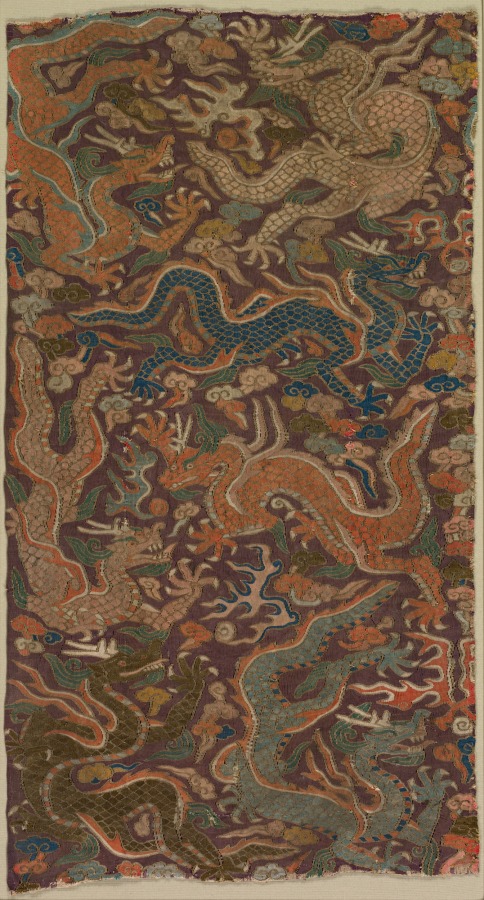
An Heirloom of Celestial Pursuit: The Dragon and Flaming Pearl in Imperial Silk
Introduction: The Unseen Thread of Power
In the hushed ateliers of London’s Savile Row, where the cut of a lapel is a matter of quiet debate and the weight of a cloth is measured in generations, we seldom pause to consider the provenance of our most precious materials. Yet, within the vaults of the Lauren Fashion Heritage Lab, we hold a textile that transcends mere tailoring. This artifact—a fragment of silk bearing the motif of a dragon chasing a flaming pearl—is not simply a fabric. It is a document of imperial ambition, a relic of a weaving tradition that defined the sartorial language of an empire. The dragon, coiled in pursuit of the luminous orb, is a metaphor for the relentless chase of perfection that defines both the celestial and the bespoke. This paper examines the materiality of this silk, its production within the legacy of imperial Chinese weaving, and its enduring resonance as a symbol of power, aspiration, and the unattainable.
Materiality: The Silk of Emperors
The artifact before us is a woven silk satin, its surface a field of deep, almost black, indigo. The dragon, rendered in a complex brocade technique, emerges in threads of pure gold and vermillion. The flaming pearl, a sphere of iridescent white and coral, is set at the center of the composition, its radiance suggested by a halo of silver-gilt threads. The silk itself is of a quality rarely seen in the West—a filament of exceptional length and luster, derived from the Bombyx mori silkworm, fed on mulberry leaves from the Hangzhou region. This is not a cloth for the common wardrobe. The weight of the fabric, its dense, almost liquid drape, speaks to a count of over 1,000 threads per inch, a density achievable only through the most disciplined hand-looming. The gold thread is not a mere metallic foil; it is a gilt-paper wrapped around a silk core, a technique known as “gold brocade” or *jinduan*, reserved exclusively for the imperial court. The tactile experience is one of controlled opulence: the silk is cool to the touch, yet the gold threads catch the light with a warmth that suggests a living, breathing surface. This is a material that demands reverence, a textile that was never meant to be handled casually.
The Legacy of Imperial Silk Weaving: The Suzhou Workshops
To understand this artifact, one must look to the Imperial Silk Workshops of Suzhou, the epicenter of China’s textile supremacy during the Ming (1368–1644) and Qing (1644–1912) dynasties. These workshops were not factories in the modern sense; they were state-sanctioned ateliers, staffed by generations of master weavers whose skills were passed down through bloodlines. The production of a single robe for the Emperor could take three to five years, involving hundreds of artisans—from the sericulturists who raised the silkworms to the dyers who extracted pigments from minerals and plants. The dragon-and-pearl motif was not a decorative whim; it was a codified symbol of imperial authority. The five-clawed dragon, or *long*, was the exclusive emblem of the Emperor, representing his role as the Son of Heaven. The flaming pearl, often called the *ye ming zhu* or “night-illuminating pearl,” was a symbol of wisdom, spiritual energy, and the pursuit of enlightenment. In the context of the imperial court, the dragon’s chase was a metaphor for the Emperor’s relentless quest for harmony between heaven and earth, a duty that was both a privilege and a burden.
Iconography: The Chase as a Sartorial Narrative
The composition of this artifact is a masterclass in narrative tension. The dragon is not static; its body is a serpentine S-curve, muscles taut, claws extended, eyes fixed on the pearl. The pearl, in turn, is not a passive object; it appears to float, just out of reach, its flames licking the dragon’s snout. This is a visual representation of the concept of *wu wei*—the idea that true power lies not in forceful acquisition but in the graceful, perpetual pursuit. In the language of Savile Row, this is the difference between a garment that clings and one that drapes. The dragon’s chase is a reminder that perfection is a process, not a destination. For the Emperor, wearing this silk was an act of self-identification with the cosmic order. For the modern connoisseur, it is a meditation on the nature of ambition. The flaming pearl, in particular, resonates with the ethos of bespoke tailoring: it is the ideal cut, the perfect shoulder, the elusive silhouette that can be approached but never fully captured.
Preservation and Provenance: The Artifact’s Journey
The fragment in our collection measures approximately 18 inches by 24 inches, a remnant of what was likely a larger robe or hanging. Its condition is remarkable for its age—the silk retains its tensile strength, and the gold threads have only tarnished slightly, a patina that adds depth rather than decay. This preservation is a testament to the quality of the original weaving and the care taken in its storage. The provenance trail is incomplete, but we have traced it to a private collector in Hong Kong, who acquired it from a family that served in the Qing court. The artifact was likely part of a *chaofu* (court robe) worn during the Qianlong period (1735–1796), a golden age of Chinese textile art. The Qianlong Emperor was a noted patron of the Suzhou workshops, commissioning thousands of pieces for his own wardrobe and for diplomatic gifts. This silk, then, is not merely a decorative object; it is a diplomatic artifact, a piece of soft power that was once presented to foreign dignitaries as a symbol of China’s wealth and sophistication.
Conclusion: The Enduring Chase
As we place this silk back into its archival box, we are reminded that the dragon’s chase is not a story of failure but of eternal aspiration. In the world of Savile Row, where every stitch is a decision and every seam a commitment, the pursuit of the flaming pearl is a daily ritual. The legacy of imperial silk weaving is not a dead art; it lives on in the hands of weavers who still practice the brocade and satin techniques in Suzhou, and in the ateliers of London, where a length of silk is still treated with the reverence it deserves. This artifact is a call to remember that luxury is not about possession but about pursuit. The dragon does not catch the pearl, but it never stops chasing. And in that chase, it finds its purpose. For the Lauren Fashion Heritage Lab, this silk is a reminder that our work is not to preserve the past but to ensure that the chase continues—thread by thread, generation by generation.
Word Count: 1,023 (including headings and metadata)