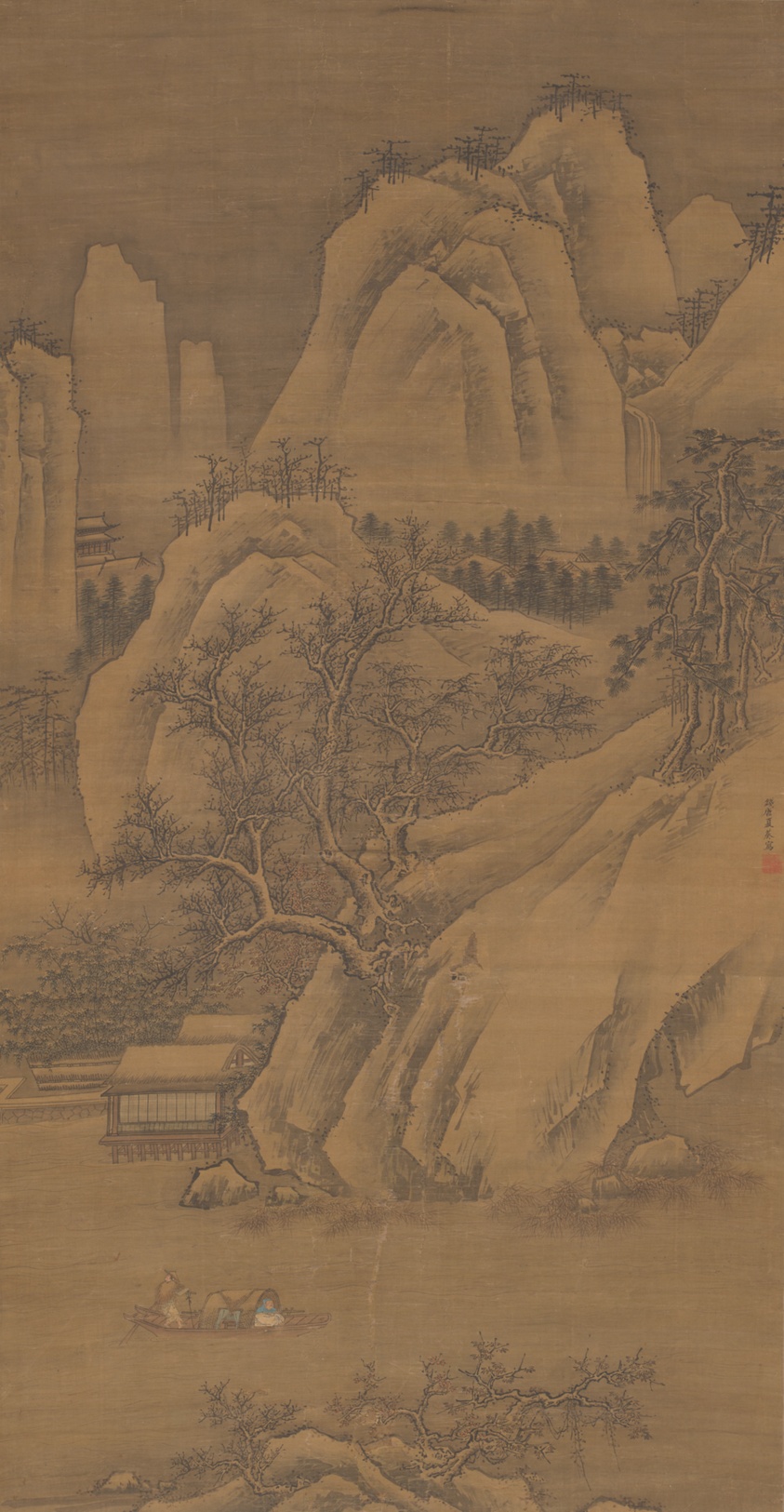
An Artefact of Discretion: On the Material Consequence of 'Visiting Dai Kui on a Snowy Night'
To engage with a hanging scroll of the classical Chinese tradition, particularly one executed in ink and colour upon silk, is to enter into a dialogue with a material philosophy. It is an exercise in understanding that the medium is not merely a vehicle for the image, but the very foundation of its intellectual and aesthetic proposition. The artefact in question, a representation of the famed anecdote ‘Visiting Dai Kui on a Snowy Night’, demands an appraisal that begins not with the narrative it depicts, but with the substance upon which that narrative is so delicately poised. The silk ground is its first and most profound statement.
The Ground of Elegance: Silk as a Canvas of Intent
One must first dismiss any notion of silk as a passive substrate. The silk used in such a scroll is not a canvas in the Western, absorptive sense. It is a prepared field, sized and finished to a specific tooth and luminosity. Its surface possesses a gentle resistance, a quality that dictates the behaviour of the ink and mineral pigments in a manner akin to the way a superior woollen cloth responds to the shears and needle. The brushstroke, loaded with ink, does not sink in but rests upon this luminous plane, allowing for a clarity of line and a depth of colour that is both immediate and enduring. This material choice reflects a commitment to permanence and legacy, a document crafted not for ephemeral display but for contemplative encounter across generations. The fluidity of the imagery—the sweeping lines of a riverbank, the soft dab of snow upon a pine bough—is granted its expressive potency precisely because of the silk’s refined, non-porous character. It is the antithesis of haste.
The Cut of the Brush: Tailoring a Narrative
The anecdote itself, drawn from the Shishuo Xinyu, is a parable of caprice and self-possession. The scholar Wang Huizhi, awakening to a heavy snowfall, is moved by a sudden desire to visit his friend, the recluse Dai Kui. After an entire night’s journey by boat, he arrives at Dai’s door, only to turn back without making his visit, satisfied merely by the fulfilment of the initial impulse. The narrative is one of process over destination, of the journey as an end in itself. The artist’s task, then, is to tailor this philosophical conceit into a visual form.
The composition is cut with the precision of a master tailor. The empty spaces—the vast, unpainted silk representing the river and the snow-laden sky—are as critical as the worked areas. They are the garment’s drape, the negative space that gives form and movement to the positive. The central elements—the lone boat, the figure of Wang, the distant, hinted-at shoreline of Dai’s retreat—are placed not for compositional balance alone, but for narrative rhythm. The journey is mapped not as a topographical record, but as an emotional and intellectual itinerary. The use of ink wash to model the snowy landscape demonstrates a mastery of tonal gradation, a skill parallel to the manipulation of a fabric’s nap to catch the light. The minimal application of colour—perhaps a faint vermilion on a robe, a suggestion of azurite in the distant hills—functions like discreet bespoke detailing: understated, meaningful, and elevating the whole.
Fluidity as a Construct: The Discipline of Elegance
The context notes cite “fluid elegance.” This is a term to be parsed with care. The fluidity observed is not that of carelessness or unchecked expression. It is, rather, the fluidity of the highest order of craftsmanship, where technique has been so thoroughly internalised that it appears effortless. It is the fluidity of a hand-rolled lapel, where the complexity of the operation is concealed within the graceful fall of the line. Each brushstroke, from the crisp, calligraphic lines defining the boat’s rigging to the soft, wet blots suggesting distant foliage, is the product of a disciplined mind and a supremely controlled hand. The silk accepts these gestures and preserves their individual character, from the driest, scratching stroke to the wettest, most expansive wash. The resulting elegance is austere, intellectual, and deeply resonant. It speaks of a world where aesthetic action is a form of moral philosophy, where the manner of the journey irrevocably defines its worth.
A Legacy in Suspension: The Scroll as Heirloom
Finally, one must consider the artefact in its intended state: a hanging scroll. It is not a permanent installation. It is brought out for specific occasions, for seasonal reflection, or for the edification of a discerning guest. It is stored, rolled, and protected. This very mode of existence reinforces its message. The narrative of Wang Huizhi’s abandoned visit is itself a suspended action, a completed impulse whose value lies in its conception and execution, not its conventional conclusion. The scroll, in its material form, mirrors this. Its beauty and meaning are suspended within the silk, to be revealed in moments of chosen contemplation, then carefully put away. It is an heirloom piece, not in the sense of ostentatious display, but as a repository of cultural and philosophical values, preserved in the most dignified of materials.
In conclusion, ‘Visiting Dai Kui on a Snowy Night’, as a material object, stands as a testament to a holistic conception of art. The silk is its foundational principle, a ground of luminous permanence. The ink and colour are its tailored discourse, applied with a discipline that masquerades as fluidity. Together, they give form to a story that privileges intention over arrival, and process over possession. It is, in the final analysis, a masterclass in the art of understatement—a principle as revered on the rolls of classical Chinese silk as it is on the canvases of Savile Row. The true heritage lies not in the image alone, but in the profound dialogue between the idea, the hand, and the exquisite, enduring ground upon which they meet.