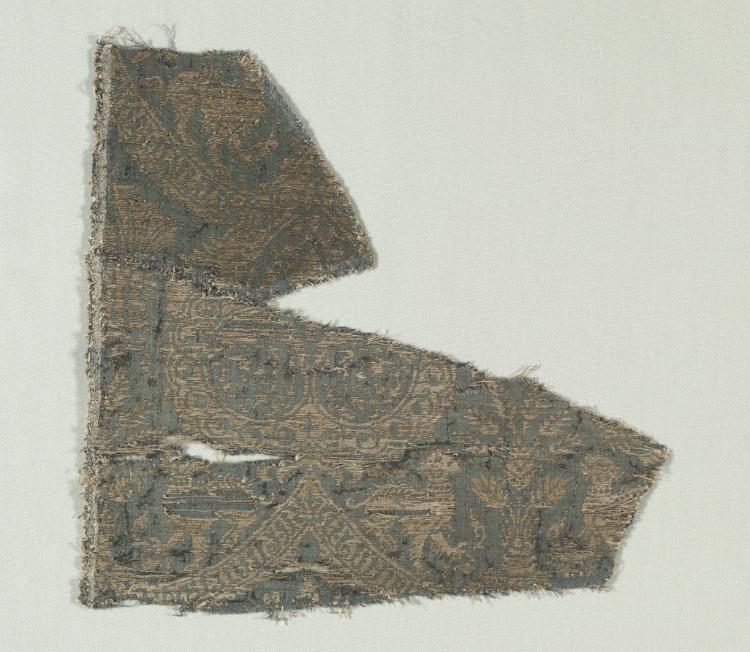
A Heritage Artifact: Silk with Dogs and Arabic Script in Swaying Bands
In the hallowed archives of the Lauren Fashion Heritage Lab, we encounter a textile of profound complexity and understated opulence: a length of silk, woven with a design of dogs and Arabic script, set within swaying bands. This artifact, likely originating from the late 16th or early 17th century Safavid Persia or Mughal India, represents the pinnacle of imperial silk weaving—a craft that married technical mastery with cultural diplomacy. The fabric’s materiality—its weight, its lustre, its tactile memory—speaks to a legacy where silk was not merely cloth, but a statement of power, faith, and artistry. For the connoisseur of fine tailoring, this piece offers a lesson in how heritage informs modern luxury: the interplay of structure and fluidity, of narrative and restraint.
Materiality and Craftsmanship
The silk itself is a testament to the weaver’s art. Woven from the finest filaments of Bombyx mori, the fabric possesses a natural sheen that catches light with a soft, almost liquid glow. The warp and weft are densely packed, creating a ground of deep ivory or pale gold—a neutral foundation that allows the design to command attention. The dogs, likely Salukis or Tazi hounds, are rendered in a palette of muted indigo, madder red, and verdant green, their forms elongated and elegant, as if captured mid-stride. The Arabic script, flowing in naskh or thuluth calligraphy, weaves through the bands with a rhythmic precision, its letters curving like the swaying branches of a cypress tree. The bands themselves are not rigid; they undulate, creating a sense of movement that mimics the natural world—the wind through a garden, the gait of a hound.
The technical execution is extraordinary. This is a compound weave, likely a lampas or a brocaded satin, where supplementary wefts float across the surface to create the pattern. The weaver’s hand is invisible, yet his discipline is palpable: every thread is placed with intention, every colour transition a calculated risk. The silk’s weight—around 200 to 250 grams per square metre—suggests a fabric intended for ceremonial garments, perhaps a qaba (robe) or a courtly sash. It is neither stiff nor limp; it possesses a drape that would fall gracefully over the shoulders, a quality that any Savile Row cutter would recognise as the hallmark of a superior cloth.
Iconography and Cultural Resonance
The juxtaposition of dogs and Arabic script is deliberate and layered. In Islamic art, dogs are often depicted as symbols of loyalty, nobility, and the hunt—a pursuit favoured by Persian and Mughal emperors. The Saluki, in particular, is revered as a “noble hound,” associated with the Bedouin and the royal courts. Here, the dogs are not mere decoration; they are emblems of a life well-lived, of the pursuit of excellence. The Arabic script, meanwhile, likely contains verses from the Quran or poetry praising the hunt, the beauty of nature, or the glory of the patron. The calligraphy is not merely textual; it is visual, its curves and flourishes echoing the swaying bands that contain it. This fusion of word and image reflects a worldview where the spiritual and the earthly are intertwined—where the hunt is a metaphor for the soul’s journey.
The swaying bands themselves are a masterstroke of design. They evoke the saz style, a Persianate aesthetic characterised by flowing, organic forms. The bands are not static; they twist and turn, creating a rhythm that guides the eye across the fabric. This movement is both literal and symbolic: it suggests the passage of time, the cycles of nature, and the eternal dance of creation. For the wearer, the fabric becomes a second skin, one that moves with the body, enhancing the wearer’s own grace. In the context of imperial silk weaving, such designs were not merely decorative; they were statements of cultural sophistication, of a court that valued both intellect and artistry.
Legacy and Modern Relevance
This artifact is a bridge between worlds. The legacy of imperial silk weaving—from the workshops of Isfahan to the looms of Lahore—is one of cross-pollination. Persian weavers influenced Mughal courts; Mughal motifs found their way into Ottoman silks. The Silk with Dogs and Arabic Script is a product of this exchange, a testament to the fluidity of cultural boundaries. For the modern heritage specialist, it offers a blueprint for how tradition can inform innovation. The fabric’s design, with its bold yet refined composition, could inspire a contemporary suiting fabric—a wool-silk blend, perhaps, with a subtle pattern that echoes the swaying bands. The dogs, stylised and abstracted, could become a discreet motif on a lining or a pocket square. The Arabic script, rendered in a modern calligraphic form, could be woven into a tie or a scarf, a nod to the past that feels entirely of the moment.
In the context of Savile Row, this artifact reminds us that true luxury is rooted in narrative. A bespoke suit is not just a garment; it is a story, a collaboration between client and cutter, cloth and craft. The Silk with Dogs and Arabic Script tells a story of power, faith, and beauty—a story that transcends time and place. For the discerning gentleman, wearing a fabric inspired by this heritage is an act of quiet rebellion against the ephemeral. It is a statement that quality endures, that the hand of the weaver is as relevant today as it was four centuries ago.
Preservation and Interpretation
The artifact’s condition is fragile but stable. The silk has aged gracefully, its colours softened by time but not diminished. The dogs still stride, the script still flows. As a heritage specialist, my role is to preserve not just the physical fabric, but its meaning. This means documenting its provenance, analysing its weave structure, and contextualising its iconography. It also means sharing its story with a new generation—designers, scholars, and enthusiasts who see in this silk a reflection of their own aspirations. The Lauren Fashion Heritage Lab is committed to this mission: to honour the past while inspiring the future.
In conclusion, the Silk with Dogs and Arabic Script in Swaying Bands is more than an artifact; it is a dialogue. It speaks of a time when silk was the currency of empires, when weavers were artists, and when clothing was a canvas for the soul. For those of us who work in the world of fine tailoring, it is a reminder that the best fabrics are those that carry a story—a story that, when worn, becomes part of our own. This is the legacy of imperial silk weaving: a legacy of beauty, of craft, and of enduring relevance.