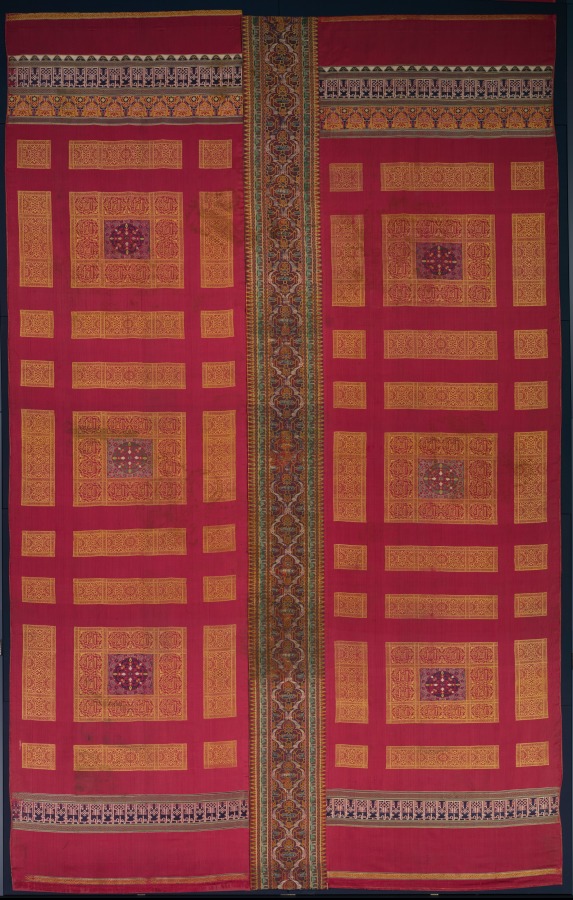
An Examination of a Specimen: The Alhambra Silk Curtain
One must approach the subject not as a mere fragment of drapery, but as a testament to a consummate industrial and artistic discipline. The artefact in question—a silk curtain from the Alhambra palace, circa the 14th century Nasrid period—serves as a definitive statement of power, piety, and peerless technical execution. Its materiality, silk, is the foundational premise of its authority. To understand this piece is to appreciate the legacy of imperial silk weaving, a global enterprise of the medieval age, where the loom was as potent a tool of statecraft as the sword, and the resulting textiles were the currency of prestige.
The Foundation: Imperial Sericulture & the Politics of Thread
The very presence of such a curtain in Granada speaks to a sophisticated, state-controlled supply chain. Silk was not simply a material; it was a geopolitical instrument. The cultivation of the mulberry tree, the rearing of the Bombyx mori silkworm, and the arduous reeling of the filaments represented a monumental capital investment and a closely guarded monopoly. From the imperial ateliers of Byzantium and the caliphates of Damascus and Baghdad, the knowledge migrated westward, finding its ultimate European expression in the tiraz factories of Islamic Iberia. The Alhambra, as the seat of the last Muslim kingdom in Spain, would have maintained its own royal workshop, or dar al-tiraz. Here, the raw silk—potentially imported, but increasingly sourced from local Andalusian sericulture—was transformed. The curtain before us, therefore, is the product of a vertically integrated operation, from leaf to loom, all under the crown’s direct supervision. This control ensured that the symbolism woven into the fabric was as officially sanctioned as the script on a coin.
Construction & Composition: A Grammar of Opulence
Analysing the cloth itself reveals a lexicon of advanced technique. The ground is likely a compound weave, perhaps a lampas or a samite, structures that allow for the intricate interplay of pattern and background, creating a depth of field that mere embroidery could not achieve. The density of the threads per square inch would have been exceptionally high, a measure of quality that directly correlates to expense and durability. The handle of the original piece would have been substantial, yet fluid—a drape of immense gravitas. The dyes are of particular note: the deep, resonant reds derived from kermes or cochineal, the blues from indigo, and the likely use of gold-wrapped thread (filé) for highlights. These were not mere colours; they were commodities, often more valuable by weight than the silk they adorned. Their permanence, resisting the centuries, speaks to the mastery of the dyer’s art, another specialised branch of the imperial textile complex.
The Narrative in the Weave: Iconography of a Dynasty
The pattern, though now faded, would have communicated with crystalline clarity. One expects to encounter the foundational vocabulary of Nasrid decorative art: the interlace of vegetal arabesques (ataurique), the precise, crystalline geometry of the strapwork (lacería), and the omnipresent cursive script—likely the thuluth style—bearing phrases such as “Wa la ghalib illa Allah” (“There is no conqueror but God”), the motto of the Nasrid sultanate. This is not decoration for decoration’s sake. This is a programmed visual environment, a fabric manifesto. The curtain served as a spatial delimiter, separating the sultan’s audience from his person. As one approached, the textile itself instructed, humbled, and asserted divine legitimacy. The repetition of pattern and praise created a hypnotic, awe-inspiring field, transforming architecture into a woven testament to a divinely ordained order. The silk, with its inherent luminosity, would have animated these patterns in the shifting light of the palace, making the very walls seem to breathe with sacred text.
Legacy & Connoisseurship: From the Alhambra to Savile Row
The legacy of this imperial weaving tradition is profound and, in certain respects, perennial. While the dar al-tiraz system faded, the principles it enshrined did not. The centralisation of quality, the integration of craft under patronage, and the understanding of cloth as a medium for the most sophisticated expression prefigure the very ethos of the later European court workshops and, indeed, the modern bespoke trade. One discerns a direct lineage in the value placed on integrity of material, perfection of technique, and the silent language of status. The Savile Row cutter understands, as the Nasrid master weaver did, that the true object is not merely the garment or the curtain, but the assurance it embodies. It is the assurance of provenance, of unassailable method, and of a beauty that arises from structural integrity rather than superficial application.
In conclusion, this Alhambra curtain stands as a peerless exemplar. It is the product of an empire’s full industrial and artistic might, deployed to create an object that was simultaneously functional, theological, and political. Its silk is more than a fibre; it is the canvas for a civilisation’s self-portrait. To study it is to acknowledge that the highest expressions of tailoring—whether for a palace window or a gentleman’s silhouette—are always, and inevitably, built upon such foundations of uncompromising materiality and intentional, articulate craft. The loom, in the right hands, is an instrument of sovereignty.