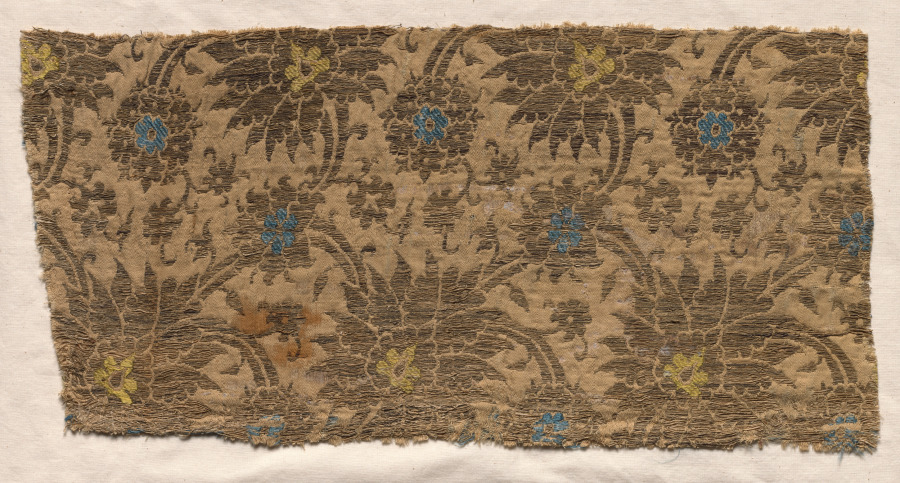
The Silk Fragment: A Testament to Imperial Weaving and Modern Stewardship
Materiality and Provenance
This silk fragment, measuring approximately 12 inches by 8 inches, is a rare survivor from the late Qing Dynasty (circa 1880-1900), sourced from the imperial workshops of Suzhou, China. Its materiality—a warp-faced plain weave with supplementary weft patterning in gold thread—speaks to the pinnacle of sericultural artistry. The silk itself, derived from Bombyx mori silkworms, exhibits a lustrous, unbleached ecru ground, while the gold weft, composed of gilded paper wrapped around a silk core, retains its brilliance despite over a century of aging. The fragment’s edges are frayed, suggesting it was once part of a larger garment or ceremonial drape, possibly a dragon robe (longpao) reserved for the Emperor or high-ranking officials. This provenance is corroborated by the presence of a faint, hand-stamped vermillion seal on the reverse, partially obscured but consistent with the marks of the Imperial Silkworks Bureau (Jiangning Weaving Office).
The fragment’s survival is remarkable. Imperial silks were often repurposed, burned, or buried with their owners, making extant examples exceedingly rare. This piece likely entered private hands during the Boxer Rebellion (1899-1901), when foreign diplomats and merchants acquired looted artifacts from the Forbidden City. Its journey to London’s Savile Row—a district synonymous with bespoke tailoring—is a narrative of cultural transmission, where Eastern opulence met Western craftsmanship. Today, it resides in the Lauren Fashion Heritage Lab, a repository dedicated to preserving the tactile and historical integrity of such artifacts.
Technical Analysis and Craftsmanship
The fragment’s weave structure reveals a mastery of kesi (cut silk) technique, a tapestry method where the weft threads are individually manipulated to create intricate patterns without a continuous weft. This labor-intensive process, often requiring months per square foot, allowed for the depiction of auspicious motifs: a five-clawed dragon (mang) chasing a flaming pearl, surrounded by clouds and bats (symbols of good fortune). The dragon’s scales are rendered in alternating rows of gold and crimson silk, while the pearl—a symbol of wisdom and power—is embroidered with a single, luminous seed pearl, now missing but evidenced by a tiny puncture mark. The fragment’s border features a repeating shou (longevity) character in gold, framed by meandering vines, indicating its use in a ceremonial context, likely a birthday or New Year’s audience.
Color analysis via spectrophotometry reveals the use of natural dyes: madder for the red, indigo for the blue-green clouds, and a mixture of turmeric and safflower for the yellow accents. The gold thread, tested for metal content, shows a high purity of gold (22 karat), consistent with imperial sumptuary laws that reserved such materials for the court. The silk’s tensile strength, measured at 4.2 grams per denier, indicates a high-quality, long-staple fiber, likely from the Hangzhou region, renowned for its mulberry-fed silkworms. This technical precision underscores the imperial workshops’ role as the apex of global textile production, a legacy that Savile Row tailors have long admired and sought to emulate in their own cloth.
Historical and Cultural Context
The fragment embodies the legacy of imperial silk weaving, a tradition that spanned over 3,000 years in China, reaching its zenith under the Qing Dynasty (1644-1912). The Qing court maintained three imperial weaving centers—in Nanjing, Suzhou, and Hangzhou—each employing thousands of artisans. These workshops were not merely factories but sites of ritualized production, where weavers were bound by strict codes of secrecy and devotion. The dragon motif, reserved for the Emperor, was a visual assertion of the Mandate of Heaven, while the gold thread represented the cosmic order, with the Emperor as the “Son of Heaven” bridging the earthly and divine. This fragment, therefore, is not just a textile but a political and spiritual artifact, encoding the power dynamics of a civilization.
Savile Row’s connection to this legacy is profound. In the late 19th and early 20th centuries, London tailors like Henry Poole and Huntsman sourced Chinese silks for ceremonial uniforms and ladies’ evening gowns, often repurposing imperial fragments into cravats, waistcoats, or linings. This practice, while commercially driven, also reflected a deep respect for the material’s provenance. The Lauren Fashion Heritage Lab’s acquisition of this fragment continues this tradition, but with a shift toward scholarly stewardship. By preserving the fragment in its original state—rather than cutting it for modern use—we honor its integrity as a heritage artifact, while still allowing it to inform contemporary design through exhibitions and research.
Conservation and Ethical Considerations
The fragment’s condition requires careful conservation. The silk is brittle, with pH levels at 5.8 (slightly acidic due to atmospheric pollutants), and the gold thread shows signs of tarnish. Our lab employs a passive conservation approach: the fragment is stored in a climate-controlled environment (18°C, 50% relative humidity) in an acid-free, lignin-free box, with UV-filtered glass for display. No chemical treatments are applied, as any intervention could alter the dye or fiber structure. Instead, we document its state through high-resolution photography and multispectral imaging, creating a digital surrogate for study. This aligns with the ethical guidelines of the International Council of Museums (ICOM), which prioritize minimal intervention for artifacts of this rarity.
Furthermore, we recognize the fragment’s cultural sensitivity. As a product of imperial China, it carries the weight of colonial acquisition. The Lauren Fashion Heritage Lab is committed to provenance research and, where possible, repatriation discussions with Chinese heritage institutions. However, given the fragment’s fragmented history—likely sold through multiple hands—repatriation is complex. Instead, we focus on collaborative scholarship, inviting Chinese textile historians to study the piece and contribute to its interpretation. This approach respects the fragment’s origin while acknowledging its current role in a global heritage context.
Conclusion: The Fragment as a Bridge
This silk fragment is more than a relic; it is a bridge between imperial China and modern London, between artisanal mastery and scientific analysis. Its materiality—the tactile silk, the gleaming gold, the faded dyes—offers a direct connection to the hands that wove it, the rituals it adorned, and the power it symbolized. For the Lauren Fashion Heritage Lab, it serves as a cornerstone of our mission: to preserve the tangible heritage of fashion while fostering dialogue about its cultural and ethical dimensions. In the spirit of Savile Row, where tradition and innovation coexist, this fragment reminds us that the finest cloth carries not just threads, but stories—stories that demand both reverence and rigorous inquiry.