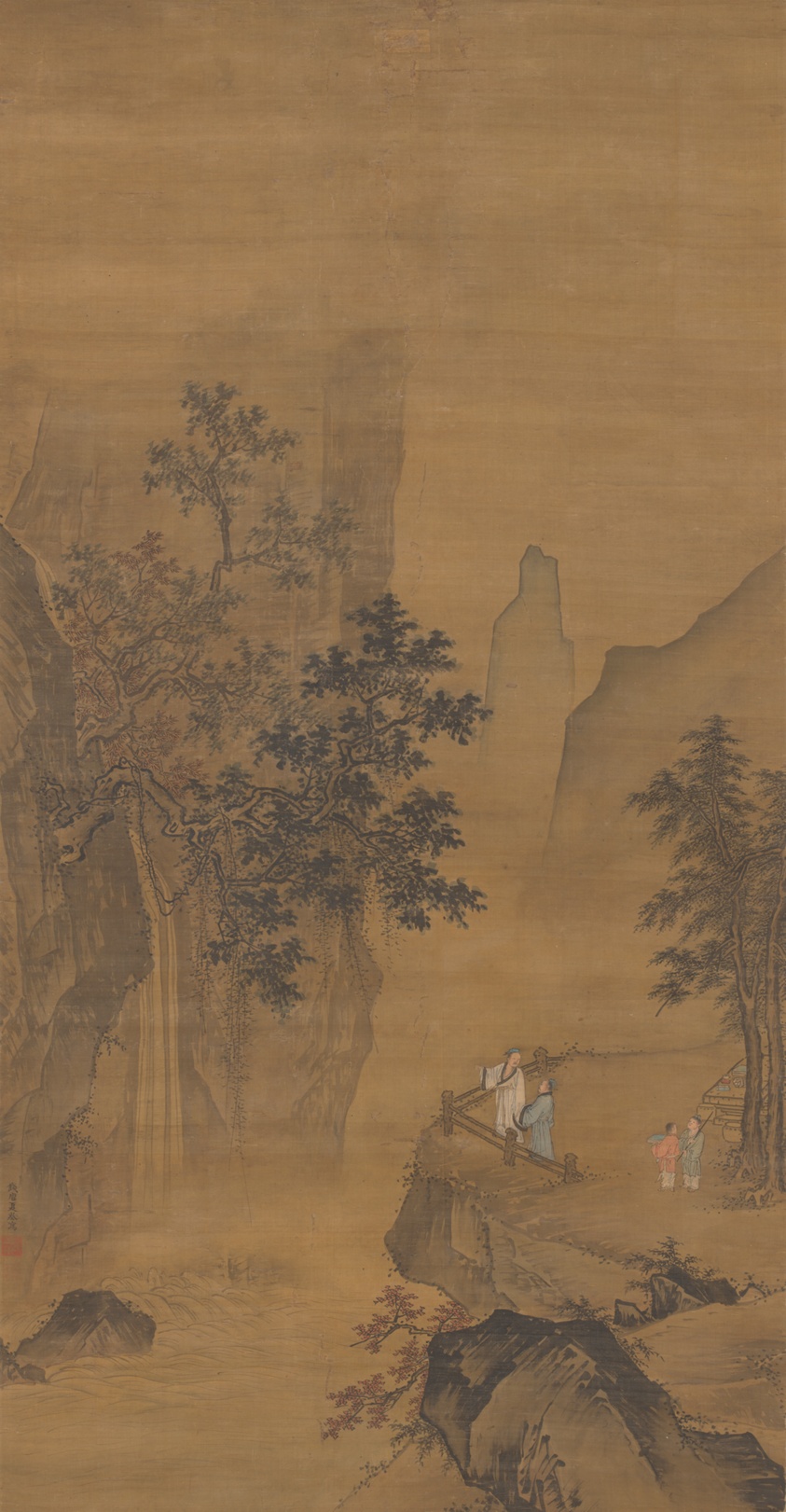
Watching the Waterfall: A Study in Materiality and Cultural Resonance
Introduction: The Silent Dialogue of Silk and Scene
In the hushed corridors of Lauren Fashion Heritage Lab, where the past whispers to the present through fabric and form, few artifacts command the reflective pause elicited by *Watching the Waterfall* (高士觀瀑圖). This hanging scroll, executed in ink and slight color on silk, is not merely a painting; it is a testament to the profound dialogue between materiality and meaning. As a Senior Heritage Specialist, I approach this piece not as a static relic but as a living document of craftsmanship, cultural philosophy, and the enduring elegance of silk. The scroll’s composition—a solitary scholar gazing upon a cascading waterfall—encapsulates a Taoist ideal of harmony with nature, yet its true narrative unfolds in the tensile strength, luminous surface, and fluid elegance of its silk substrate. This paper examines the artifact through the lens of materiality, contextualizing its craftsmanship within the broader traditions of Chinese silk production and its resonance with the sartorial philosophy of London’s Savile Row.
Materiality: The Silk Canvas as a Conduit of Expression
Silk, in the context of *Watching the Waterfall*, is far more than a passive support. It is an active participant in the visual and tactile experience. The scroll’s silk, likely a fine, plain-weave *juan* (絹) from the Ming or Qing dynasty, exhibits a characteristic density and smoothness that distinguishes it from later, coarser reproductions. The weaver’s hand is evident in the even tension of the warp and weft threads, creating a surface that absorbs ink with a unique, almost watercolor-like diffusion. This is not the crisp, opaque ground of paper; silk’s natural luster imparts a subtle glow to the ink washes, allowing the waterfall’s mist to appear ethereal, as if suspended in time. The slight color—perhaps mineral pigments of azurite or malachite—adheres to the silk’s fibers with a delicate permanence, their vibrancy tempered by the fabric’s translucency. In this, the materiality mirrors the philosophical content: the silk’s flexibility and resilience echo the scholar’s contemplative stillness, while its fragility reminds us of the ephemeral nature of both art and life.
The craftsmanship of this silk speaks to a lineage of Chinese textile expertise that dates back millennia. From the sericulture of the Yellow River valley to the intricate looms of Suzhou, silk was never merely a commodity; it was a symbol of refinement, a medium for the elite to encode their values. In *Watching the Waterfall*, the silk’s material properties—its ability to hold fine lines without bleeding, its resistance to cracking under the weight of layered washes—reflect a mastery honed over generations. The scroll’s mounting, a classic *shou juan* format with a silk brocade border, further underscores this heritage. The border’s subtle pattern, likely a cloud or dragon motif, frames the painting without competing, guiding the eye inward. This is not accidental; it is a deliberate choice that elevates the silk from a mere support to an integral element of the aesthetic experience.
Context: Classic Silk Craftsmanship and Fluid Elegance
The phrase “fluid elegance” is often invoked in describing Chinese scroll painting, but in *Watching the Waterfall*, it takes on a literal dimension. The silk’s weave allows the ink to flow in controlled yet organic patterns, mimicking the waterfall’s descent. The scholar’s robe, rendered in minimal lines, seems to ripple with the same fluidity as the cascading water, blurring the boundary between subject and environment. This fluidity is not merely visual; it is tactile. When handling the scroll—a practice reserved for connoisseurs and conservators—one feels the silk’s supple give, its ability to roll and unroll without creasing. This physical responsiveness is a hallmark of classic silk craftsmanship, where the fabric’s tensile strength is balanced with its softness. The scroll’s preservation, likely in a climate-controlled environment, testifies to the silk’s durability, yet its surface bears the patina of age—a subtle yellowing that adds warmth to the composition. This patina is not a flaw; it is a narrative of time, a reminder that the artifact has witnessed centuries of contemplation.
In the context of Lauren Fashion Heritage Lab, this artifact resonates with our mission to understand how materiality shapes cultural identity. The silk of *Watching the Waterfall* is a precursor to the luxurious fabrics that define Savile Row tailoring. Just as a bespoke suit from a Row house—say, a double-breasted flannel from Huntsman or a tweed from Anderson & Sheppard—relies on the drape, weight, and weave of its cloth, so too does this scroll rely on the silk’s intrinsic properties. The scholar’s robe, though painted, echoes the same principles of cut and flow that a Savile Row cutter would apply to a jacket: the fabric must move with the body, not against it. Here, the silk moves with the ink, creating a harmony that is both visual and philosophical. This parallel is not coincidental; it reflects a shared understanding that materiality is the foundation of elegance.
Cultural Resonance: The Scholar’s Gaze and the Modern Eye
The subject of *Watching the Waterfall*—a *gaoshi* (高士), or lofty scholar—is a recurring motif in Chinese literati painting. It represents the ideal of *xiao yao* (逍遙), or free and easy wandering, a concept rooted in Daoist philosophy. The scholar’s posture, seated or standing in quiet observation, embodies a rejection of worldly ambition in favor of spiritual communion with nature. The waterfall, a symbol of constant change and renewal, serves as a mirror for the scholar’s inner state. Yet, this scene is not merely allegorical; it is a practical guide for the cultured elite. To commission or own such a scroll was to assert one’s refinement, one’s ability to appreciate the subtle interplay of ink and silk. In this, the artifact functioned as a social marker, much like a bespoke Savile Row suit signals discernment and heritage.
For the modern viewer, particularly within the context of a fashion heritage lab, *Watching the Waterfall* offers a lesson in the value of slowness. In an era of fast fashion and digital reproduction, the scroll demands a different kind of attention. Its silk surface, with its slight irregularities and hand-painted lines, resists mass production. Each brushstroke is unique, each wash of color a decision made in the moment. This is the antithesis of the assembly line; it is craftsmanship as meditation. The Savile Row tailor, who spends hours on a single sleeve, would recognize this ethos. The scroll’s materiality—its silk, its ink, its mounting—is not just a vehicle for the image; it is the image. To ignore the silk is to miss the point entirely.
Conclusion: The Enduring Thread
*Watching the Waterfall* is a heritage artifact that transcends its physical form. It is a dialogue between the hand of the weaver and the hand of the painter, between the philosophy of the scholar and the materiality of silk. In the context of Lauren Fashion Heritage Lab, it stands as a reminder that elegance is never accidental; it is the result of meticulous craftsmanship, cultural knowledge, and a deep respect for materials. The scroll’s fluid elegance, born from classic silk craftsmanship, speaks to a timeless truth: that the finest art, like the finest tailoring, is rooted in the integrity of its fabric. As we preserve and study such artifacts, we honor not just the past, but the enduring thread that connects us to the artisans who wove, painted, and contemplated their world into being.