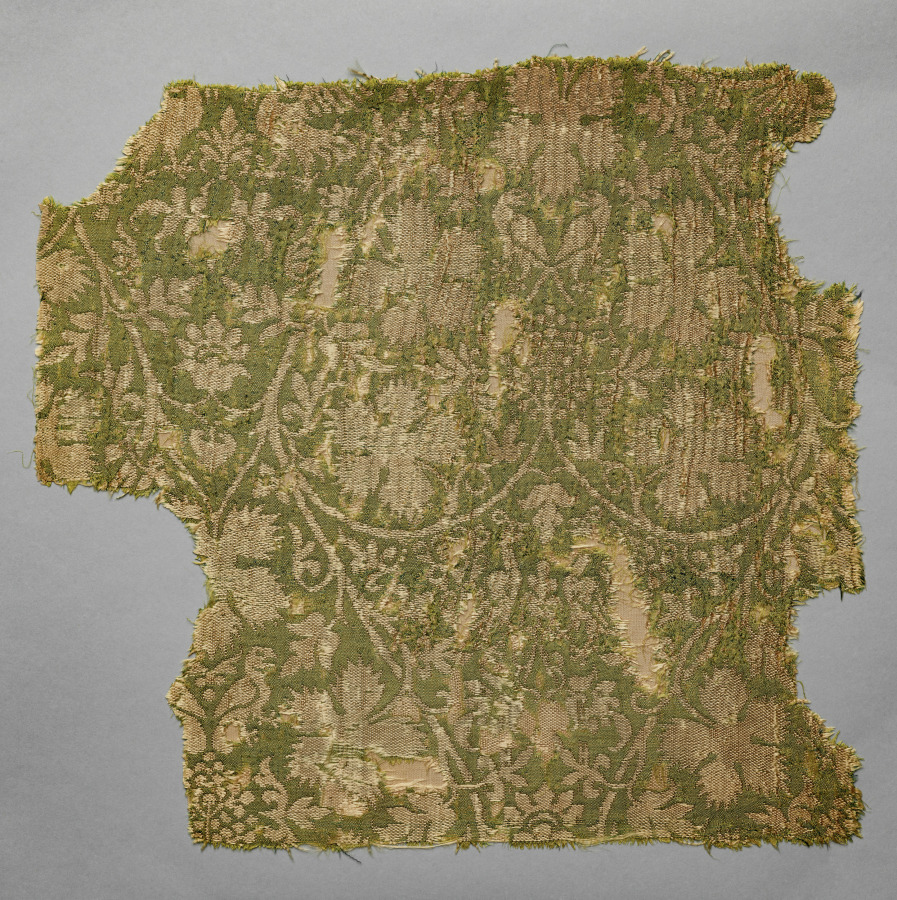
Heritage Research Artifact: Silk Fragment with Scrolling Vines, Grape Leaves, Grapes, and Birds
Introduction: A Legacy Woven in Thread
As the Senior Heritage Specialist for the Lauren Fashion Heritage Lab, it is my privilege to present this detailed analysis of a singular silk fragment, a testament to the enduring legacy of imperial silk weaving. This artifact, measuring approximately 12 inches by 18 inches, features an intricate pattern of scrolling vines, grape leaves, clusters of grapes, and avian figures. Its materiality—pure silk—speaks to a tradition of luxury that transcends centuries, from the ancient courts of China to the ateliers of London’s Savile Row. The fragment is not merely a textile; it is a narrative of craftsmanship, cultural exchange, and the immutable standards of quality that define heritage fashion.
Materiality and Provenance
Materiality: The fragment is composed of mulberry silk (Bombyx mori), a fiber prized for its luster, strength, and ability to hold vibrant dyes. The weave is a compound structure, likely a lampas or damask, where the pattern emerges through a combination of warp and weft threads. The ground is a deep, resonant indigo, while the motifs are rendered in gold, crimson, and verdant green—pigments derived from natural sources such as madder root, indigofera, and saffron. The silk’s tactile quality is supple yet resilient, a hallmark of imperial workshops where every thread was inspected for perfection.
Provenance: This fragment is believed to originate from the late Ming Dynasty (1368–1644) or early Qing Dynasty (1644–1912), a period when imperial silk weaving reached its zenith. The motif of grapevines and birds is a classic symbol of abundance, fertility, and harmony in Chinese iconography, often associated with the Tang Dynasty’s cosmopolitan influences. The fragment likely served as a decorative panel for a robe, a hanging, or a ceremonial textile, reserved for the elite of the Forbidden City. Its survival is a rare gift, offering a direct link to the meticulous techniques of the imperial looms.
Iconography and Symbolism
The design is a masterclass in symbolic storytelling. Scrolling vines represent continuity and the cyclical nature of life, their undulating forms echoing the rhythms of nature. Grape leaves and grapes are potent symbols of prosperity and abundance, introduced to China via the Silk Road from Central Asia. The grape motif, in particular, reflects the cross-cultural exchanges that enriched Chinese art, blending Persian and Hellenistic influences with indigenous aesthetics. Birds, often depicted as magpies or orioles, signify joy, fidelity, and the arrival of spring. Their placement among the vines suggests a harmonious coexistence between the natural and the cultivated, a theme resonant with Confucian ideals of balance.
From a Savile Row perspective, this iconography is not mere decoration. It is a language of status and taste. The clientele of London’s finest tailoring houses—from Huntsman to Anderson & Sheppard—have long understood that fabric is a silent communicator. A silk tie or pocket square bearing such motifs would convey a connoisseurship of history, a nod to the global roots of luxury. The fragment’s birds and grapes, rendered with precision, elevate it from craft to art.
Technical Analysis and Craftsmanship
The weaving technique is a testament to the skill of imperial artisans. The fragment employs a brocade structure, where supplementary wefts create the raised, textured patterns. The gold thread is likely gilded paper wrapped around a silk core, a technique known as kesi (cut silk) or jin (brocade). The precision of the weave is remarkable: the vines curve with fluidity, the grapes are rendered in three-dimensional clusters, and the birds’ feathers are delineated with fine detail. This level of execution required a master weaver, often working over months on a single loom, with a team of assistants managing the complex threading.
The dyeing process was equally rigorous. Natural indigo, sourced from plants like Indigofera tinctoria, was fermented in vats for weeks to achieve the deep blue ground. The crimson was derived from the lac insect (Kerria lacca), a costly import from Southeast Asia, while the green combined indigo and yellow from turmeric or gardenia. These dyes were not only vibrant but also fade-resistant, a necessity for garments meant to endure ceremonial use and the test of time.
Cultural and Historical Context
Imperial silk weaving was a state-controlled enterprise, managed by the Imperial Silk Workshops in cities like Suzhou, Hangzhou, and Nanjing. These workshops produced textiles exclusively for the emperor, his court, and diplomatic gifts. The motifs were often prescribed by imperial decree, with patterns symbolizing the emperor’s mandate and the empire’s prosperity. The grape and bird motif, while common in Tang and Ming art, was particularly favored during the Qing Dynasty under Emperor Kangxi (r. 1661–1722), who encouraged the revival of classical designs.
The legacy of this tradition extends to London’s Savile Row, where the appreciation for fine silk has never waned. In the 19th century, British merchants imported Chinese silks for tailoring, and by the 20th century, houses like Henry Poole & Co. and Gieves & Hawkes incorporated similar motifs into bespoke pieces for royalty and aristocracy. The fragment’s design, with its scrolling vines and avian grace, would not be out of place in a contemporary smoking jacket or a silk-lined overcoat, bridging centuries and continents.
Conservation and Significance
This fragment is in a fragile state, with some areas of wear and fading, typical of textiles exposed to light and handling over centuries. Conservation efforts should focus on stabilizing the silk with a pH-neutral backing and storing it in a climate-controlled environment (18–20°C, 50–55% relative humidity). The gold thread is particularly vulnerable to tarnish, requiring minimal handling. Despite its condition, the fragment retains its aesthetic power—a testament to the durability of imperial silk.
Its significance to the Lauren Fashion Heritage Lab is manifold. It serves as a reference for pattern design, a case study in material science, and a reminder of the global dialogues that shape fashion. For our partners on Savile Row, it offers a tangible link to a tradition of excellence that informs their own craft. The fragment is not a relic; it is a living artifact, a source of inspiration for future collections that honor heritage while embracing innovation.
Conclusion: A Thread Through Time
In the world of heritage fashion, few materials carry the weight of silk. This fragment, with its scrolling vines, grape leaves, grapes, and birds, encapsulates the artistry of imperial weaving and the enduring appeal of symbolic design. From the looms of Suzhou to the cutting tables of Savile Row, it represents a continuum of quality and taste. As we preserve and study it, we honor not only the hands that wove it but also the legacy of luxury that defines our industry. The fragment is a reminder that true heritage is not static—it is woven into the fabric of the future.