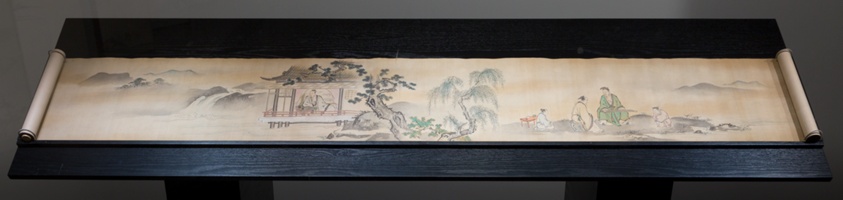
An Examination of Refinement: The Four Accomplishments as a Benchmark of Discretion
In the considered appraisal of a gentleman’s cultivation, one must look beyond the mere cut of his cloth to the substance of his character. The canvas, as it were, upon which this substance is most subtly expressed has long been silk. Not the garish, ostentatious silks of mere display, but those of a profound and quiet legacy—a material whispering of ancient trade routes, of meticulous handwork, and of a sensibility that values depth over immediacy. It is upon this most venerable of grounds that we encounter the subject of our study: the scholarly motif of The Four Accomplishments. Executed in ink and colours on silk, this artifact represents not merely a decorative scene, but the very codification of an elegant mind.
The Ground: Silk as the Unspoken Arbiter of Taste
Before one can appreciate the painting, one must understand the fibre. Silk, in its highest form, is the ultimate expression of material integrity. Its acquisition—from the precise cultivation of the mulberry grove to the patient unwinding of the cocoon—speaks of a process that cannot be rushed, a natural chronology that demands respect. The resulting ground possesses a luminosity, a tensile strength, and a receptivity to pigment that no lesser material can counterfeit. To commission a work upon silk is to make a silent but unequivocal statement: that the subject matter is worthy of permanence, of a clarity that will endure. The slight, deliberate resistance of the silk to the brushstroke ensures that each line, each wash of colour, is applied with a certainty of purpose. There is no room for indecision here; the medium tolerates no clumsiness.
The Motif: A Curriculum of Civilised Comportment
The Four Accomplishments—qin (the guqin, or lute), qi (the game of strategy, Go), shu (calligraphy), and hua (painting)—constitute a quartet of pursuits far removed from the vulgarities of commerce or the brute application of force. They are the instruments of inner cultivation. In our artifact, they are depicted not as static symbols, but as active engagements within a scholar’s retreat, likely nestled amidst a landscape of refined austerity.
The rendering of the guqin is a study in auditory suggestion. The artist’s command of line must convey the instrument’s elegant curvature, the taut promise of its strings. This is not a device for public performance, but for private communion—a dialogue between the player and a universe of subtle resonance. The depiction of Go is an exercise in strategic implication. A mere handful of stones placed upon the board’s grid suggests a contest of profound intellectual depth, a battle of wits conducted in utter silence, where territory is gained not through aggression, but through foresight and patience.
Most telling, however, are the twin arts of the hand: calligraphy and painting. Here, the materiality of the artifact and its subject become one. The same inks and mineral pigments used to depict the scholar at his desk are those with which he practices his craft. The brushwork that paints him must itself exemplify the very virtues it portrays: bone structure, rhythmic vitality, and essential spirit. A poorly painted scroll in the image would betray the entire conceit. Thus, the artifact performs a double duty: it is both an illustration of refinement and a concrete demonstration of it.
Fluid Elegance: The Synthesis of Medium and Message
The directive of “fluid elegance” is not a mere stylistic preference; it is the operational principle of both the craftsman and the scholar-gentleman he depicts. In the silk painting, elegance arises from restraint—from the sparing use of colour against the vast, meaningful emptiness of the silk ground. The fluidity is found in the uninterrupted, confident line that describes a robe’s drapery or the gnarled branch of a scholar’s rockery. This is a visual language that rejects the superfluous.
Consider the application of colour. It is never flat, never merely decorative. A robe of azurite blue is modulated with washes to suggest the fall of light and the form beneath. The faintest hint of vermilion on a scholar’s seal is a calculated accent, a punctuation mark of personal authority. This is colour with a purpose, applied with the same strategic intent as a move in Go. The silk, with its slight tooth and absorbency, allows these pigments to settle with a soft brilliance, locking them into the very fibres, ensuring the work’s longevity—much as the practice of the Accomplishments secures the legacy of the mind.
Conclusion: A Legacy Woven in Thread and Thought
This research artifact, therefore, stands as a definitive statement. It is a confluence of supreme materiality, timeless iconography, and masterful execution. The silk is its foundation: a testament to patience and natural order. The Four Accomplishments are its thesis: a manifesto for a life devoted to cultivated intelligence and serene self-mastery. The fluid elegance of its rendering is the proof of its argument.
To possess such an object—or indeed, to understand its nuances—is to align oneself with a heritage that values the quiet authority of knowledge over the transient noise of fashion. It is the sartorial equivalent of a bespoke suit from Savile Row: understated, impeccably constructed from the finest materials, and speaking in a quiet tone that is only audible to those educated to hear it. In the end, both the silk painting and the tailored garment serve the same purpose: they are the armour of the discerning individual, crafted not for war, but for civilisation.