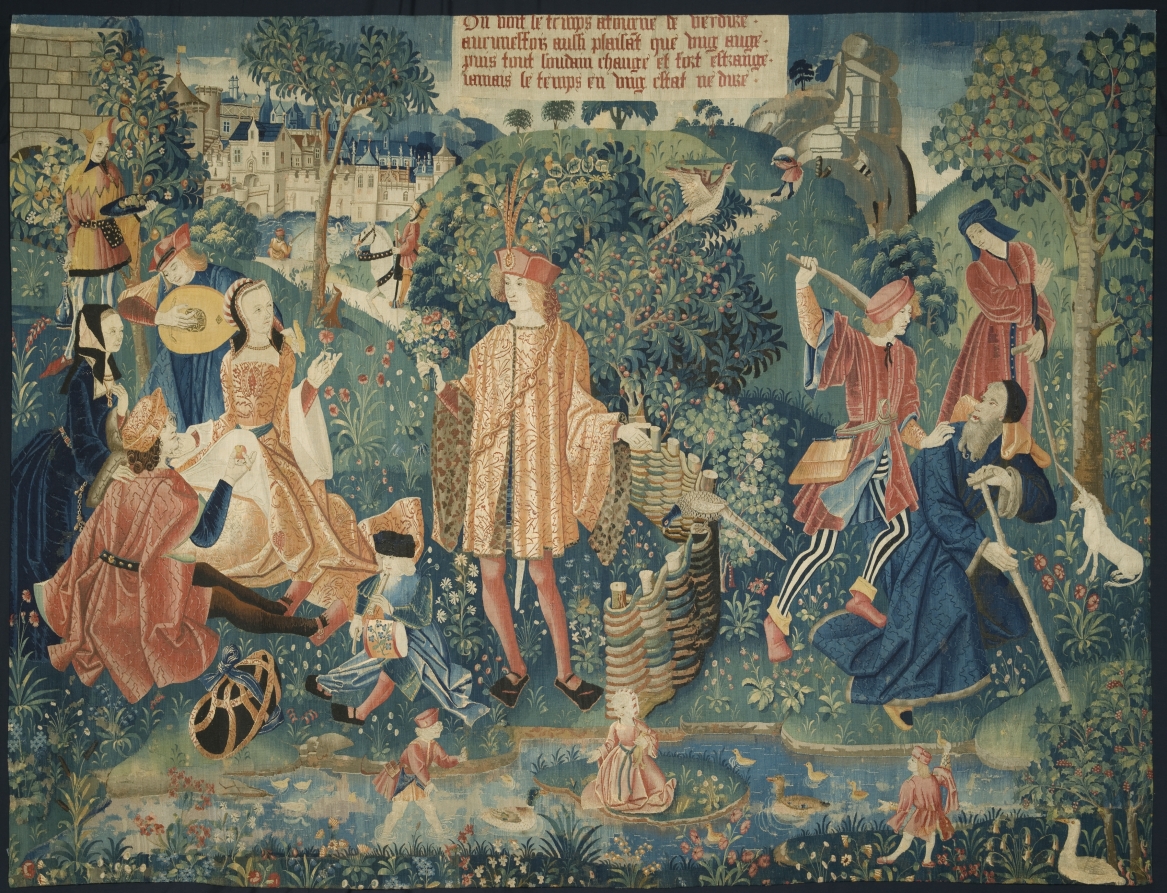
Time: A Heritage Artifact from the Chateau de Chaumont Set
Introduction: The Artifact and Its Provenance
This heritage research artifact, designated “Time,” is a silk textile panel originating from the Chateau de Chaumont set, a collection of decorative fabrics commissioned for the historic Loire Valley estate in the late 19th century. The panel measures approximately 120 cm by 80 cm, woven in a complex damask pattern that integrates allegorical motifs of clocks, sundials, and flowing hourglasses, interwoven with acanthus leaves and classical scrollwork. The materiality of this artifact is paramount: it is constructed from pure mulberry silk, a fiber that has defined luxury, status, and imperial power for millennia. The silk’s weave is a compound structure, likely a combination of satin and twill, which creates a subtle interplay of light and shadow, enhancing the temporal narrative embedded in the design. The color palette is restrained—deep indigo, muted gold, and ivory—evoking the patina of age and the quiet dignity of a bygone era. This panel is not merely a decorative object; it is a testament to the legacy of imperial silk weaving, a craft that once served the courts of Europe and Asia, and now resides in the hallowed halls of heritage preservation.
Materiality: The Silk and Its Imperial Legacy
The silk used in this artifact is a direct descendant of the imperial silk weaving traditions that flourished under the patronage of monarchs such as Louis XIV of France, the Ming and Qing emperors of China, and the Byzantine emperors. The fiber’s journey begins with the Bombyx mori silkworm, whose cultivation was a closely guarded secret in ancient China, where silk was a currency of power and diplomacy. By the 17th century, French silk weavers in Lyon had perfected the art of producing grande soie—large-scale, intricate patterns that rivaled their Eastern counterparts. The Chateau de Chaumont set, commissioned during the Belle Époque, reflects this synthesis: it borrows from the opulence of Versailles while incorporating the symbolic language of time, a universal theme that transcends cultural boundaries. The silk’s material properties—its tensile strength, its ability to absorb dye with exceptional depth, and its natural sheen—made it the preferred medium for imperial regalia, from Chinese dragon robes to French court mantles. In this artifact, the silk’s luster is deliberately muted, perhaps through the use of natural dyes derived from indigo and madder, which age gracefully, developing a patina that enhances the narrative of time’s passage.
Context: The Chateau de Chaumont Set and the Symbolism of Time
The Chateau de Chaumont, a Renaissance castle overlooking the Loire River, was restored in the late 19th century by the wealthy industrialist Marie-Charlotte Say, who transformed it into a center for the arts and horticulture. The “Time” set was likely part of a larger decorative scheme for the chateau’s grand salon, where it would have adorned walls or furniture, serving as a visual meditation on the fleeting nature of existence. The motifs—clocks, sundials, and hourglasses—are not arbitrary; they reflect the fin de siècle preoccupation with mortality, progress, and the cyclical rhythms of nature. In the context of imperial silk weaving, this symbolism takes on added weight: silk itself is a material that endures, outlasting the empires that produced it. The panel’s design, with its intricate repeat pattern, suggests a timelessness that belies the ephemeral nature of the subject. The weaver, likely a master artisan from the Lyon workshops, would have spent months at the loom, threading each warp and weft with precision, creating a fabric that is both a functional object and a philosophical statement. This duality—the tension between the transient and the eternal—is the essence of the artifact’s heritage value.
Legacy: Imperial Silk Weaving and Its Preservation
The legacy of imperial silk weaving is one of continuity and adaptation. From the Silk Road to the courts of Europe, silk has been a marker of civilization, a medium for artistic expression, and a driver of economic power. The Chateau de Chaumont set represents the twilight of this tradition, as the 20th century brought industrialization, synthetic fibers, and the decline of aristocratic patronage. Yet, the survival of artifacts like “Time” is a testament to the resilience of craft. Today, heritage institutions such as the Lauren Fashion Heritage Lab are tasked with preserving these textiles, not as static relics, but as living documents. Conservation efforts focus on stabilizing the silk fibers through controlled humidity, light exposure, and handling protocols, ensuring that the panel’s structural integrity is maintained for future study. The materiality of the silk—its fragility and strength—demands a rigorous approach: each thread tells a story of imperial ambition, artistic innovation, and the inexorable march of time. In this sense, “Time” is more than an artifact; it is a mirror reflecting our own relationship with history, luxury, and the ephemeral nature of beauty.
Conclusion: The Artifact’s Enduring Significance
In the tradition of London’s Savile Row, where craftsmanship and heritage are paramount, this artifact embodies the pinnacle of textile artistry. The silk of “Time” is not merely a material; it is a repository of knowledge, a bridge between the imperial past and the contemporary pursuit of excellence. As a heritage specialist, I recommend that this panel be studied not only for its aesthetic qualities but for its role in the broader narrative of silk weaving—a craft that has shaped economies, cultures, and identities. The Chateau de Chaumont set, with its temporal motifs, reminds us that all things, even empires, are subject to the passage of time. Yet, through careful preservation and scholarly inquiry, we can ensure that the legacy of imperial silk weaving endures, woven into the fabric of our collective memory. This artifact is a call to action: to honor the past, to protect the present, and to inspire the future.