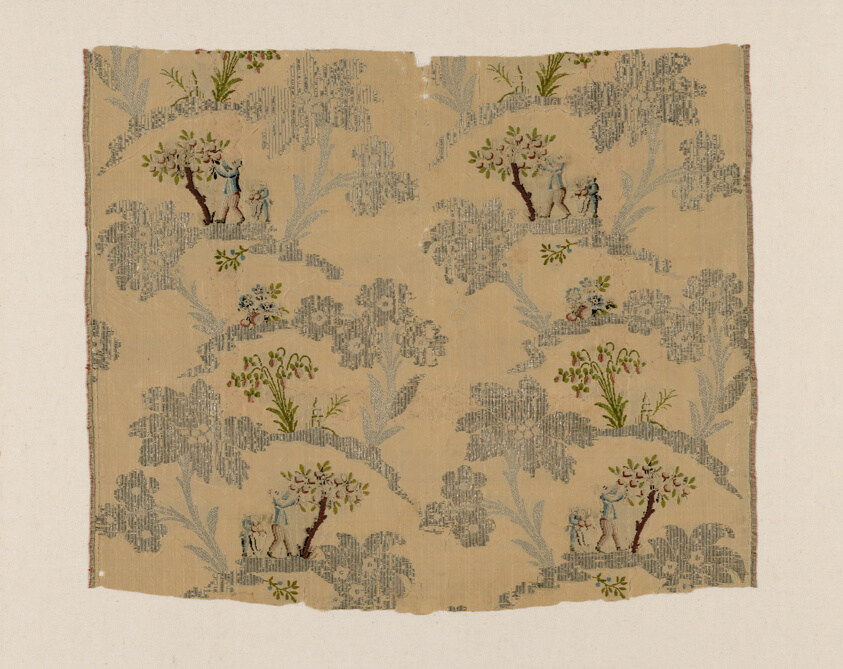
The Fragment as a Testament to Craft: Deconstructing a Silk, Silver, and Weave Artifact
Introduction: The Materiality of Memory
In the hushed, bespoke corridors of London’s Savile Row, where the whisper of shears and the weight of a bolt of cloth are the only currencies of consequence, a fragment is never merely a remnant. It is a concentrated archive. The artifact under examination—a piece of silk, silvered-metal strips, and silvered-metal-strip-wrapped silk, executed in a weft-rib plain weave with supplementary brocading wefts and patterning wefts—is not a scrap. It is a microcosm of a lost era of textile opulence, a tangible echo of the fluid elegance that defined the highest echelons of classic silk craftsmanship. This paper will deconstruct this fragment, not as a broken piece, but as a complete statement of heritage, technique, and aesthetic philosophy.
I. The Foundation: Silk and the Savile Row Ethos
Silk, in the context of heritage tailoring, is the quintessential material of ceremony and prestige. Unlike the robust worsteds and tweeds of daily wear, silk signifies a departure into the extraordinary. The base of this fragment—a weft-rib plain weave—is deceptively simple. The weft-rib structure, created by using a heavier or more frequent weft than warp, provides a subtle, horizontal texture. This is not a fabric that shouts; it whispers. It offers a ground of quiet, structural integrity upon which the more dramatic elements are built. The choice of a plain weave base, rather than a more complex satin or twill, is a deliberate act of restraint. It ensures that the fluid elegance of the final piece is not compromised by a heavy, rigid foundation. The silk itself, likely a high-twist filament, would have possessed a natural, liquid drape—a quality that Savile Row cutters prize for garments that move with the wearer, not against them.
II. The Metallic Intervention: Silvered-Metal Strips and Wrapped Yarns
The true mastery of this fragment lies in its metallic components: silvered-metal strips and silvered-metal-strip-wrapped silk. The use of silvered metal—a thin layer of silver applied to a base metal, often copper or a copper alloy—is a hallmark of high-status textile production from the 18th and 19th centuries. The silvered-metal strips are flat, ribbon-like elements that are introduced as supplementary brocading wefts. They do not interlace with the ground weave but float on the surface, creating areas of reflective, metallic pattern. This is a technique of immense precision; the weaver must control the tension of these stiff, unforgiving strips to avoid kinking or breaking, which would ruin the fabric’s integrity.
More sophisticated still is the silvered-metal-strip-wrapped silk. Here, a core of fine silk filament is tightly spiraled with a silvered-metal strip. This creates a yarn that combines the tensile strength and softness of silk with the lustre and weight of metal. This wrapped yarn is used as a patterning weft, allowing for intricate, curvilinear designs that would be impossible with a flat strip alone. The wrapped yarn can be manipulated into tight curves and delicate loops, giving the fabric a three-dimensional, almost embroidered quality. The combination of flat strips and wrapped yarns creates a dynamic interplay of light: the flat strips catch the light in broad, even flashes, while the wrapped yarns scatter it in a shimmering, granular texture. This is not a static decoration; it is a living surface that changes with every movement of the wearer.
III. The Weave Architecture: Brocading and Patterning Wefts
The technical specification—supplementary brocading wefts and patterning wefts—reveals the layered complexity of the weave. A supplementary brocading weft is an extra weft that is introduced only in specific areas to create a pattern, while the ground weave continues uninterrupted. This is the technique that allows for the metallic strips to appear only where desired, creating a design that is both integrated and distinct. The patterning wefts, often of the silvered-metal-wrapped silk, are used to build the motifs—perhaps floral arabesques, geometric medallions, or stylized foliage—that are characteristic of classic silk craftsmanship. The weaver must manage multiple shuttles simultaneously, each carrying a different material, and coordinate their insertion with the ground weft. This is a process of extreme mental and physical discipline, a dance of hands and eyes that has been honed over generations.
The weft-rib plain weave base provides the necessary stability for this complex brocading. The ribs, created by the heavier weft, act as a subtle grid that helps to anchor the supplementary wefts and prevent them from shifting. The result is a fabric that is structurally sound, yet visually and tactilely rich. The fragment, in its surviving state, likely shows areas where the metallic strips have tarnished or the silk has faded, revealing the underlying structure. These signs of age are not flaws; they are the patina of history, a testament to the material’s journey through time.
IV. Fluid Elegance: The Aesthetic of Movement
The term fluid elegance is not a mere description; it is a technical requirement. A fabric of this weight and metallic content could easily become stiff and cumbersome. The genius of the design is that the ground weave of silk provides the necessary drape, while the metallic elements are applied with a lightness of hand. The supplementary brocading wefts are not densely packed; they are spaced to allow the silk ground to breathe and move. The silvered-metal-wrapped silk, despite its metallic core, retains a degree of flexibility because of the silk core. When the fabric is suspended, it falls in soft, undulating folds, with the metallic patterns catching the light in a continuous, flowing rhythm. This is the hallmark of classic silk craftsmanship: the ability to marry the rigid and the supple, the precious and the practical, into a single, harmonious whole.
Conclusion: The Fragment as a Living Document
This fragment of silk, silvered-metal strips, and wrapped yarns is far more than a broken piece of cloth. It is a document of a lost language of luxury, a testament to the weaver’s art, and a physical embodiment of an aesthetic that prized both opulence and grace. For the heritage specialist, it offers a lesson in the power of materiality: the way a single weave structure can dictate the movement of a garment, the way a metallic strip can capture light and time, and the way a fragment, properly understood, can speak volumes about the culture that produced it. In the world of Savile Row, where every stitch is a decision, this fragment stands as a reminder that true elegance is not in the whole, but in the perfect execution of every part.