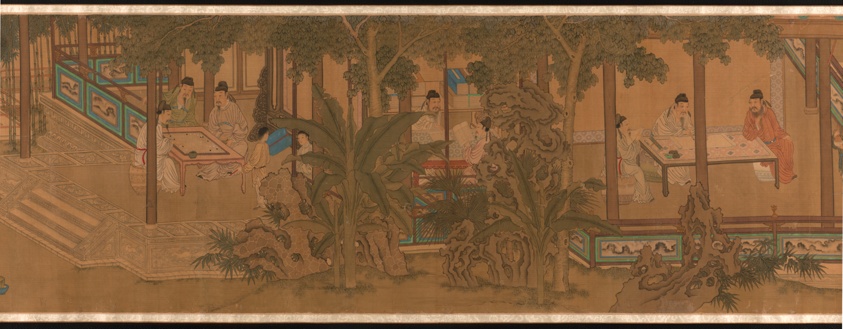
The Four Accomplishments: A Heritage Artifact of Silk and Scholarly Virtue
Introduction: The Convergence of Craft and Philosophy
Within the hallowed corridors of the Lauren Fashion Heritage Lab, we examine not merely garments, but the very fabric of cultural identity. The artifact before us—a handscroll executed in ink and color on silk, depicting the Four Accomplishments (qin, qi, shu, hua: the zither, chess, calligraphy, and painting)—represents a pinnacle of classical Chinese scholarly refinement. Yet, its materiality speaks a universal language of luxury and legacy. This is not an object of passive observation; it is a testament to the disciplined hand, the cultivated mind, and the enduring dialogue between artisan and aristocrat. In the spirit of London’s Savile Row, where bespoke tailoring elevates cloth into character, we must understand this handscroll as a bespoke expression of intellectual and aesthetic mastery, rendered on the most demanding of substrates: silk.
Materiality: Silk as the Canvas of Civilization
Silk is the foundational protagonist of this narrative. Unlike paper, which absorbs ink with a porous immediacy, silk presents a surface of luminous resistance. The handscroll format—a continuous, horizontal roll—demands a fluidity of composition that mirrors the unspooling of a narrative. The artisan who painted this work understood that silk’s warp and weft are not neutral; they are active participants. The ink must be applied with a precision that respects the fabric’s lustrous sheen, never overwhelming it, but rather allowing the color to breathe within the weave. This is analogous to the Savile Row cutter who selects a bolt of worsted wool, knowing its drape will define the suit’s silhouette. Here, the silk’s fluid elegance is not decorative; it is structural. The subtle gradations of ink—from the deep, contemplative black of calligraphic strokes to the soft, mineral hues of landscape—are achieved through a mastery of brush pressure and moisture, a technique that would be impossible on a less forgiving ground.
The Four Accomplishments: A Code of Conduct for the Cultured Man
The iconography of the Four Accomplishments is not mere decoration; it is a curriculum vitae of the soul. Each element—the zither (qin), the game of Go (qi), calligraphy (shu), and painting (hua)—represents a discipline that cultivates patience, strategy, and aesthetic sensitivity. In the context of a handscroll, these pursuits are depicted as a sequential journey, inviting the viewer to unroll the scroll and walk alongside the scholar. The zither, often shown in a pavilion, symbolizes harmony with nature; the chessboard, with its black and white stones, represents the balance of opposing forces; calligraphy is the physical manifestation of thought; painting is the capture of the ephemeral world. This is not unlike the ethos of a bespoke tailor, for whom each garment is a composition of proportions, fabrics, and stitches that must harmonize with the wearer’s form and character. The scholar who commissions such a scroll is commissioning a portrait of his own aspirations—a bespoke identity rendered in silk and ink.
Savile Row Parallels: The Tailoring of a Masterpiece
To a London-trained eye, the handscroll’s construction reveals a rigorous attention to detail that would be familiar to any master tailor on Savile Row. The silk is not simply a sheet; it is a composite of multiple panels, joined with invisible seams that allow the scroll to roll and unroll without distortion. The mounting—the backing paper, the protective silk borders, the jade roller ends—is a system of engineering as precise as a jacket’s canvas interfacing. The fluid elegance of the painted figures, their robes draping in controlled folds, echoes the drape of a well-cut overcoat. The calligraphy, often executed by a different hand than the painting, is akin to the embroidered monogram on a shirt cuff—a signature of the patron’s identity. The entire object is a collaboration between painter, calligrapher, mounter, and patron, much like the collaboration between tailor, cutter, finisher, and client. The result is not a commodity; it is a bespoke artifact, imbued with the heritage of its makers and the virtue of its owner.
Heritage and the Modern Gaze
In the Lauren Fashion Heritage Lab, we do not preserve these artifacts as relics. We study them as living documents of material culture. The Four Accomplishments handscroll speaks to a timeless truth: that luxury is not about opulence, but about intention. The silk, the ink, the composition—all are chosen with a discipline that reflects the scholar’s inner cultivation. This is the same discipline that defines a Savile Row suit: the choice of a 16-ounce worsted over a 9-ounce, the decision to hand-stitch a lapel, the patience to let a garment settle over three fittings. The handscroll, like the suit, is a heritage artifact that bridges past and present, reminding us that the most enduring expressions of culture are those that honor both craft and concept.
Conclusion: The Unrolling Continuum
As we unroll this handscroll, we are not merely viewing a painting; we are participating in a ritual of revelation. The Four Accomplishments are not static achievements; they are practices that require constant refinement. The silk, with its inherent fragility, demands care and respect. In this, the artifact mirrors the human condition: we are all works in progress, composed of materials and choices that define our legacy. For the Lauren Fashion Heritage Lab, this handscroll is a masterclass in the marriage of materiality and meaning. It teaches us that true elegance is never accidental; it is the result of disciplined hands, cultivated minds, and a profound respect for the heritage that shapes us. And in that, it is as relevant to a London tailor as it is to a Chinese scholar—a testament to the universal language of craft and virtue.