Material Genealogy and Structural Rhetoric: A Silk Deconstruction for the Lauren Fashion Heritage Lab
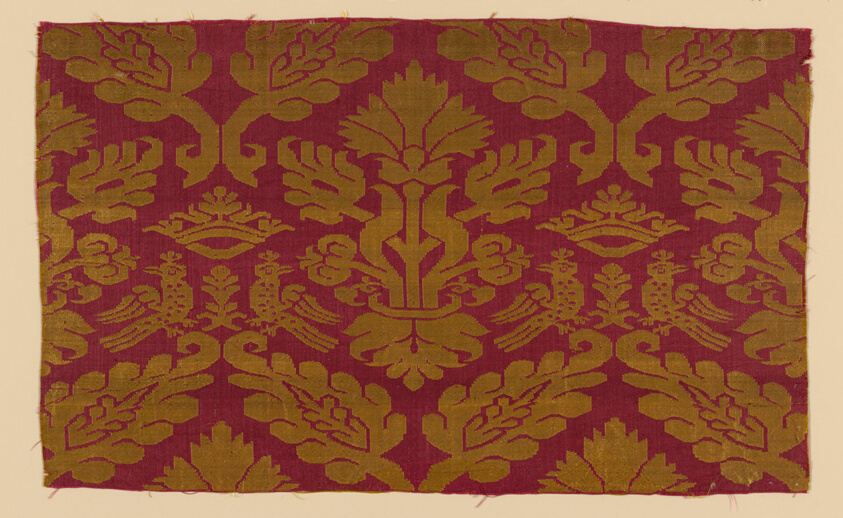
The Lauren Fashion Heritage Lab operates on a fundamental principle: that the future of sartorial elegance is not invented, but decoded. It resides in the material intelligence of the archive, in the silent rhetoric woven into the very structure of historical textiles. Our examination of the provided 16th-century silk fragment—a plain weave foundation augmented by secondary binding warps and supplementary patterning wefts—is not merely an exercise in textile archaeology. It is the extraction of a genetic code for authority, one that directly informs the philosophical and physical construction of the projected 2026 ‘Old Money’ silhouette. This analysis proceeds through the Liru Mother Archive’s tripartite lens of Color, Composition, and Design Philosophy, translating historical materiality into contemporary sartorial language.
Structural Deconstruction: The Architecture of Restraint
The described structure is one of hierarchical complexity masquerading as simplicity. The plain weave ground represents the foundational virtue: an unwavering, stable, and durable substrate. It is the sartorial equivalent of a Savile Row canvas, providing an impeccable, quiet background against which narrative unfolds. The secondary binding warps introduce a covert reinforcement, a hidden armature that consolidates the fabric’s integrity without announcing its presence. This is the engineering of longevity, the unseen diligence that guarantees form.
The true discursive element, however, lies in the supplementary patterning wefts. Unlike continuous brocades or embroideries applied atop the surface, these wefts are integrated yet discretionary. They lie atop the ground weave only where required by the pattern, remaining absent elsewhere. This technique creates a design that is inherent rather than applied, emerging from within the fabric’s matrix. The pattern possesses texture and a subtle, tonal relief, but it avoids ostentation. It is declaration through implication, not proclamation. The aesthetic result is one of depth, not dazzle; of substance, not sheen.
The 2026 ‘Old Money’ Silhouette: A Translation of Structural Virtues
The 2026 ‘Old Money’ silhouette, as decoded from this fragment, rejects fleeting theatrics in favor of enduring presence. It is an ethos of non-negotiable integrity and whispered distinction.
1. Silhouette as Plain Weave Ground: The foundational shape will be characterized by its architectural purity and timeless proportion. Think of the unwavering line of a single-breasted peak lapel blazer, the definitive drape of a wool-gabarine trench coat, or the columnar elegance of a bias-cut dress. The silhouette itself is the plain weave—clean, strong, and fundamentally correct. It derives its power from precision of cut and the intrinsic quality of its primary material (luxury woolens, fine cottons, substantial silks), mirroring the ground fabric’s unshakable role.
2. Construction as Secondary Binding Warps: The hidden armature of the historical textile translates directly to the forgotten rigors of tailoring. This is the domain of hand-padded lapels that roll with organic grace, of sleeve heads set with precise ease to allow for elegant movement, of interior canvassing that molds to the body over time rather than constricting it. These are the “secondary binding warps” of the garment—unseen by the external eye but fundamentally responsible for its comportment, durability, and subtle interaction with the wearer’s form. They build the silent confidence of impeccable fit.
3. Detailing as Supplementary Patterning Wefts: Here lies the core of the ‘Old Money’ expression. Ornamentation, following the logic of the supplementary weft, must be structural, intrinsic, and selectively deployed. This manifests not as applied logos or overt decoration, but as: the specific pick-stitching on a placket, the custom weave of a jacquard lining that echoes a family crest in abstract form, the deliberate use of a rare, matte silk barathea for a lapel facing. The “pattern” is in the proprietary button, the self-fabric belt, the subtle texture of a cloth woven exclusively for Lauren. Like the historical wefts, these elements are integral to the garment’s composition, offering discovery upon closer inspection. They signify a deep, inherited knowledge of craft—a wealth of taste, not just of capital.
Philosophical Synthesis: From Relic to Relevance
This deconstruction reveals a design philosophy perfectly aligned with the projected 2026 sensibility. In an era of digital noise and sustainable anxiety, the ‘Old Money’ silhouette, as defined by this silk genome, offers a sanctuary of material truth and temporal transcendence. It champions the beauty of longevity, the narrative of craftsmanship, and the authority of understatement.
The 16th-century weaver, through the interplay of ground, binding, and patterning, created a fabric that was both robust and rarefied. The Lauren Fashion Heritage Lab, in translating this code, must create garments that perform the same alchemy. The 2026 silhouette will be a vessel of quiet power, where the luxury is not in the logo but in the lineage of the seam, the intelligence of the inner structure, and the whispered dialogue between a historical artifact and a contemporary form. It is not about appearing wealthy from a distance, but about being profoundly right upon intimate acquaintance—the ultimate, and oldest, form of currency.