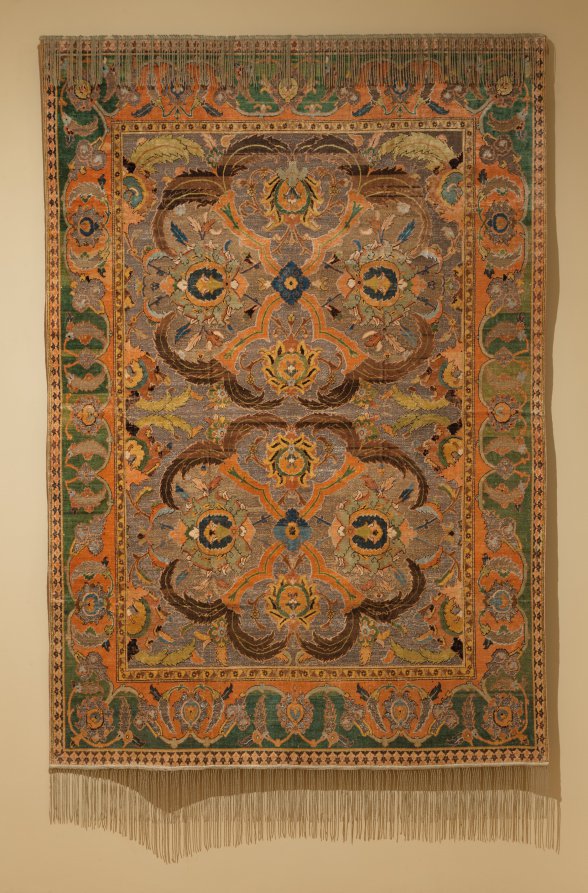
An Examination of Imperial Legacy in Thread: The Royal Carpet
To consider the royal carpet—specifically, the exemplar woven with silk and metal thread—is to engage with an object that transcends mere floor covering. It is a statement of dominion, a testament to technological and artistic supremacy, and a profound articulation of material hierarchy. Its presence in a state chamber was never incidental; it was a deliberate, non-verbal proclamation. The essence of this proclamation resides fundamentally in its materiality: silk. This fibre, more than any other, carries the indelible legacy of imperial ambition, transforming the carpet from a functional object into a cartography of power.
The Sovereign Fibre: Silk as a Political Instrument
One must first appreciate that silk was, for centuries, a strictly controlled currency of state. Its production, from sericulture to the loom, was often a closely guarded imperial monopoly, a state secret as valuable as any treasury. To clothe oneself in silk was to announce one’s proximity to the centre of power; to tread upon it, however, was a privilege of breathtaking exclusivity. A royal carpet in silk, therefore, immediately inverts the expected order. It takes a material historically associated with the most intimate, bodily adornment of the sovereign and renders it a foundation. This is not degradation, but rather the ultimate luxury: the creation of a terrain worthy of the imperial footfall. The carpet becomes an extension of the royal person, a portable realm over which dominion is absolute.
The weave itself—be it the monumental precision of a Persian Tabriz, the intricate narrative of a Mughal *talim*, or the héraldic rigidity of a European Baroque workshop—served as a microcosm of the empire. Floral motifs spoke of a controlled, paradisiacal nature; geometric borders echoed the imposed order of law and architecture; interlacing patterns demonstrated infinite connectivity, a metaphor for far-reaching influence. The silk thread, with its unparalleled capacity for fine detail and luminous depth, was the only medium capable of executing such complex iconography with the requisite authority and finesse.
The Alchemy of Light: Metal Thread and the Performance of Authority
If silk provides the narrative depth, the introduction of metal thread—typically silver gilt or pure gold strip wound upon a silk core—introduces the element of performance. This is where the object transitions from a passive symbol to an active participant in the theatre of power. Metal thread is not merely decorative; it is reactive. It captures and refracts ambient light from torch sconce, candle, or window, creating a dynamic, low-level luminescence that animates the entire surface.
Consider the scene: a dignitary approaches the throne, his eyes lowered in protocol. His path is defined by a shimmering field, a river of light guiding him to the source of authority. With every shift in perspective, with every flicker of flame, the carpet subtly changes, appearing alive and imbued with a celestial quality. This controlled scintillation performs a vital function. It dazzles and humbles, reinforcing the immutable gap between the sovereign, seated amidst such crafted radiance, and the subject. The metal thread, often used to highlight key motifs—coats of arms, imperial monograms, triumphant allegories—ensures these symbols are never static. They pulse with a quiet, expensive fire, a constant, whispering reminder of the wealth and divine favour underpinning the regime.
Craft as Control: The Imperial Workshop & the Erasure of the Hand
The legacy of imperial silk weaving is as much about organisation as artistry. The creation of such carpets was an industrial endeavour, housed in vast, state-sponsored *ateliers*—the *karkhanas* of the Mughals, the workshops of the Ottoman Topkapı, the Savonnerie under Louis XIV. Here, armies of specialists—dyers, spinners, cartoonists, weavers—operated under a rigid hierarchy, their individual hands subsumed into a collective output that bore only the stamp of the patron. This systematic eradication of individual artistry was itself an imperial gesture. The carpet was not the expression of a single weaver’s soul; it was the manifestation of a system’s flawless efficiency, a mirror of the bureaucratic machine that administered the empire.
The materials themselves bore witness to this control. The cochineal red, the lapis lazuli blue, the vibrant saffron yellow—these were colours derived from global trade networks commanded by the crown. The very palette was a map of influence. The silk, likely from imperial estates, and the bullion for the metal thread, from state coffers, rendered the object a pure distillation of sovereign resource. To gift such a carpet was to transfer a fragment of this systemic power; to receive one was to be acknowledged within its sphere.
A Legacy Underfoot: From Throne Room to Heritage
Today, removed from the hushed awe of the state apartment and displayed under the neutral glare of museum lighting, the royal carpet retains its rhetorical power, though its audience has changed. We no longer kneel upon it, but we still bend towards it, peering close to decipher its codes. The silk, now perhaps slightly faded, whispers of botanical knowledge and worm husbandry. The metal thread, tarnished in places, hints at treasury accounts and mining rights. The wear patterns near a dais tell of countless audiences; a meticulous repair speaks of dynastic continuity.
Its legacy is dual. It stands as an unsurpassed pinnacle of human craftsmanship, a benchmark for technical and aesthetic achievement in textile arts. Simultaneously, it is an unvarnished artifact of a worldview rooted in absolute hierarchy, colossal expenditure, and the concentration of sublime skill for the aggrandisement of the few. To study it is to understand that in the imperial lexicon, beauty was never an abstract ideal. It was a calculated, material argument—woven in silk and gold, and laid decisively upon the floor for all to see, and, crucially, upon which to tread with profound caution.