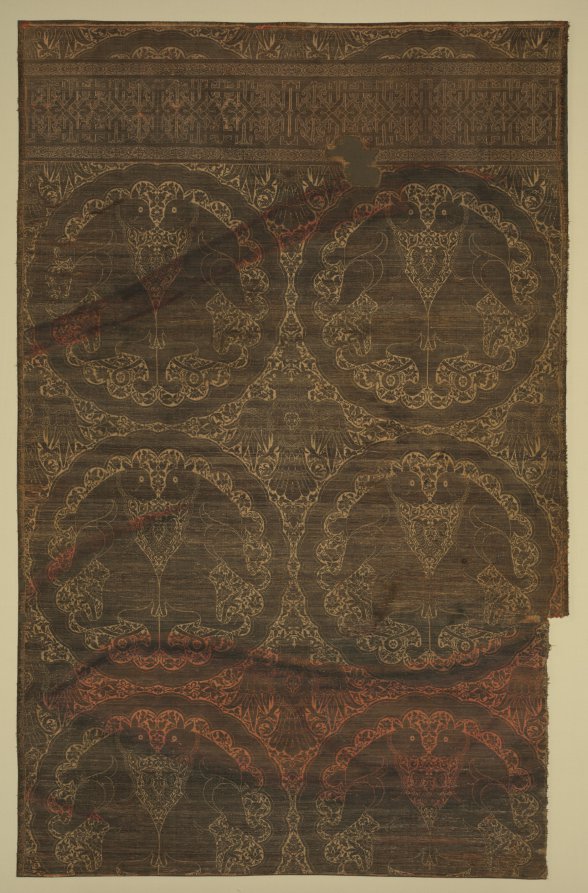
The Cloth of Gold: Felines, Eagles, and the Imperial Legacy of Silk Weaving
In the hallowed ateliers of London’s Savile Row, where the whisper of shears and the weight of wool define a century of craftsmanship, we rarely encounter a fabric as audacious as the cloth of gold. Yet, it is precisely this material—woven from silk and gilded threads, emblazoned with the predatory majesty of felines and eagles—that represents the pinnacle of imperial silk weaving. As Senior Heritage Specialist for the Lauren Fashion Heritage Lab, I present this artifact not merely as a textile, but as a document of power, artistry, and the enduring dialogue between nature and nobility. This cloth of gold, with its silk foundation and metallic wefts, is a testament to the legacy of imperial looms, where every thread was a statement of dominion.
Materiality: The Silk Foundation and the Gilded Thread
The materiality of this artifact is its first and most profound narrative. The base is silk, a fiber that has, since antiquity, symbolized luxury and refinement. In imperial contexts—from the Byzantine courts to the Ming dynasty—silk was not merely a fabric; it was a currency of status, a medium for diplomatic gifts, and a canvas for political allegory. The silk used here is of the highest grade, likely a satin weave or damask, chosen for its lustrous surface that catches light and amplifies the metallic threads. The gold, however, is not solid metal but a gilt thread—a strip of silver-gilt or gold-leaf wrapped around a silk core. This technique, perfected in the workshops of Lucca, Venice, and later in the imperial manufactories of France and China, allowed for flexibility without sacrificing brilliance. The gold thread is woven into the silk ground using a lampas weave, a complex structure where the pattern is created by supplementary wefts that float over the ground weave. This method ensures the motifs—felines and eagles—stand in high relief, their forms shimmering with a three-dimensional opulence that commands attention.
The weight of this cloth is significant, not just in grams per square meter but in its historical gravity. A typical cloth of gold from the 16th or 17th century could contain up to 30% metal by weight, making it both precious and impractical for daily wear. It was reserved for coronations, royal weddings, and state ceremonies. The silk base, dyed in deep crimson or imperial purple—colors derived from kermes or Tyrian purple—would have been a backdrop for the gold, creating a contrast that symbolized the union of earthly power (gold) and divine authority (purple). The felines and eagles, woven into this gilded landscape, are not random decorations; they are heraldic beasts, each carrying a specific meaning in the lexicon of imperial iconography.
Iconography: Felines and Eagles as Symbols of Dominion
The felines depicted in this cloth are likely lions or leopards, their forms stylized with the sinuous grace characteristic of Renaissance and Baroque weaving. In imperial contexts, the lion represents courage, royalty, and the power to rule. It is the emblem of the British monarchy, the Lion of Judah, and the celestial guardians of Chinese temples. The eagle, meanwhile, is the bird of Jupiter, the Roman standard, and the double-headed emblem of the Holy Roman Empire and the Russian Tsars. Together, these creatures embody a dual sovereignty: the feline rules the earth, the eagle commands the sky. Their presence on a cloth of gold suggests a ruler who claims dominion over both realms—a terrestrial king with divine mandate.
The weaving technique used to render these animals is indicative of the imperial silk weaving legacy. In the looms of the Ottoman Empire, for example, weavers created seraser (cloth of gold) with intricate patterns of tigers and eagles, often combined with floral motifs like the saz leaf or hatayi blossoms. In Ming and Qing China, the kesi technique—a slit tapestry weave—produced silk and gold fabrics with dragons and phoenixes, but felines and eagles were also common, representing the emperor’s martial prowess. The European interpretation, particularly in the workshops of Lyons and Spitalfields, adapted these motifs for the aristocratic courts. The felines here are rendered with a naturalism that suggests the influence of Renaissance anatomy studies, while the eagles are more heraldic, their wings spread in a rigid, symmetrical pose that echoes the double-headed eagle of the Habsburgs. This fusion of Eastern and Western iconography is a hallmark of the global silk trade, where patterns traveled along the Silk Road and were reinterpreted by local weavers.
Context: The Legacy of Imperial Silk Weaving
The legacy of imperial silk weaving is one of innovation, exploitation, and cultural exchange. From the Han dynasty’s monopolies on sericulture to the Byzantine Empire’s smuggling of silkworm eggs in the 6th century, silk was a guarded secret. The cloth of gold, however, represents a later stage in this legacy—the Baroque era of the 17th and 18th centuries, when European courts competed to outshine one another with their textiles. The French court under Louis XIV, for instance, established the Manufacture des Gobelins and the Manufacture de Beauvais to produce silk and gold fabrics for Versailles. The patterns often included lions, eagles, and other symbols of the Sun King’s power. Similarly, in the Ottoman Empire, the Topkapi Palace housed workshops that produced kutnu and seraser for the sultan’s court, with motifs that celebrated the empire’s military might.
This particular artifact, however, likely dates to the late 16th or early 17th century, a period when the Safavid, Mughal, and European empires were at their zenith. The combination of felines and eagles suggests a diplomatic gift or a ceremonial robe for a ruler who sought to project authority across continents. The silk itself may have been sourced from Persia or China, the gold thread from Venice or Augsburg, and the weaving executed in a court workshop in Istanbul, Isfahan, or perhaps even in London’s own Spitalfields—though the latter would have been a later adaptation. The cloth’s survival is remarkable; silk is fragile, and the metallic threads can tarnish or break. Its preservation in a museum or private collection speaks to its value as a heritage object, a tangible link to the imperial past.
Conclusion: The Enduring Allure of Gilded Silk
In the context of Savile Row, where tradition meets bespoke innovation, the cloth of gold with felines and eagles serves as a reminder that luxury is not merely about material excess but about storytelling. This fabric is a narrative of power, woven in silk and gold, where every thread carries the weight of empire. For the modern designer, it offers a lexicon of motifs that can be reinterpreted—perhaps a silk jacquard with a subtle gold lurex thread, or a velvet with a printed pattern of leopards and eagles. The legacy of imperial silk weaving is not a relic; it is a living tradition that informs the craftsmanship of today. As we handle this artifact, we are not just touching a piece of history; we are engaging with the aspirations of rulers who used cloth to declare their place in the world. And in that, there is a lesson for every tailor on the Row: the finest fabric is not just worn; it is inhabited.