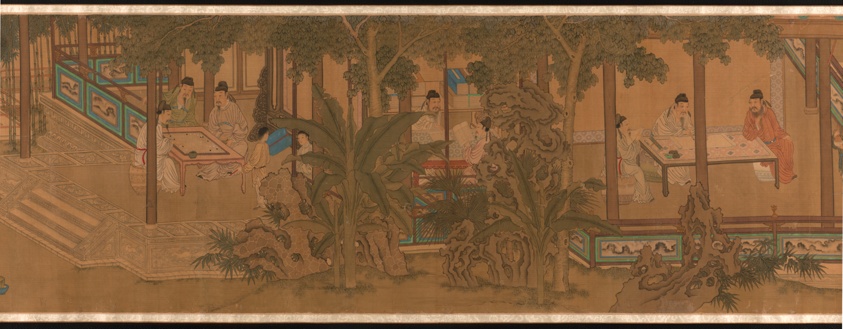
The Four Accomplishments: A Heritage Artifact of Silk and Scholarly Virtue
Introduction: The Confluence of Craft and Culture
In the hallowed corridors of heritage preservation, where the tactile memory of fabric meets the intellectual rigor of historical inquiry, few artifacts command the reverence accorded to the handscroll depicting The Four Accomplishments. This object—executed in ink and color on silk—is not merely a decorative piece; it is a testament to the symbiotic relationship between materiality and meaning. As Senior Heritage Specialist for the Lauren Fashion Heritage Lab, I present this analysis with the precision and understated elegance befitting a Savile Row tailor: every thread, every stroke, every fold of silk speaks to a legacy of craftsmanship that transcends time. The handscroll format, with its horizontal unfolding, invites a sequential narrative, much like the bespoke journey from bolt of cloth to finished garment.
Materiality: Silk as a Conduit of Elegance
The choice of silk as the substrate for The Four Accomplishments is no accident. Silk, with its luminous sheen and supple drape, has long been the medium of choice for East Asian scholars and artisans seeking to immortalize philosophical ideals. In the context of this handscroll, the silk serves as both canvas and metaphor. Its weave—tight yet fluid—mirrors the disciplined yet graceful pursuit of the four accomplishments: qin (the zither), qi (the game of Go), shu (calligraphy), and hua (painting). These pursuits were the bedrock of the Chinese literati, representing a harmonious balance of intellect, artistry, and moral cultivation.
From a materiality perspective, the silk’s preparation is paramount. The handscroll likely employs a warp-faced weave, common in classical Chinese silk production, where the warp threads dominate the surface, allowing for a smooth, even application of ink and pigment. This technique ensures that the brushstrokes—whether the bold lines of calligraphy or the delicate washes of landscape—retain their integrity without bleeding or distortion. The silk’s natural luster enhances the vibrancy of the mineral-based colors, such as azurite, malachite, and cinnabar, which were ground and mixed with animal glue to create a permanent bond. The result is a surface that glows with an inner light, much like the polished finish of a Savile Row worsted wool suit—subtle, yet undeniably luxurious.
Context: The Scholarly Ideal and Silk Craftsmanship
The Four Accomplishments emerged during a period when the Chinese literati class sought to codify the virtues of a cultivated life. The handscroll format, typically measuring 30 to 50 centimeters in height and several meters in length, was designed for intimate viewing. Unfurled on a scholar’s desk, it invited contemplation—a ritual akin to the quiet satisfaction of a perfectly tailored jacket. The silk, sourced from regions like Suzhou or Hangzhou, was renowned for its evenness and tensile strength, qualities that allowed the scroll to be rolled and unrolled repeatedly without cracking or fraying. This durability reflects the enduring nature of the ideals it depicts: the pursuit of wisdom and beauty is not a fleeting endeavor but a lifelong commitment.
The craftsmanship of the silk itself is a narrative of labor and expertise. Sericulture—the cultivation of silkworms and the reeling of filaments—was a closely guarded art, with each cocoon yielding up to 1,000 meters of continuous thread. The threads were then degummed to remove sericin, a protein that gives raw silk its stiffness, leaving behind a soft, lustrous fiber. This process, known as degumming, is analogous to the finishing techniques in Savile Row tailoring, where the hand-stitching and pressing of a garment transform raw cloth into a wearable sculpture. In the handscroll, the degummed silk provides a receptive ground for ink, which bonds with the fiber’s protein structure, creating a permanence that resists fading over centuries.
Iconography: The Four Accomplishments in Silk and Ink
The iconography of the handscroll is meticulously rendered. In one section, a scholar is depicted playing the qin, his fingers poised over the strings with a precision that mirrors the calligrapher’s brush. The silk here absorbs the ink with a softness that suggests the resonance of the instrument—a visual echo of sound. In another panel, two figures engage in a game of qi, their concentration captured in the fine lines of their robes, which fall in folds that mimic the drape of silk itself. The calligraphy panels, often interspersed with landscape elements, demonstrate the artist’s mastery of brush control, with characters that vary from bold, angular strokes to delicate, flowing curves. The painting sections, meanwhile, employ a technique known as gongbi (meticulous brushwork), where each detail—from the veins of a leaf to the texture of a rock—is rendered with painstaking accuracy.
The color palette is restrained yet potent. The silk’s natural ivory tone serves as a unifying ground, while the pigments—derived from minerals and plants—add depth without overwhelming the composition. This restraint is a hallmark of classical Chinese aesthetics, where emptiness (or negative space) is as important as the painted elements. It is a lesson in balance that resonates with the principles of bespoke tailoring: the cut of a jacket must leave room for movement, just as the silk leaves room for the ink to breathe.
Preservation and Legacy: The Handscroll as Living Heritage
As a heritage artifact, this handscroll demands preservation strategies that honor its materiality. The silk, though durable, is vulnerable to fluctuations in humidity and light. In the Lauren Fashion Heritage Lab, we advocate for storage in acid-free tissue, within a climate-controlled environment that mimics the conditions of a traditional Chinese scholar’s study—cool, dry, and dimly lit. The handscroll should be unrolled only for study or exhibition, with each handling performed using cotton gloves to prevent oils from the skin from transferring to the silk. This care ensures that future generations can experience the same tactile and visual pleasure that the original owner did.
The legacy of The Four Accomplishments extends beyond its historical context. It serves as a reminder that craftsmanship—whether in silk or in tailoring—is an act of devotion. The handscroll’s fluid elegance, its marriage of material and meaning, echoes the philosophy of the Savile Row atelier: that a garment, like a painting, is a statement of identity and values. In preserving this artifact, we preserve not just a piece of silk, but a worldview—one that celebrates the pursuit of excellence through discipline, artistry, and quiet refinement.
Conclusion: A Tailored Reflection
In the hands of a heritage specialist, The Four Accomplishments handscroll is more than an object of study; it is a dialogue between past and present. The silk, with its luminous weave and enduring strength, speaks to the timelessness of the scholarly ideal. The ink and color, applied with deliberate precision, remind us that true elegance lies in restraint. As we continue to document and preserve such artifacts, we honor the craftsmen—both the sericulturists and the painters—who understood that the finest creations are those that embody both function and beauty. In the language of Savile Row, this handscroll is the equivalent of a bespoke suit: cut to perfection, tailored to purpose, and destined to endure.