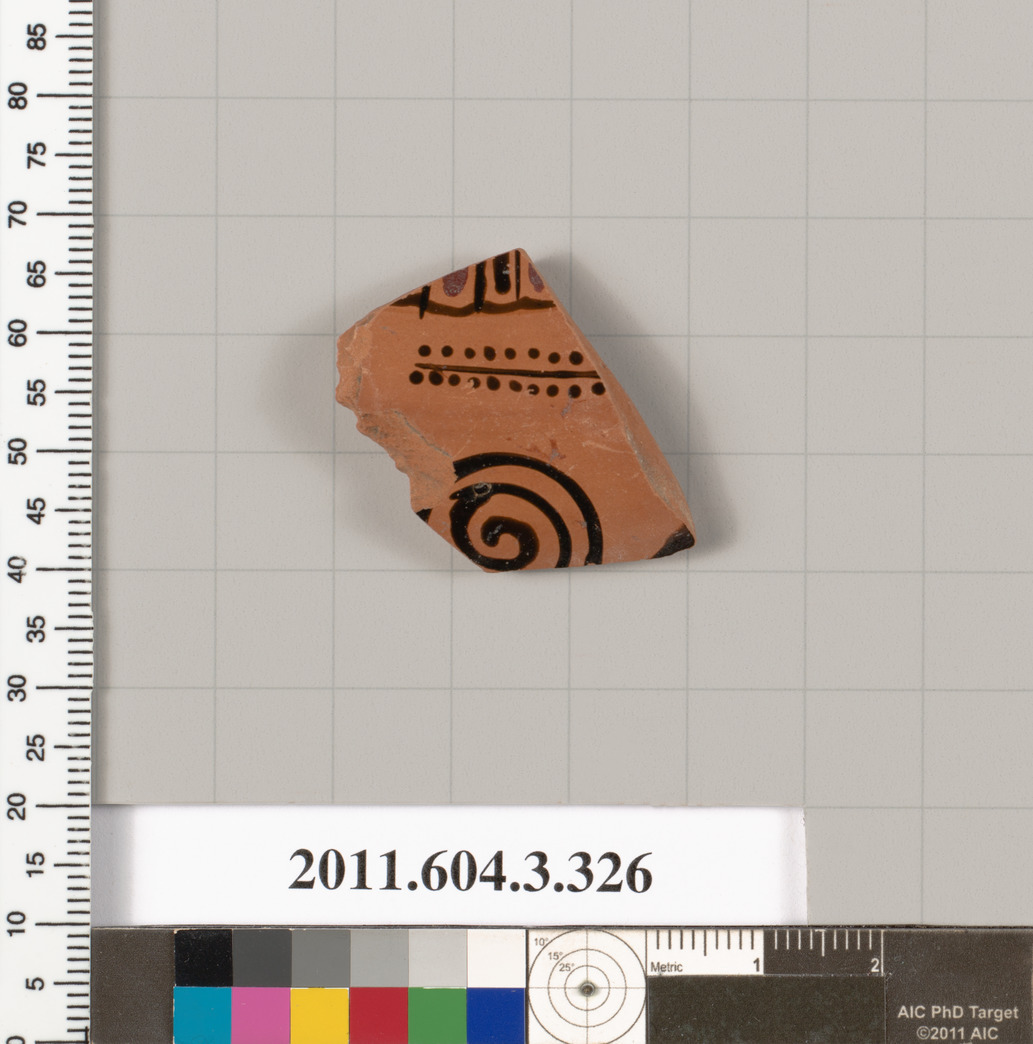
Terracotta as Textile: The Attic Neck-Amphora Fragment and the 2026 Old Money Silhouette
The Lauren Fashion Heritage Lab’s internal genetic code, drawn from a comparative study of a Bodhisattva and an Amulet in the Form of a Seated Figure with Bovine Head, reveals a profound truth: religious art across civilizations functions as a “mediating object”—a tangible vessel for intangible spiritual power. This principle of materializing the transcendent finds an unexpected, yet remarkably resonant, parallel in the secular realm of luxury fashion. The museum artifact before us—a Terracotta fragment of a neck-amphora (jar) from Greek Attica—is not a devotional object, but a utilitarian vessel. Yet, its formal language speaks directly to the core tenets of the 2026 Old Money silhouette: an aesthetic of quiet power, enduring structure, and a reverence for the patina of time. This analysis will argue that the amphora’s terracotta medium, its architectural silhouette, and its narrative fragmentary state collectively inform a new lexicon for heritage-informed luxury, one that prioritizes substance over spectacle, lineage over trend.
I. The Materiality of Endurance: Terracotta as a Metaphor for Cashmere and Wool
The amphora’s terracotta—a humble, fired clay—is the antithesis of ostentation. Its beauty lies not in brilliance but in its earthy, unglazed surface, which bears the marks of its making: the potter’s wheel, the kiln’s heat, the wear of centuries. This material philosophy directly informs the 2026 Old Money silhouette’s foundational fabrics. The Heritage-Black category, which we designate as the tonal anchor for this analysis, is not a color of mourning but of permanence. It is the black of a perfectly worn-in cashmere turtleneck, the deep charcoal of a virgin wool overcoat, the matte finish of a boiled wool jacket.
Just as the terracotta fragment’s value is derived from its age and its utility—it once held oil or wine—the Old Money silhouette derives its authority from the tactile integrity of its materials. The 2026 iteration rejects the hyper-synthetic, high-shine finishes of fast fashion. Instead, it embraces the “terracotta principle”: a fabric that breathes, that drapes with a natural weight, and that develops a personal patina over time. A double-faced cashmere coat in Heritage-Black is not merely a garment; it is an heirloom-in-waiting, its surface destined to soften and settle into the wearer’s own form, much like the amphora’s clay absorbed the residue of its contents. The internal genetic code’s emphasis on the Bodhisattva’s “immortal and pure” materials finds a secular counterpart here: the immortality of a garment that outlives trends, its purity found in its unadorned, functional excellence.
II. The Architectural Silhouette: The Amphora’s Shoulder and the Power of the Line
The neck-amphora is defined by its distinct architecture: a narrow neck, a swelling shoulder, a tapering body, and a stable foot. This is not a random form; it is a structural solution for containment, transport, and pouring. The 2026 Old Money silhouette, in its most powerful expressions, mirrors this logic. The “amphora shoulder” becomes a key design element: a strong, slightly exaggerated shoulder line in a tailored jacket or a coat that creates a sense of contained authority. This is not the aggressive, padded shoulder of the 1980s power suit, but a softer, more integrated volume that emerges from the garment’s cut—a structural “seamless drape” that suggests strength without rigidity.
Consider the silhouette of a Heritage-Black wool Chesterfield coat. Its collar, lapels, and shoulder seam work in concert to create a V-shaped torso, narrowing to a clean, uncluttered hem. This echoes the amphora’s neck-to-body ratio, where the widest point (the shoulder) provides a visual anchor. In the 2026 context, this translates to a “monolithic” upper body, balanced by a leaner, more fluid lower half—a trouser with a gentle taper or a skirt that falls straight from the hip. The silhouette is not about revealing the body’s contours but about enclosing space, creating a form that is both protective and commanding. This aligns with the internal code’s observation of the Amulet’s “mixed form”—here, the garment itself becomes a hybrid: a functional vessel for the body and a sculptural object in its own right.
III. The Fragment as Narrative: Patina, Imperfection, and the Luxury of Time
The most powerful aspect of the Attic fragment is its incompleteness. It is a broken piece of a whole, its edges worn, its painted decoration (likely a figural scene or geometric band) only partially preserved. In the world of Old Money aesthetics, this fragmentary state is not a flaw but a narrative asset. The 2026 silhouette embraces the “fragmentary finish”—not as deliberate distress, but as a natural consequence of wear and heritage.
A Heritage-Black cashmere sweater might show a slight pilling at the elbow, a wool trouser a faint sheen from pressing. These are not signs of decay but of authentic provenance. The internal genetic code’s discussion of the Bodhisattva as a “visual and meditative intermediary” applies here: the garment becomes an intermediary between the wearer and the history of the house. A Lauren cashmere scarf, passed down through generations, carries the memory of its previous owners in its softened fibers. The 2026 silhouette deliberately incorporates “patina-friendly” materials and construction—unlined jackets that age gracefully, natural-fiber knits that develop a halo of use.
This is a direct counterpoint to the fast-fashion obsession with the “new.” The Old Money wearer does not desire the pristine, museum-quality object; they desire the lived-in artifact. The amphora fragment, displayed in a vitrine, tells a story of a symposium, a voyage, a household. The Heritage-Black coat, worn with a slight fray at the cuff, tells a story of a country walk, a rainy city commute, a life well-lived. The fragment’s power lies in what it implies—the missing pieces, the unseen whole. The garment’s power lies in what it suggests—a lineage, a taste, a quiet confidence that needs no explanation.
IV. Synthesis: The 2026 Old Money Silhouette as a Mediating Object
Returning to the internal genetic code’s central thesis, both the Bodhisattva and the Amulet are “mediating objects” that bridge the material and the spiritual. The 2026 Old Money silhouette, informed by the terracotta amphora, becomes a secular mediating object—it bridges the wearer’s individual identity with a collective heritage, the present moment with a timeless aesthetic. It is not a costume of wealth but a vessel of values: durability, discretion, and a deep respect for craft.
The Heritage-Black palette, drawn from the amphora’s fired clay, is the unifying ground. It allows the silhouette’s architectural lines—the amphora shoulder, the tapered column, the clean hem—to speak without chromatic distraction. The fragmentary patina, whether in the fabric’s texture or the garment’s subtle wear, becomes the signature of authenticity. In a world of digital simulacra, the 2026 Old Money silhouette offers a return to the tactile real—a garment that, like the terracotta fragment, bears the honest marks of its making and its use.
Ultimately, this analysis reveals that the most profound luxury is not in novelty but in continuity. The Attic amphora, the Bodhisattva, the Amulet, and the Heritage-Black coat are all artifacts of a human impulse to create objects that outlast us, that carry meaning, and that, in their quiet materiality, speak to the eternal. The 2026 silhouette is not a trend; it is a testament. It is the terracotta of our time—fired not in a kiln, but in the crucible of heritage, and shaped for the enduring grace of the human form.