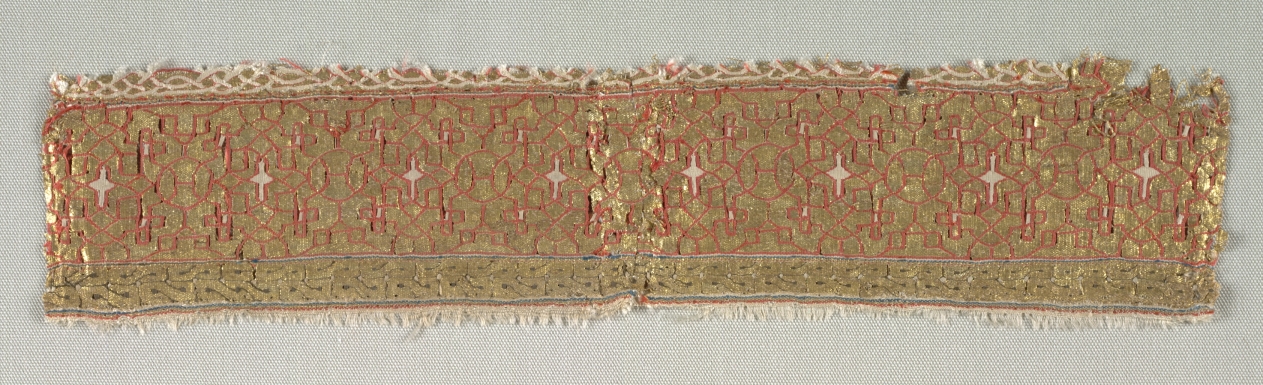
An Examination of the Guilloche Band: Imperial Legacy in Ecclesiastical Vestment
Within the hallowed confines of the Lauren Fashion Heritage Lab, we are afforded the privilege of interrogating artefacts not merely as decorative fragments, but as constitutive documents of history, power, and technical ambition. The subject of this particular examination—a guilloche band, once adorning the dalmatic of San Valero—presents a compelling case study. It is a discreet yet eloquent testament to the profound and enduring legacy of imperial silk weaving, a legacy where aesthetic authority was inextricably bound to technological supremacy and geopolitical assertion.
Material Provenance and Technical Sovereignty
To comprehend the full weight of this artefact, one must first acknowledge the absolute primacy of its material: silk. In the medieval and early modern periods, silk was not a mere textile; it was a strategic commodity, a currency of state, and the ultimate expression of luxury. Its production, from sericulture to the complex loom, represented the pinnacle of pre-industrial technology. The very presence of such a band in a Spanish ecclesiastical context speaks of supply chains that were, for centuries, dominated by the Eastern Roman Empire—Byzantium—and later, the Islamic caliphates. The deliberate cultivation of silk weaving within the Byzantine Empire was a act of economic and cultural policy, a monopoly guarded with the utmost severity. To possess and work silk was to participate in a rarefied language of power. This fragment, therefore, is born of a lineage that traces directly back to the imperial workshops of Constantinople, where technique was a state secret and patterns were decreed by imperial iconography.
The Guilloche: A Motif of Command
The specific pattern, the guilloche, is far from an arbitrary selection. It is a braided border, an interlace of ribbons forming a continuous, sinuous plait. Its origins lie in classical antiquity—observe Roman mosaics and architectural friezes. Its adoption and perpetuation in Byzantine silk weaving is a hallmark of that empire’s self-conception as the direct heir to Rome. The guilloche is an emblem of ordered infinity, a boundless, repeating structure that implies perpetuity and immutable law. It is a border that contains and defines, a frame that asserts the significance of the space it encloses. On a vestment, it performs a dual function: it accentuates the sacred architecture of the garment—the neckline, the cuffs, the hem—while simultaneously broadcasting a cultural claim. The wearer, a cleric, is thus framed by a motif that carries the weight of both imperial and divine authority, a potent synthesis of temporal and spiritual dominion.
Context: The Dalmatic of San Valero and the Translation of Power
The association with San Valero, an early bishop of Zaragoza, situates this band within the specific narrative of Spanish Reconquista and its complex material culture. Following the fall of Byzantine territories and the expansion of Islamic weaving centres in Al-Andalus, the pathways of silk—and its symbolic vocabulary—shifted. The recapture of territories by Christian kingdoms did not halt the appetite for these superlative textiles; it redirected it. Workshops in centres like Toledo began to produce telas de pañería, often employing Mudejar or Morisco weavers, thus perpetuating the technical idioms of the very cultures being politically subdued.
The dalmatic, a liturgical garment worn by deacons, becomes a fascinating site of this cultural translation. To adorn it with a silk band featuring a classical imperial motif like the guilloche is a profound statement. It signifies the assimilation of a prestige language. The Church, the new seat of enduring power in the post-Roman world, appropriates the visual language of the old empire to bolster its own universal claim. The silk is no longer a Byzantine import; it may well be a product of a local, yet technologically descended, workshop. The pattern, however, remains a recognisable standard of excellence and authority. It is a conscious display of inherited legitimacy.
Legacy in the Canon of Craft
From the perspective of the Heritage Lab, concerned with the continuous thread of craftsmanship, the implications are clear. The technical execution evident in this band—the precision of the weave, the clarity of the interlace, the enduring vibrancy of the dye—sets a benchmark. This is not rustic handiwork; it is the product of a systematised, master-apprentice tradition operating at the highest level of contemporary technology. The control required to maintain the mathematical regularity of the guilloche pattern on a draw-loom is considerable. It speaks to a rigorous, almost doctrinal approach to manufacture, where deviation from the standard is not an expression of individuality but a failure of execution.
This ethos of technical perfection in service of a established, authoritative pattern finds its echoes in the most revered traditions of modern bespoke tailoring. The precise, repetitive geometry of a pick-stitched lapel, the flawless interlace of hand-padded canvas, the immutable structure of a coat’s forepart—these are not merely techniques. They are the guilloche bands of Savile Row. They are the border motifs that frame the wearer, asserting a legacy of excellence, a continuity of standards, and a silent claim to a place within a hierarchy of quality. They are, in their own way, imperial.
In conclusion, this fragment of silk, this guilloche band from a saint’s vestment, is a compacted archive. It documents the migration of a supreme technology from East to West, the translation of an imperial motif from secular to sacred authority, and the unyielding demand for technical perfection that defines true luxury across the ages. It reminds us that heritage in material culture is rarely a simple matter of nostalgia; it is often the strategic deployment of a proven language of power, woven one impeccable thread at a time.