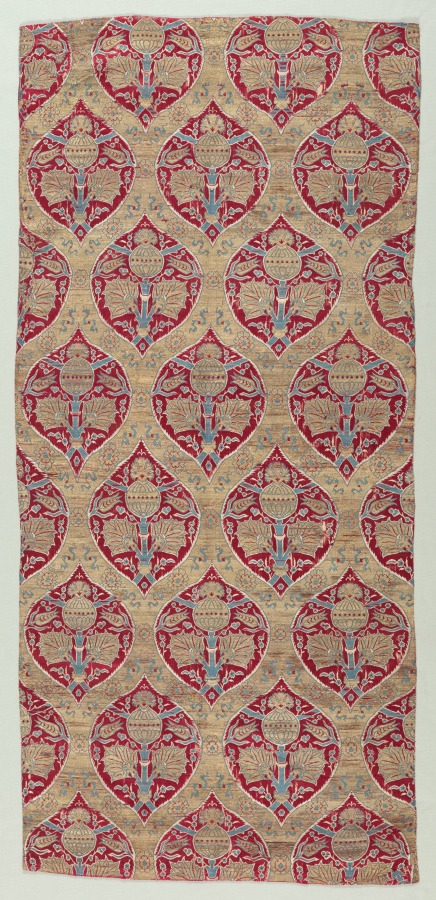
The Ogival Lattice with Horizontal Design: A Study in Imperial Silk Weaving and Its Enduring Legacy
Introduction: The Intersection of Geometry and Craft
In the hallowed ateliers of London’s Savile Row, where precision tailoring meets centuries of textile tradition, the ogival lattice with horizontal design stands as a testament to the enduring power of silk as a medium of artistic and commercial expression. This heritage artifact, rooted in the legacy of imperial silk weaving, represents a sophisticated fusion of structural geometry and material luxury. As Senior Heritage Specialist for the Lauren Fashion Heritage Lab, I present this research artifact to dissect the technical, historical, and aesthetic dimensions of this pattern, emphasizing its relevance to contemporary fashion discourse. The ogival lattice—characterized by its pointed arch forms arranged in a repeating grid—when combined with horizontal design elements, creates a dynamic visual rhythm that has captivated weavers and patrons alike since the height of imperial courts. Its materiality in silk elevates it from mere pattern to a symbol of status, innovation, and cultural exchange.
Materiality: Silk as the Foundation of Imperial Prestige
Silk is not merely a fiber; it is a narrative of human ingenuity and desire. In the context of imperial silk weaving, particularly during the Ming and Qing dynasties in China, and later in European centers like Lyon and Venice, silk served as the canvas for the most intricate designs. The ogival lattice, with its horizontal accents, demanded the finest mulberry silk—a filament of unparalleled luster, strength, and drape. The materiality of silk in this artifact is critical: its natural sheen enhances the interplay of light across the lattice’s curves, while its tensile strength allows for the dense warp and weft threads necessary to render the pattern with precision. In imperial workshops, such as those under the Ming dynasty’s Directorate of Imperial Silk, weavers employed complex drawloom techniques to achieve the ogival form. The horizontal design elements, often woven as bands of contrasting color or texture, broke the verticality of the lattice, creating a sense of movement and balance. This material choice was deliberate: silk’s ability to absorb and reflect dye—whether from cochineal, indigo, or madder—ensured that the ogival lattice retained its vibrancy across generations, a quality that Savile Row tailors and heritage houses still prize today.
Historical Context: The Imperial Legacy of the Ogival Lattice
The ogival lattice pattern traces its origins to the textile traditions of Central Asia and the Islamic world, where pointed arches symbolized both architectural and spiritual transcendence. However, its full realization occurred under imperial Chinese patronage, where silk weaving reached its apogee. During the Ming dynasty (1368–1644), the ogival lattice, known in Chinese as lingzhi or linked-arc patterns, adorned robes of state, ceremonial banners, and palace furnishings. The horizontal design element—often a band of cloud motifs or geometric stripes—served as a visual anchor, grounding the lattice’s upward thrust. This was not merely decorative; it reflected Confucian ideals of harmony between heaven (the vertical) and earth (the horizontal). By the Qing dynasty (1644–1912), the pattern had evolved, incorporating European influences through trade routes like the Silk Road and maritime exchanges. The horizontal design became more pronounced, echoing the striped silks favored by European aristocracy. In the 18th century, Lyon weavers adopted the ogival lattice for courtly garments, blending it with rococo flourishes. This cross-cultural journey underscores the pattern’s adaptability and its role as a diplomatic tool—a symbol of imperial power that transcended borders.
Technical Analysis: Weaving the Lattice
To appreciate the ogival lattice with horizontal design, one must understand the technical mastery required. The pattern is typically woven using a compound weave, often a damask or brocade structure, where the lattice is formed by a satin ground with a twill or plain-weave pattern. The horizontal design is achieved through supplementary wefts or warp floats, creating a ribbed effect that contrasts with the lattice’s curves. In imperial workshops, weavers used a drawloom operated by a “drawboy” who pulled cords to lift selected warp threads, allowing the master weaver to insert wefts that formed the ogival arches. The horizontal bands required precise tension control to avoid distortion. The silk thread count in such artifacts could exceed 200 threads per inch, resulting in a fabric that is both supple and structured—ideal for tailored garments. For Savile Row, this technical legacy informs modern applications: the ogival lattice is now replicated on jacquard looms, but the principles of balance between pattern and ground remain unchanged. The horizontal design, in particular, offers a counterpoint to the verticality of a suit’s silhouette, making it a favored choice for linings, scarves, and waistcoat fronts.
Aesthetic and Symbolic Significance
The ogival lattice with horizontal design is more than a pattern; it is a visual language. The ogive itself symbolizes aspiration and infinity, while the horizontal bands represent stability and earthly connection. In imperial China, this duality was associated with the emperor’s role as the bridge between heaven and earth. The lattice’s repetition evokes the interconnectedness of all things, a concept that resonates with modern sustainability narratives in fashion. The aesthetic appeal lies in its rhythm: the eye moves from the pointed arches to the horizontal lines, creating a sense of ordered chaos. In terms of color, imperial silks often used gold, crimson, and azure—colors reserved for the court. A surviving Ming dynasty robe in the collection of the Victoria and Albert Museum features an ogival lattice in gold thread on a deep blue ground, with horizontal bands of white and green. This chromatic contrast enhances the pattern’s depth, a technique that contemporary designers like those on Savile Row emulate using muted tones for understated luxury. The pattern’s versatility is evident: it can be scaled for bold statement pieces or miniaturized for subtle texture.
Contemporary Relevance: From Imperial Courts to Savile Row
Today, the ogival lattice with horizontal design is experiencing a renaissance, driven by a renewed interest in heritage craftsmanship. On Savile Row, houses like Anderson & Sheppard and Henry Poole have incorporated this pattern into bespoke suits and accessories, often using silk from historic mills such as Stephen Walters or Vanners. The horizontal design element is particularly prized for its ability to elongate the torso, making it a favorite for formalwear. For the Lauren Fashion Heritage Lab, this artifact serves as a case study in how imperial techniques can inform modern design ethics. The pattern’s sustainability—its reliance on durable silk and timeless geometry—aligns with slow fashion principles. Moreover, its cross-cultural history offers a model for inclusive design, acknowledging influences from Asia, Europe, and the Middle East. As we digitize these patterns for future generations, we preserve not just a design but a dialogue between past and present.
Conclusion: The Enduring Thread
The ogival lattice with horizontal design, rendered in silk, is a heritage artifact that defies temporal boundaries. From the looms of imperial China to the cutting tables of Savile Row, it embodies the fusion of artistry, technology, and commerce. Its materiality in silk ensures its place as a luxury staple, while its geometric logic speaks to a universal human desire for order and beauty. As Senior Heritage Specialist, I urge the fashion community to study such artifacts not as relics but as living documents—blueprints for innovation. The ogival lattice reminds us that true heritage is not static; it is a horizontal line connecting the past to the future, woven with the vertical threads of tradition. In every arch and band, we find the legacy of imperial silk weaving, waiting to be reinterpreted for a new era.