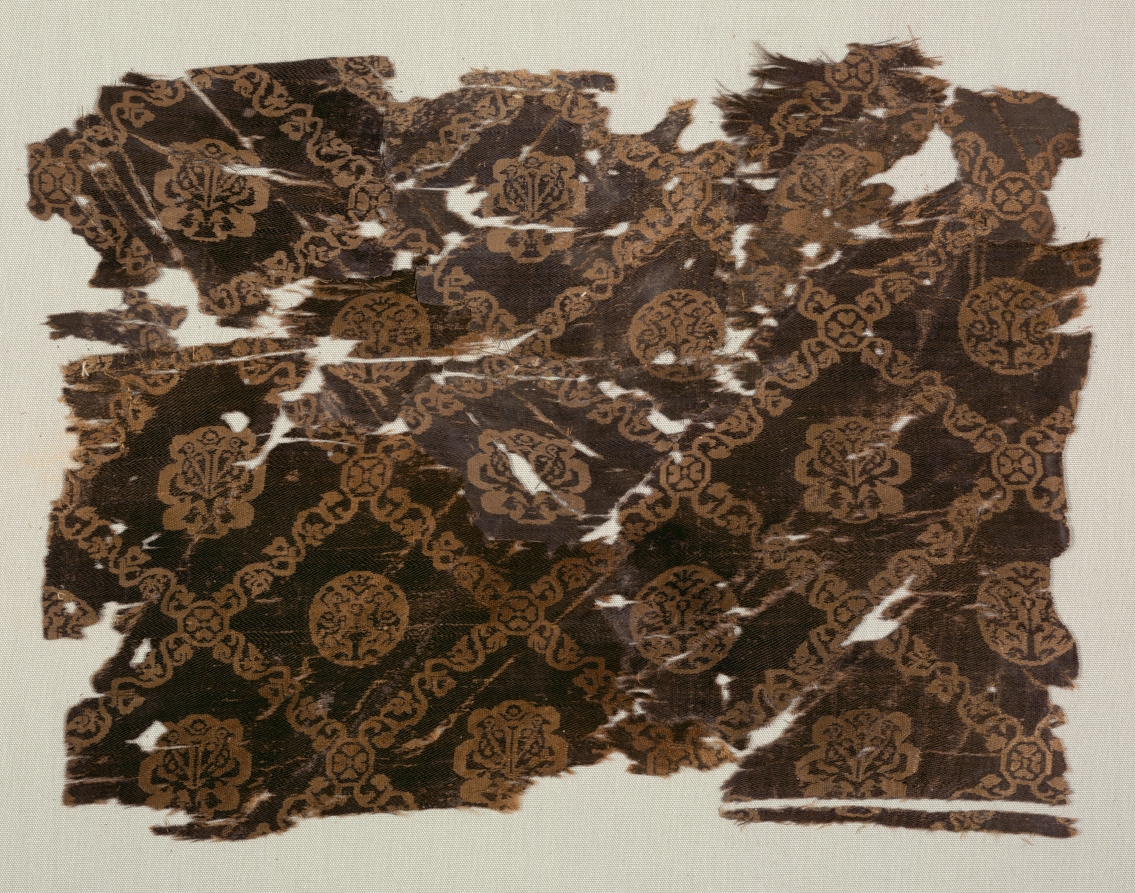
The Lattice of Beasts: A Study in Imperial Silk and the Geometry of Power
Materiality and the Imperial Mandate
The artifact under consideration—a silk textile bearing a lattice of animals enclosed within medallions—is not merely a fabric. It is a document of imperial authority, a testament to the confluence of material science, political symbolism, and artisanal mastery. As a Senior Heritage Specialist at the Lauren Fashion Heritage Lab, I approach this piece with the precision of a Savile Row cutter: every thread, every motif, every structural decision speaks to a lineage of power. The materiality of silk itself is the first and most profound statement. Cultivated from the Bombyx mori silkworm, this lustrous protein fibre was, for millennia, a state monopoly in China, guarded as fiercely as the secret of porcelain. Its production required an intricate ecosystem of mulberry groves, sericulture, and reeling—a process that yielded a filament of unparalleled tensile strength and luminosity. In the imperial context, silk was not a commodity; it was a currency of sovereignty, a medium through which the emperor’s mandate was woven into the very fabric of the realm.
The lattice structure—a geometric grid of intersecting lines that frames the medallions—is no mere decorative flourish. It is a deliberate architectural choice, echoing the ordered cosmology of the imperial court. In Savile Row tailoring, we speak of the “skeleton” of a garment: the canvas, the interlinings, the precise placement of seams that dictate drape and form. Here, the lattice serves a similar function. It imposes a rigorous, repeating order upon the chaotic vitality of the animal motifs. The grid is a symbol of control, of the emperor’s ability to harness and contain the natural world within the boundaries of his rule. The medallions—circular or lozenge-shaped enclosures—act as microcosms, each a self-contained universe where a specific creature, often a dragon, phoenix, qilin, or lion, is depicted in a stylized, heraldic pose. This is not naturalism; it is iconography. Each animal carries a weight of symbolic meaning: the dragon for imperial power and yang energy, the phoenix for rebirth and yin, the qilin for benevolence and justice. The repetition of these motifs across the lattice creates a rhythmic mantra of authority, a visual assertion that the emperor’s dominion extends to every corner of the known world.
The Legacy of Imperial Silk Weaving
To understand this artifact, one must appreciate the technical virtuosity required to produce it. Imperial silk weaving was a state-sponsored enterprise, centred in workshops such as the Imperial Silk Factory in Nanjing or the Suzhou Silk Bureau. These were not mere factories; they were academies of craft, where master weavers—often hereditary artisans—operated drawlooms of immense complexity. The creation of a lattice with medallions demanded a sophisticated understanding of warp and weft manipulation. The weaver had to coordinate the pattern harness, which controlled the warp threads, to create the grid and the curved contours of the medallions simultaneously. This was a feat of memory and dexterity, as the pattern repeats were often recorded on paper diagrams or, in later periods, on punched cards—a precursor to the Jacquard loom. The silk itself was often dyed using natural pigments derived from plants, minerals, and insects, yielding colours that were both vibrant and stable. The crimson of cinnabar, the gold of orpiment, the deep blue of indigo—each hue was chosen not only for its aesthetic effect but also for its symbolic resonance. Gold thread, often made by wrapping silk filaments around a gilt paper core, was reserved for the most prestigious pieces, its shimmering presence a direct reference to the emperor’s wealth and divine radiance.
The legacy of this weaving tradition extends far beyond the imperial court. When European traders, particularly the British East India Company, began to import Chinese silks in the 17th and 18th centuries, they were captivated by these intricate patterns. The lattice of animals in medallions became a template for chinoiserie, a European interpretation of Chinese aesthetics that influenced everything from wallpaper to porcelain. In London, Savile Row tailors of the 19th century would have handled such silks, repurposing them into waistcoats, cravats, and dressing gowns for the aristocracy. The fabric’s rigid geometry and heraldic motifs resonated with the British sensibility for order and lineage. A gentleman wearing a silk waistcoat with a dragon medallion was not merely adopting an exotic fashion; he was draping himself in a symbol of absolute authority, albeit one divorced from its original political context. The lattice, once a symbol of imperial control, became a pattern of cosmopolitan sophistication.
Preservation and the Modern Gaze
Today, as a heritage specialist, I approach this silk artifact with a dual perspective: that of the conservator and that of the designer. The materiality of silk presents unique challenges. The protein fibres are susceptible to light, humidity, and mechanical stress. The metallic threads, if present, can tarnish and weaken the surrounding silk. Preservation requires a controlled environment—stable temperature, low light levels, and minimal handling. Yet, the artifact’s value is not solely historical. It is a source of inspiration for contemporary design. The lattice of animals in medallions offers a lexicon of motifs that can be reinterpreted for modern textiles. The geometric grid provides a framework for digital printing or jacquard weaving, while the animal motifs can be abstracted into graphic symbols. In the Lauren Fashion Heritage Lab, we study these artifacts not as relics to be venerated but as living documents that inform our understanding of pattern, structure, and symbolism. The lattice teaches us about the power of repetition and containment; the animals remind us that fashion has always been a language of status and identity.
In conclusion, this silk with a lattice of animals in medallions is a masterclass in material and symbolic economy. It is a product of imperial ambition, a technical marvel, and a cultural ambassador. For the Savile Row sensibility, it represents the pinnacle of craft—a fabric that is both structured and fluid, both ancient and timeless. As we continue to study and preserve such artifacts, we honour not only the weavers who created them but also the enduring dialogue between power, pattern, and the human desire to adorn. The lattice remains, a grid of authority woven into the very threads of history.