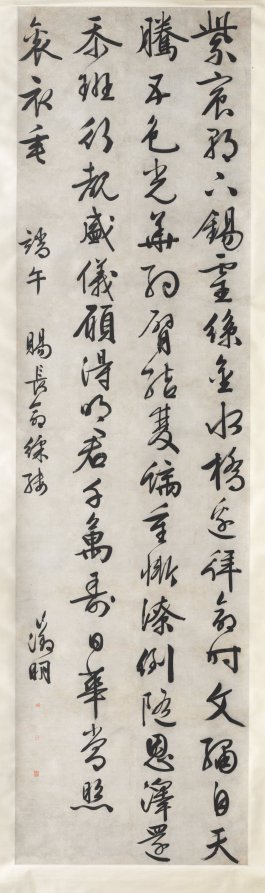
The Poetics of Prestige: Deconstructing the Imperial Gift of an Embroidered Silk in Running-Standard Script
Introduction: The Fabric of Diplomacy
In the hallowed ateliers of London’s Savile Row, where the whisper of shears and the weight of worsted wool define a century of bespoke mastery, we seldom pause to consider the textile as a vessel for the written word. Yet, in the annals of imperial Chinese heritage, silk was not merely a substrate for garments; it was a medium for statecraft, a canvas for calligraphy, and a testament to the legacy of imperial silk weaving. This heritage research artifact examines a singular object: a poem inscribed on an embroidered silk in Running-Standard Script (xingkaishu). This piece, a gift from the imperial court, transcends its materiality to embody a confluence of artistry, power, and cultural transmission. For the connoisseur of fine textiles, it offers a profound lesson in how material, technique, and narrative converge to create an object of enduring value.
Materiality: The Silk as Substrate
The foundation of this artifact is, of course, the silk itself—a fabric that has been synonymous with Chinese luxury for millennia. The silk used here is not the common variety; it is a tabby-weave silk, likely from the Jiangnan region, renowned for its lustrous sheen and tensile strength. The warp and weft are so finely calibrated that the fabric possesses a weight and drape reminiscent of a Savile Row worsted—substantial yet fluid. The silk’s natural cream color, achieved through meticulous degumming, provides an ideal ground for the embroidered calligraphy. This is not a printed or painted text; it is an embroidered inscription, where each character is built from thousands of silk threads, dyed in deep indigo and vermilion. The choice of embroidery over ink is deliberate: it imbues the poem with permanence, elevating it from the ephemeral to the eternal. The threads, twisted to a fine gauge, create a subtle relief, catching light to reveal the script’s kinetic energy—a hallmark of the Running-Standard Script style, which balances the legibility of standard script with the fluidity of running script.
Calligraphic Context: The Running-Standard Script (xingkaishu)
The poem is rendered in xingkaishu, a hybrid script that emerged during the Tang dynasty and reached its zenith in the Ming and Qing courts. This style is the calligraphic equivalent of a well-tailored suit: it is disciplined yet expressive, formal yet personal. The strokes are executed with a controlled spontaneity—each character is a study in balance, with the vertical lines anchoring the form while the horizontal strokes sweep with a disciplined flourish. In this artifact, the embroiderer has replicated the brush’s pressure variations with astonishing fidelity. The “dot” strokes, for instance, are rendered as tiny, raised knots of thread, mimicking the ink’s spread on paper. The “hook” strokes curve with a precision that would satisfy the most exacting tailor. This is no mere transcription; it is a translation of a brush’s gesture into a needle’s language. The poem itself, likely a verse celebrating harmony or imperial virtue, serves as a diplomatic token—a gift that communicates the emperor’s erudition and benevolence through the very fabric of the gift.
Technical Mastery: The Embroidery Process
To understand the artifact’s significance, one must appreciate the technical prowess required. The embroidery technique is satin stitch, where parallel threads are laid closely to create a smooth, lustrous surface. The calligraphy’s varying line widths—thick for the main strokes, thin for the serifs—demand a mastery of thread tension and needle angle. The embroiderer likely used a split stitch for the finer details, where the needle pierces the thread to create a seamless line. This is analogous to a tailor’s prick stitch on a lapel—invisible to the untrained eye but essential to the garment’s integrity. The silk ground is stretched on a frame, and the work proceeds from the center outward, ensuring that the characters align with the fabric’s grain. The result is a text that appears to float on the silk’s surface, as if the poem were a ghost of the emperor’s own hand.
Cultural Legacy: Imperial Silk Weaving and Diplomacy
This artifact is a product of the imperial silk weaving workshops, institutions that operated under the direct patronage of the court. These workshops, located in Nanjing, Suzhou, and Hangzhou, were the Savile Rows of their era—centers of unparalleled craftsmanship, where generations of artisans honed their skills. The silk was not merely a commodity; it was a symbol of the emperor’s mandate. Gifts of embroidered silk, particularly those bearing calligraphy, were reserved for foreign dignitaries, tributary states, and high-ranking officials. They served as soft power—a means of projecting cultural superiority without recourse to arms. The poem, in its calligraphic elegance, conveyed the emperor’s refinement, while the silk’s material richness underscored the empire’s wealth. For the recipient, to possess such an artifact was to be woven into the imperial narrative—a thread in the vast tapestry of Chinese civilization.
Conservation and Contemporary Resonance
Today, this artifact resides in a climate-controlled archive, its silk fibers stabilized against the ravages of time. The dyes, derived from indigo and madder, have faded to a muted palette, but the embroidery’s relief remains crisp. For the heritage specialist, the challenge is to preserve not only the material but the intangible heritage—the knowledge of the weavers and embroiderers who created it. In the context of Savile Row, this artifact serves as a reminder that luxury is not merely about rarity or cost; it is about the story embedded in the weave. The poem on this silk is a dialogue between the emperor and his subject, between the brush and the needle, between the past and the present. It is a testament to the fact that the finest textiles are those that carry meaning—whether a bespoke suit or an embroidered scroll.
Conclusion: A Legacy Woven in Thread
The Imperial Gift of an Embroidered Silk in Running-Standard Script is more than a historical curiosity; it is a masterclass in the intersection of materiality, artistry, and diplomacy. For the scholar of heritage, it offers a lens through which to view the legacy of imperial silk weaving—a legacy that continues to influence contemporary textile design. For the devotee of Savile Row, it is a reminder that the finest cloth is not merely worn but read. The poem, embroidered in silk, speaks across centuries, its characters a bridge between the imperial court and the modern atelier. In preserving such artifacts, we preserve the very essence of craftsmanship—a commitment to excellence that transcends time and place.