← BACK TO ARCHIVES
Silk
Heritage Synthesis: The Salt Maidens, Matsukaze with Yukihira's Coat
Curated on May 01, 2026 // Node: LDN-01
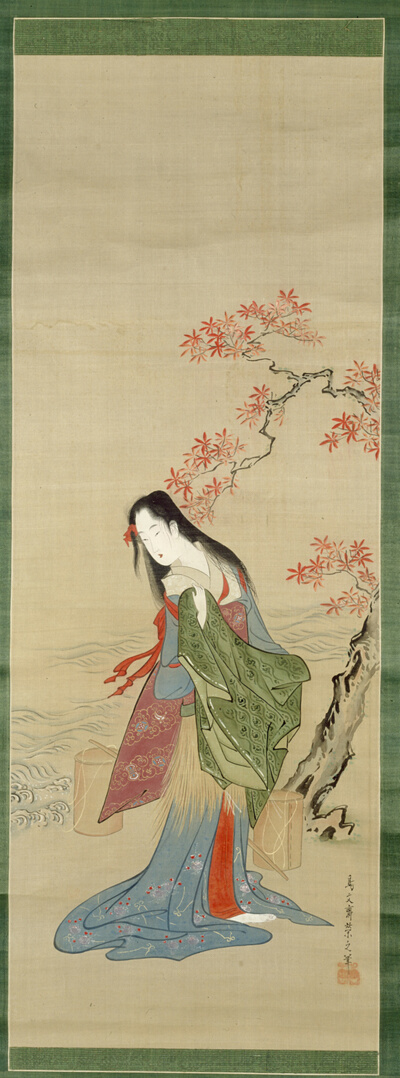
The Salt Maidens: A Study in Materiality and Narrative on Silk
In the hallowed corridors of heritage preservation, where the tactile and the temporal converge, the hanging scroll titled *Matsukaze with Yukihira’s Coat* stands as a singular testament to the confluence of Japanese classical narrative and the exacting artistry of silk craftsmanship. As a Senior Heritage Specialist at the Lauren Fashion Heritage Lab, I approach this artifact not merely as a decorative object, but as a material document—a woven ledger of aesthetic intention, cultural memory, and the fluid elegance that defines the highest echelons of textile art. This scroll, executed in ink and colors on silk, demands a forensic appreciation of its medium, its story, and its silent dialogue with the viewer.
The Silk as Substrate: A Foundation of Fluid Elegance
The choice of silk as the primary material for this hanging scroll is neither incidental nor merely traditional. Silk, in its raw and refined states, possesses a unique capacity to absorb and reflect light, to hold pigment with a luminosity that paper cannot replicate, and to drape with an inherent grace that mirrors the narrative’s own themes of transience and longing. The scroll’s silk ground, likely a finely woven habutae or a similar plain-weave fabric, provides a surface that is both resilient and receptive. The ink and colors—mineral pigments bound with animal glue—settle into the silk’s interstices, creating a depth of field that shifts with ambient light. This is not a static image; it is a living surface that breathes with the humidity of the room, a quality that the Savile Row tailor understands intimately in the context of worsted wool or cashmere. The silk’s “hand”—its tactile feel—is soft yet taut, a paradox that underpins the scroll’s structural integrity. The mounting, or *hyōgu*, further amplifies this materiality, with brocade borders that frame the painting in a dialogue of textures. The brocade, often woven with metallic threads, introduces a subtle opulence that does not compete with the painted scene but rather elevates it, much like a bespoke suit’s lining complements the outer cloth.
The Narrative of the Salt Maidens: Matsukaze and the Coat of Yukihira
The subject matter—Matsukaze, one of the two “Salt Maidens” from the Noh play *Matsukaze*—is a poignant exploration of memory, loss, and the ephemeral nature of beauty. The scroll depicts Matsukaze holding the coat of the exiled courtier Yukihira, a garment that symbolizes both his presence and his absence. The coat, rendered in sweeping brushstrokes of indigo and ochre, is not merely a prop; it is a relic of longing. Matsukaze’s posture—her kimono sleeves trailing like water, her gaze downward—conveys a quiet resignation. The ink work on her face and hands is delicate, almost translucent, while the colors of her layered robes—crimson, moss green, and pale lavender—create a chromatic harmony that echoes the seasonal cycles of the play. The salt, referenced in the title, is subtly implied through the pale, granular washes on the lower portion of the scroll, evoking the brine of the shore where the sisters toiled. This is not a dramatic scene; it is a moment of stillness, a pause in the narrative that allows the viewer to inhabit the emotion.
Context: The Art of the Hanging Scroll in the Japanese Tradition
To fully appreciate *Matsukaze with Yukihira’s Coat*, one must understand the hanging scroll’s role within the Japanese *tokonoma*—the alcove designed for the display of art and flowers. The scroll is not a static object; it is a performative artifact, changed with the seasons or for specific occasions. The silk’s flexibility allows the scroll to be rolled and stored, protecting it from light and dust, yet its display is an act of reverence. The craftsmanship of the scroll’s mounting—the *ichimonji* (the top and bottom decorative strips), the *jōge* (the upper and lower rollers), and the *fūtai* (the silk cords)—is as critical as the painting itself. A poorly mounted scroll diminishes the painting; a masterful mounting, as seen here, enhances it. The rollers, often made of wood or ceramic, are weighted to ensure the scroll hangs straight, a detail that speaks to the precision of the artisan. The brocade borders, with their geometric or floral patterns, are chosen to complement the painting’s palette and period. In this scroll, the borders are a restrained gold-and-ivory weave, allowing the viewer’s eye to rest on the central image without distraction.
Fluid Elegance: The Intersection of Craft and Emotion
The phrase “fluid elegance” is not hyperbole; it is a technical observation. The ink lines that define Matsukaze’s profile are executed with a brush that moves as if guided by a breath—a controlled spontaneity that the Japanese call *yūgen*, or profound grace. The silk’s absorbency means that the brushstroke cannot be corrected; each line is a commitment. The colors, applied in thin washes, bleed slightly into the silk, creating soft edges that mimic the diffusion of memory. The coat of Yukihira, draped over Matsukaze’s arm, is rendered with a heavier hand, its folds suggesting the weight of fabric and the weight of emotion. The contrast between the delicate figure and the substantial coat is a masterclass in material storytelling. The silk itself becomes a metaphor for the narrative: it is strong enough to hold the pigment, yet supple enough to convey vulnerability.
Preservation and Legacy: A Scholar’s Responsibility
As a heritage specialist, I am acutely aware that this scroll is a fragile witness to centuries of cultural exchange. The silk, while durable, is susceptible to fluctuations in humidity, light, and handling. The pigments, particularly the whites and greens, may have oxidized over time, altering the original hue. The mounting, too, may require conservation to prevent the silk from becoming brittle. Yet, the scroll’s condition—its crisp lines and vibrant colors—suggests careful stewardship. It is a reminder that heritage is not passive; it is an active dialogue between the past and the present. The scroll’s journey from the hands of a Japanese painter to the collection of the Lauren Fashion Heritage Lab is a testament to the global appreciation of this art form. It is our duty to ensure that the Salt Maidens continue to tell their story, not as relics, but as living artifacts that inspire future generations of designers, artisans, and scholars.
In conclusion, *Matsukaze with Yukihira’s Coat* is more than a painting; it is a material philosophy. The silk, the ink, the narrative, and the craftsmanship converge to create an object that is both intimate and universal. For the connoisseur of heritage, it offers a lesson in the power of materiality to elevate narrative. For the fashion historian, it is a reminder that cloth—whether a kimono, a coat, or a scroll—carries the weight of human experience. And for the student of elegance, it is a masterclass in the art of restraint, where every brushstroke, every fold of silk, speaks with quiet authority.
Heritage Lab Insight
Lab Insight: AIC Silk Archive Node #110306.