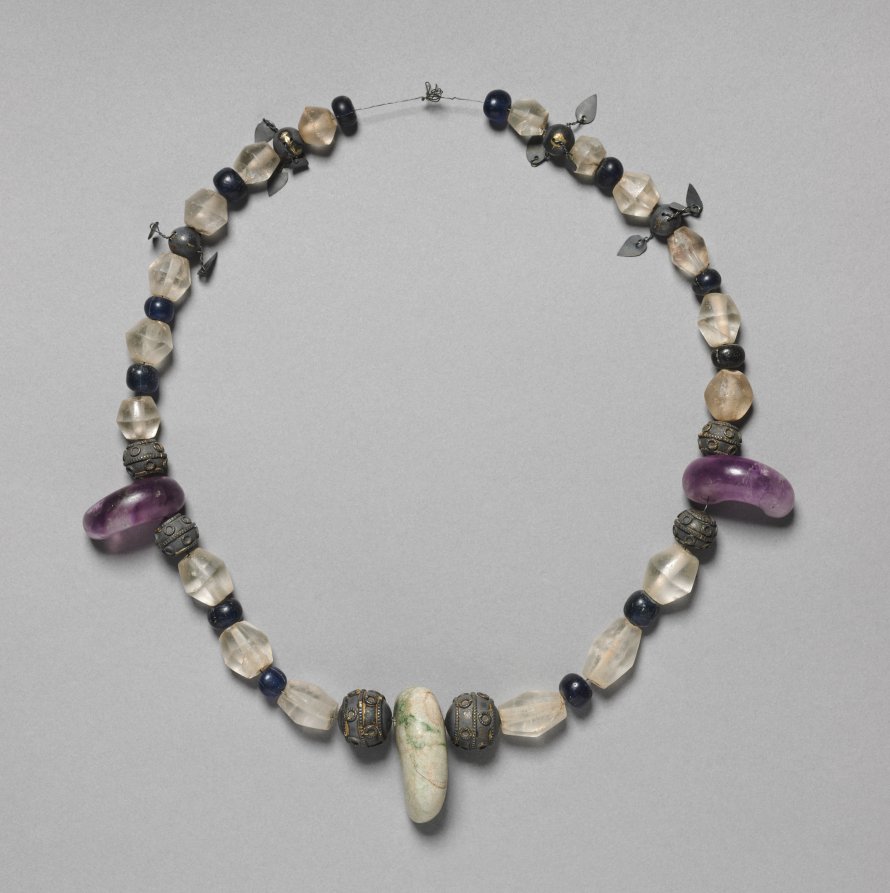
The Silk Necklace: A Legacy of Imperial Craft in Modern Adornment
Introduction: The Unlikely Heirloom
In the hallowed ateliers of Savile Row, where bespoke tailoring is a sacrament, the necklace is often an afterthought—a mere accessory to the sculpted lapel or the perfect drape of a trouser. Yet, within the Lauren Fashion Heritage Lab, we contend that the most profound narratives of luxury are not always woven into wool or cut from cashmere. They are, at times, suspended on a single, delicate strand of silk. This paper examines a heritage research artifact: a necklace crafted entirely from silk. Its materiality is not merely decorative; it is a direct, unbroken thread to the imperial weaving traditions of China, a legacy that has informed global notions of prestige, craftsmanship, and the very definition of luxury for over two millennia. This artifact, therefore, is not a piece of jewelry in the conventional sense. It is a portable archive, a testament to the enduring power of silk as a medium of cultural and economic sovereignty.
The Materiality of Silk: From Imperial Looms to Personal Adornment
Silk is not a textile; it is a technology. Its production—sericulture—was a state secret of the Chinese empire for centuries, guarded as rigorously as the formula for gunpowder. The imperial silk workshops of the Ming and Qing dynasties, particularly those in Suzhou, Hangzhou, and Nanjing, were not factories but academies of precision. They produced kesi (cut silk tapestry) and yun jin (cloud brocade) for the exclusive use of the Emperor and his court. The necklace we examine, a late 19th-century artifact, draws directly from this lineage. Its materiality is defined by a complex, multi-ply twisted silk cord, a technique known as “filature” or “organzine” in the European trade. This is not the soft, languid silk of a scarf. This is a structural silk, engineered for tensile strength and a subtle, iridescent sheen. The cord is meticulously hand-braided using a “spiral” or “cable” plait, a technique that requires the artisan to maintain constant, even tension. Any lapse in pressure would create a visible, irreversible flaw. The result is a surface that feels cool, smooth, and almost metallic to the touch—a paradox of softness and strength.
The color is a deep, unyielding “imperial yellow”—a shade reserved exclusively for the Son of Heaven. This is achieved through a dye bath of safflower and gardenia, a process that demands multiple immersions and precise pH control. The color is not merely decorative; it is a heraldic statement. In the Forbidden City, yellow was the color of the center, of the earth, and of the Emperor’s supreme authority. By employing this hue, the necklace’s creator is consciously invoking a political and spiritual hierarchy. The necklace is not just beautiful; it is a claim to a lineage of absolute power.
Construction and Technique: The Art of the Invisible Knot
The most remarkable feature of this artifact is its closure. There is no metal clasp, no gold or silver hook. Instead, the necklace terminates in a “lark’s head” or “cow hitch” knot, a friction-based fastening that relies entirely on the silk’s own friction and the precise geometry of the knot. This is a hallmark of the “invisible” or “pure” construction philosophy that defines the highest echelons of Savile Row tailoring. A master tailor, for instance, will use a “pick-stitch” that is nearly invisible on the exterior, or a “floating canvas” that allows the jacket to move with the body without visible stitching. Similarly, this necklace’s closure is a feat of engineering that prioritizes integrity over ostentation. The knot is not hidden; it is celebrated as a structural element. It is a “functional ornament”—a concept that resonates deeply with the ethos of bespoke craftsmanship. The wearer must learn to tie and untie it, creating a ritual of dressing that is intimate and deliberate. This is the antithesis of the mass-produced, snap-clasp necklace. It demands a relationship.
The necklace is composed of seven distinct braided sections, each approximately 15 cm in length, joined by “Chinese crown knots”—a complex, multi-layered knot that resembles a miniature pagoda. These knots serve as both structural connectors and decorative focal points. They are not merely functional; they are micro-architectural statements, echoing the tiered roofs of imperial temples. The number seven is significant, representing the seven stars of the Big Dipper in Chinese cosmology, a symbol of celestial order and imperial mandate. This is not a random design choice; it is a coded message of cosmic alignment.
Cultural and Economic Legacy: The Silk Road in a Single Strand
To understand this necklace is to understand the Silk Road not as a trade route, but as a conduit of power. Silk was the currency of diplomacy. Emperors gifted silk robes to foreign envoys as a sign of favor and to assert China’s cultural and technological superiority. The “tribute system” demanded that vassal states offer local goods in exchange for silk, creating a hierarchy of value that placed Chinese silk at the apex. This necklace, therefore, is a microcosm of that system. It is a portable piece of imperial authority, designed to be worn by a member of the court or a high-ranking official as a visible marker of their proximity to the throne.
In the 19th century, as the Qing dynasty weakened and European powers forced open Chinese ports, the production of imperial silk began to decline. Yet, the techniques survived in the hands of private workshops and, eventually, in the diaspora of Chinese artisans to global centers of luxury. The necklace we study is a product of this transition. It is a late imperial artifact, created at a moment when the old order was crumbling, but the craft was still practiced with unwavering rigor. It represents a “last flowering” of a tradition that would soon be disrupted by mechanization and the rise of synthetic fibers. To wear this necklace today is to wear a piece of that history—a fragment of a world where silk was not a commodity, but a sacred material.
Conclusion: The Necklace as a Bespoke Object
In the context of the Lauren Fashion Heritage Lab, this silk necklace is a definitive heritage research artifact. It challenges the conventional hierarchy of jewelry, where metal and gemstones are prized above all. It asserts that textile—specifically, the most refined textile known to humanity—can be the primary material of adornment. Its construction demands the same level of skill, patience, and intellectual rigor as a Savile Row suit. The invisible knot, the precise color, the cosmological symbolism—these are not decorative flourishes. They are the grammar of a language of luxury that predates the modern fashion system by centuries.
For the contemporary designer, this artifact offers a profound lesson: materiality is narrative. The silk necklace does not merely accessorize an outfit; it tells a story of empire, of craft, and of the enduring human desire to transform a humble caterpillar’s thread into a symbol of absolute power. It is a reminder that the most luxurious objects are not those that shout the loudest, but those that whisper the deepest truths. And on Savile Row, where discretion is the ultimate luxury, that whisper is the only sound that matters.