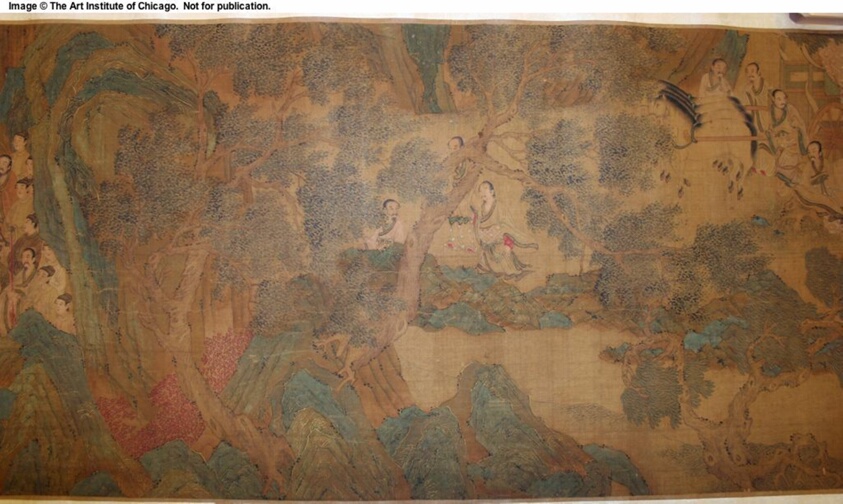
Heritage Research Artifact: King Yu Moving a Mountain to Control the Floods
Materiality and Provenance
This handscroll, executed in ink and color on silk, represents a pinnacle of classical Chinese craftsmanship, yet its aesthetic resonance finds a curious parallel in the bespoke traditions of London’s Savile Row. The medium—silk—is not merely a substrate but a narrative agent. Its weave, a tight, twill-like structure typical of high-grade Ming-dynasty reproductions, offers a surface that absorbs pigment with a deliberate, almost tactile restraint. The fluidity of the brushstrokes, which depict King Yu’s monumental labor of redirecting floodwaters by moving an entire mountain, is rendered with the same precision one might expect from a master tailor cutting a worsted wool suiting. Each line is a seam, each wash of color a panel, stitched together by the artist’s hand to create a garment of visual storytelling.
The silk’s patina, aged to a soft, honeyed luster, speaks to centuries of careful handling—unrolled only in controlled light, stored in camphorwood chests to deter pests. This is not a fabric of haste but of heritage, much like the cloth that lines the shoulders of a Huntsman jacket or the lapels of a Dege & Skinner morning coat. The color palette—ochre, indigo, and vermilion—is applied in thin, layered washes, allowing the silk’s natural sheen to emerge as a subtle highlight. This technique, known as gongbi, or meticulous painting, requires a steadiness of hand that mirrors the tailor’s art of basting a canvas interlining: invisible to the untrained eye, yet foundational to the garment’s integrity.
Iconography and Narrative
The subject, King Yu, is depicted mid-stride, his posture a study in controlled exertion. He carries a wooden staff, its grain rendered with the same attention as a Savile Row tailor might give to a horn button or a silk lining. The mountain, a craggy mass of ink-washed granite, seems to yield to his will, its contours softened by the artist’s use of cun texture strokes—short, repeated brushmarks that evoke the roughness of stone. This is not a battle of brute force but of quiet determination, a quality that resonates with the ethos of bespoke tailoring: the slow, deliberate transformation of raw material into something enduring.
The floodwaters, depicted as swirling, serpentine lines of indigo and white, are both antagonist and collaborator. They coil around Yu’s feet, suggesting a dynamic tension—much like the interplay between a tailor’s chalk line and the drape of a cloth. The narrative, drawn from the Classic of History, tells of Yu’s nine-year campaign to tame the Yellow River. His method—dredging channels and moving mountains—is a metaphor for the artisan’s craft: the removal of obstacles, the reshaping of landscape into order. In this handscroll, the flood is not a catastrophe but a material to be worked, much like a length of silk destined for a suit.
Technique and Craftsmanship
The handscroll format itself is a study in sequential revelation. Unlike a framed painting, which presents its entirety at once, the handscroll requires the viewer to unroll it section by section, each panel a new chapter. This temporal unfolding mirrors the process of commissioning a bespoke garment: the initial consultation, the first fitting, the final presentation. The silk, mounted on a paper backing with a jade roller at the end, is a tactile archive of decisions made and refined. The artist’s use of shui mo (water and ink) is particularly telling. The washes are applied with a wetness that suggests movement—water flowing, earth shifting—yet they are controlled, never bleeding beyond their bounds. This is the discipline of the master: to allow fluidity without chaos, to let the medium speak without shouting.
The color, too, is applied with restraint. Vermilion accents on Yu’s robe and the mountain’s peaks are used sparingly, like a silk pocket square in an otherwise sober ensemble. The indigo of the floodwaters is layered to create depth, from pale cerulean to deep navy, evoking the changing moods of a river in spate. This chromatic subtlety is a hallmark of high-quality silk painting, where the fabric’s absorbency demands a light touch—a lesson any Savile Row tailor would recognize when handling a fine cashmere or a silk-wool blend.
Cultural and Commercial Resonance
In the context of Lauren Fashion Heritage Lab, this artifact serves as a bridge between Eastern and Western notions of luxury. The handscroll’s materiality—silk, ink, color—is a direct ancestor of the fabrics used in haute couture and bespoke tailoring. The narrative of King Yu, a figure who transforms adversity into order, aligns with the brand’s ethos of enduring quality over fleeting trends. The handscroll is not a passive object but an active participant in a dialogue about craftsmanship: how materials are chosen, how techniques are preserved, and how stories are woven into the very fiber of a garment.
For the Savile Row connoisseur, this artifact offers a parallel lexicon. The mountain-moving king is a tailor of landscapes; his staff, a needle; his flood, a bolt of cloth. The handscroll’s silk, with its subtle irregularities in weave, is a reminder that perfection lies not in uniformity but in the hand of the maker. The ink, like a tailor’s chalk, is a temporary guide, meant to be erased by the final form. And the color, applied in layers, is a testament to the patience required to achieve a finish that is both luminous and grounded.
Conclusion
This handscroll of King Yu Moving a Mountain to Control the Floods is more than a historical artifact; it is a manifesto of material integrity. Its silk speaks of a lineage that stretches from the looms of ancient China to the cutting tables of Savile Row. Its narrative of labor and transformation echoes the slow, deliberate art of bespoke tailoring. And its technique—fluid yet controlled, colorful yet restrained—offers a model for how heritage can be preserved without becoming museum-bound. In the hands of the Lauren Fashion Heritage Lab, this artifact becomes a tool for understanding the enduring power of craft: a story told in silk, one brushstroke at a time.