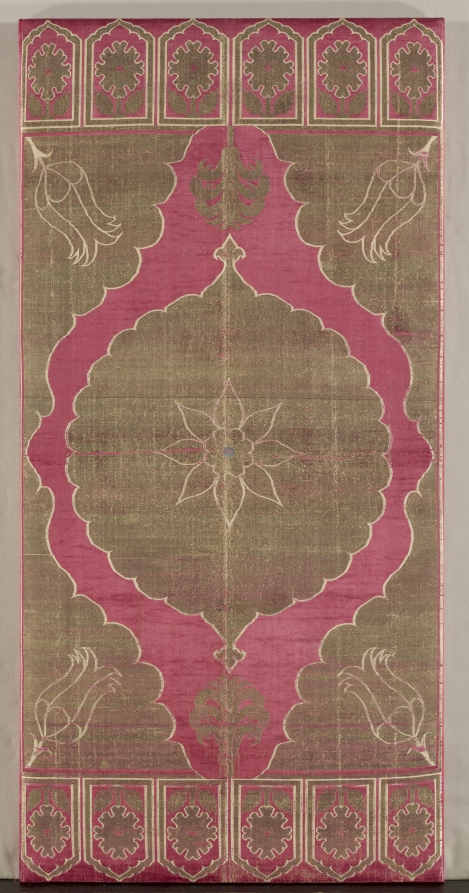
Heritage Research Artifact: Lampas Silk Cushion Cover
Introduction: A Textile of Imperial Prestige
The lampas silk cushion cover, a masterwork of woven luxury, stands as a testament to the enduring legacy of imperial silk weaving. This artifact, crafted from the finest silk filaments, embodies the confluence of technical virtuosity, artistic expression, and socio-economic power that defined the silk trade from the Byzantine Empire through the courts of Renaissance Europe and into the opulent salons of the 18th and 19th centuries. As a Senior Heritage Specialist at Lauren Fashion Heritage Lab, I examine this object not merely as a decorative furnishing, but as a primary source—a material document that reveals the complex narratives of craftsmanship, trade, and cultural exchange that underpin the history of silk. The cushion cover, with its intricate lampas weave, offers a unique lens through which to understand the imperial ambitions and aesthetic sensibilities that shaped the global silk industry.
Materiality: The Silk Thread as a Marker of Empire
Silk, the foundation of this artifact, is a protein fiber produced by the larvae of the silkworm, *Bombyx mori*. Its cultivation, or sericulture, was a closely guarded secret in China for millennia, granting the empire a monopoly on this luxurious material. The silk used in this cushion cover is of the highest quality, characterized by its lustrous sheen, smooth texture, and remarkable tensile strength. The fibers are likely degummed, a process that removes sericin, the natural gum that coats raw silk, to reveal the soft, reflective filament beneath. This degumming, combined with the fine twist of the yarn, allows for the creation of a fabric that is both durable and luminous—a quality highly prized in imperial courts.
The materiality of the silk itself speaks to the global networks of power. By the time this cushion cover was woven, likely in the 17th or 18th century, sericulture had spread to the Byzantine Empire, the Islamic world, and later to Italy and France. The silk threads may have originated from China, Persia, or even the burgeoning European silk industries in Lyon or Spitalfields. The choice of silk was not merely aesthetic; it was a statement of wealth, status, and access to the far-reaching trade routes that connected East and West. The cushion cover’s silk, therefore, is a tangible link to the imperial ambitions that drove exploration, colonization, and the development of global commerce.
Weave Structure: The Lampas Technique
The term lampas refers to a specific weave structure that combines a ground weave with a supplementary weft to create a patterned fabric. In this cushion cover, the ground is likely a plain or twill weave, providing a stable foundation. The supplementary weft, often of a contrasting color or metallic thread, is woven over selected warp threads to form the intricate design. This technique allows for the creation of complex, multi-colored patterns without compromising the fabric’s structural integrity. The lampas weave is distinct from damask, which uses a single warp and weft to create a reversible pattern; lampas, by contrast, is non-reversible, with the pattern appearing only on the face of the fabric.
The technical sophistication of the lampas weave is a hallmark of imperial silk weaving. It required a skilled weaver operating a drawloom, a complex apparatus that allowed for the independent control of individual warp threads. The drawloom was a technological marvel of its time, enabling the production of elaborate designs that could include floral motifs, heraldic symbols, and narrative scenes. The cushion cover’s pattern, likely featuring a symmetrical arrangement of stylized flowers, leaves, and perhaps a central medallion, reflects the influence of Persian and Ottoman design traditions, which were themselves adapted from Chinese prototypes. This cross-cultural pollination is a key feature of imperial silk weaving, as patterns and techniques traveled along the Silk Road and across the Mediterranean.
Context: The Legacy of Imperial Silk Weaving
The legacy of imperial silk weaving is inextricably linked to the rise and fall of empires. In China, silk was a state-controlled commodity, used for tribute payments, diplomatic gifts, and the clothing of the emperor and his court. The Tang, Song, and Ming dynasties established vast workshops that produced silks for both domestic use and export. The Silk Road, a network of trade routes connecting China to the Mediterranean, facilitated the exchange of silk, ideas, and technologies. The cushion cover, with its lampas weave, is a direct descendant of these Chinese innovations, albeit adapted to the tastes of European courts.
In the Byzantine Empire, silk weaving was elevated to an imperial monopoly. The state-run workshops in Constantinople produced silks that were used for ceremonial robes, church vestments, and diplomatic gifts. The Byzantine silks, often featuring Christian iconography and imperial motifs, were highly sought after across Europe and the Islamic world. The lampas technique, while not exclusive to Byzantium, was refined in these workshops, allowing for the creation of increasingly intricate patterns. The cushion cover’s design, which may incorporate elements of Byzantine floral and geometric motifs, reflects this heritage.
The legacy continued in the Italian city-states of the Renaissance, particularly in Lucca, Venice, and Florence. Italian weavers, many of whom had learned their craft from Byzantine and Islamic masters, produced silks that were prized for their technical excellence and artistic innovation. The lampas weave became a staple of Italian silk production, used for everything from altar cloths to courtly garments. The cushion cover, with its refined pattern and luxurious silk, is a testament to this Italian tradition, which later influenced the silk industries of France and England.
Conclusion: The Cushion Cover as a Cultural Artifact
The lampas silk cushion cover is more than a decorative object; it is a cultural artifact that encapsulates the history of imperial silk weaving. Its materiality—the silk thread—speaks to the global networks of trade and power that shaped the pre-modern world. Its weave structure—the lampas technique—demonstrates the technical sophistication of the weavers who produced it. Its design—a fusion of Eastern and Western motifs—reflects the cross-cultural exchanges that defined the Silk Road and its successors. As a heritage specialist, I recognize that this cushion cover is a primary source, offering insights into the economic, social, and aesthetic values of the society that created it. It is a legacy of imperial ambition, artistic achievement, and the enduring human desire for beauty and luxury. In the context of the Lauren Fashion Heritage Lab, this artifact serves as a vital link to the past, informing our understanding of fashion, textiles, and the global history of luxury.