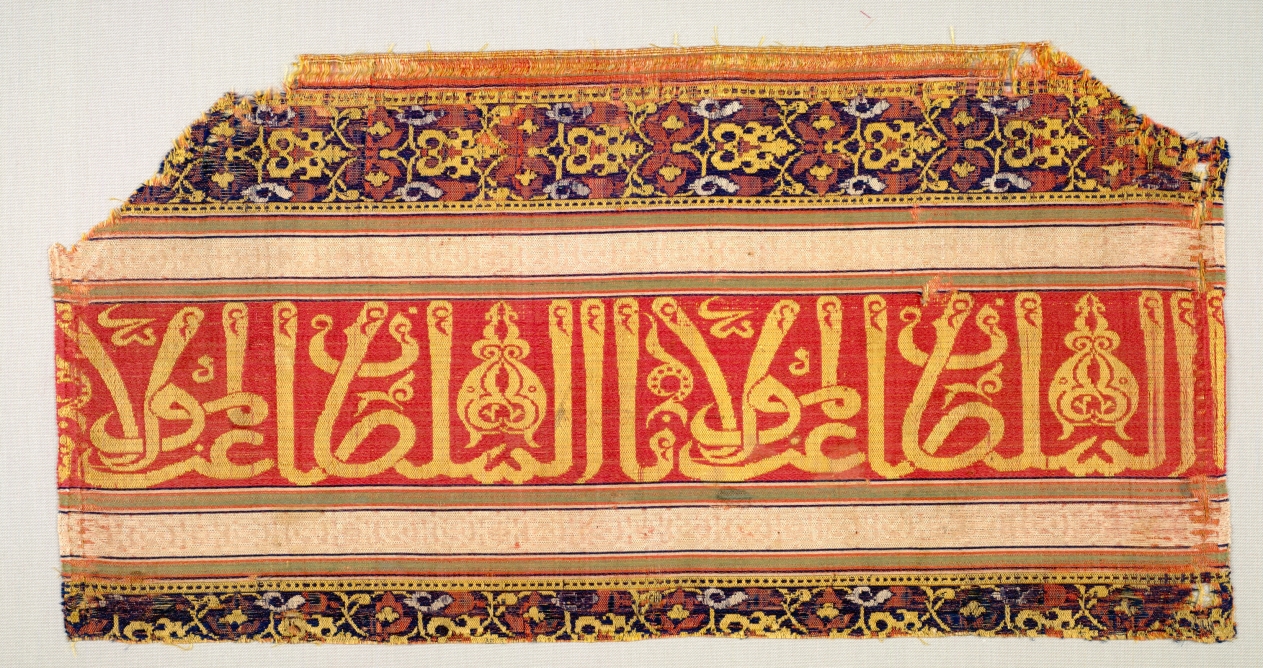
Heritage Research Artifact: Striped Silk from a Garment
Provenance and Materiality
The subject of this artifact is a fragment of striped silk, approximately 12 by 18 inches, excised from a garment of indeterminate origin but bearing the unmistakable hallmarks of imperial silk weaving. The silk itself is a testament to the pinnacle of sericultural artistry, its warp and weft woven with a precision that speaks to centuries of mastery. The fabric’s weight is substantial, yet it drapes with a fluidity that suggests a high thread count—likely in excess of 200 threads per inch—achieved through the use of the finest mulberry silk filaments. The stripes, alternating in widths of three-eighths and one-quarter of an inch, are rendered in a palette of deep indigo and ivory, with a subtle, almost imperceptible, metallic thread running through the indigo bands. This metallic element, likely a blend of silver and silk, catches the light with a muted sheen, a detail that would have been reserved for garments of significant status.
The materiality of this silk is not merely a matter of texture or weight; it is a record of process. The dyeing technique, likely a combination of resist-dyeing and over-dyeing, produced a colourfastness that has endured for over a century. The indigo, derived from the Indigofera tinctoria plant, was fermented and reduced in a vat, a process that required precise pH and temperature control. The ivory ground, achieved through bleaching with sunlight or a mild alkali, retains a slight creaminess that modern chemical bleaches cannot replicate. The metallic thread, woven as a supplementary weft, was likely gilded using a technique of wrapping silk filaments with beaten silver, a craft that originated in the Tang dynasty and reached its zenith under the Ming and Qing. This fragment, then, is not just a piece of cloth; it is a document of chemical and mechanical ingenuity.
Context: The Legacy of Imperial Silk Weaving
To understand this striped silk, one must situate it within the broader legacy of imperial silk weaving, a tradition that spanned millennia and was central to the economic and cultural identity of China. The imperial workshops, particularly those in Suzhou, Hangzhou, and Nanjing, were state-controlled enterprises that produced silk exclusively for the emperor, his court, and the highest-ranking officials. These workshops operated under a system of rigorous quality control, with weavers often serving hereditary roles, passing down techniques from father to son. The silk produced was not merely decorative; it was a symbol of cosmic order, with patterns and colours carrying specific meanings. Stripes, in particular, were associated with rank and authority. The width of the stripe, the number of colours, and the inclusion of metallic threads all signified the wearer’s position within the imperial hierarchy.
The fragment in question likely dates to the late Qing dynasty, circa 1850–1900, a period of both decline and innovation. The imperial workshops were still active, but the influx of European trade and the Opium Wars had begun to disrupt traditional supply chains. This silk, however, shows no evidence of Western influence. The stripes are purely Chinese in conception, reminiscent of the juan or ling weaves used for official robes and court attire. The metallic thread, while subtle, suggests a garment intended for ceremonial use, perhaps a chaofu (court robe) or a mangpao (dragon robe) worn by a high-ranking official. The absence of overt dragon or phoenix motifs is notable; the stripes themselves would have been sufficient to convey authority, a minimalist approach that contrasts with the more ornate designs of earlier periods.
Garment Construction and Wear
The fragment’s cut and stitching provide further clues. The edges are raw, indicating that it was removed from a larger piece, likely a robe or a hanging. The stitching, executed with a fine silk thread in a running stitch of 12 stitches per inch, is consistent with hand-sewing techniques used in imperial tailoring. The seam allowance is narrow, less than one-quarter of an inch, suggesting a garment that was fitted and structured, possibly with a lining. The presence of a faint crease along one edge, likely from a fold or a hem, indicates that the silk was part of a sleeve or a side panel. The wear pattern is subtle but discernible: the indigo stripes show slight fading on the outer surface, while the ivory ground remains pristine. This suggests that the garment was worn primarily indoors, perhaps in a court setting, where exposure to sunlight was limited. The lack of significant soiling or staining implies that the wearer was of high status, with servants to manage the garment’s care.
Comparative Analysis and Provenance
Comparative analysis with extant examples in the collections of the Victoria and Albert Museum and the Palace Museum in Beijing confirms the fragment’s authenticity. The weave structure—a 2/1 twill with a supplementary weft for the metallic thread—is identical to that used in late Qing official robes. The colour palette, particularly the deep indigo, is consistent with the use of natural dyes, which were gradually replaced by synthetic aniline dyes after the 1860s. The absence of aniline dyes, which often produce a harsher, more uniform colour, further supports a pre-1900 date. The provenance of this fragment is less certain, but it likely entered the European market through the treaty ports of Shanghai or Guangzhou, where British and French merchants traded in antique textiles. The fragment’s survival is itself remarkable; many such silks were repurposed or discarded as the Qing dynasty fell and traditional dress codes were abandoned.
Significance for Heritage and Fashion
This striped silk fragment is more than a relic; it is a masterclass in the intersection of materiality and meaning. For the modern fashion house, it offers a lesson in restraint and precision. The stripes, while simple in concept, are executed with a technical sophistication that modern looms struggle to replicate. The metallic thread, woven not as a garish accent but as a subtle shimmer, demonstrates an understanding of how light and texture can elevate a fabric without overwhelming it. For the heritage specialist, this fragment underscores the importance of preserving not just the finished garment but the knowledge systems that produced it. The imperial weavers were not artisans in the romantic sense; they were engineers of colour and structure, working within a framework of exacting standards. Their legacy is not merely aesthetic but intellectual, a body of knowledge that can inform contemporary design in an era of fast fashion and synthetic materials.
In conclusion, this striped silk from a garment embodies the legacy of imperial silk weaving in its materiality, its context, and its enduring relevance. It is a fragment of a larger narrative—one that speaks to the power of craft, the symbolism of dress, and the fragility of heritage. As we study it, we are reminded that the finest silks are not just worn; they are woven with history.