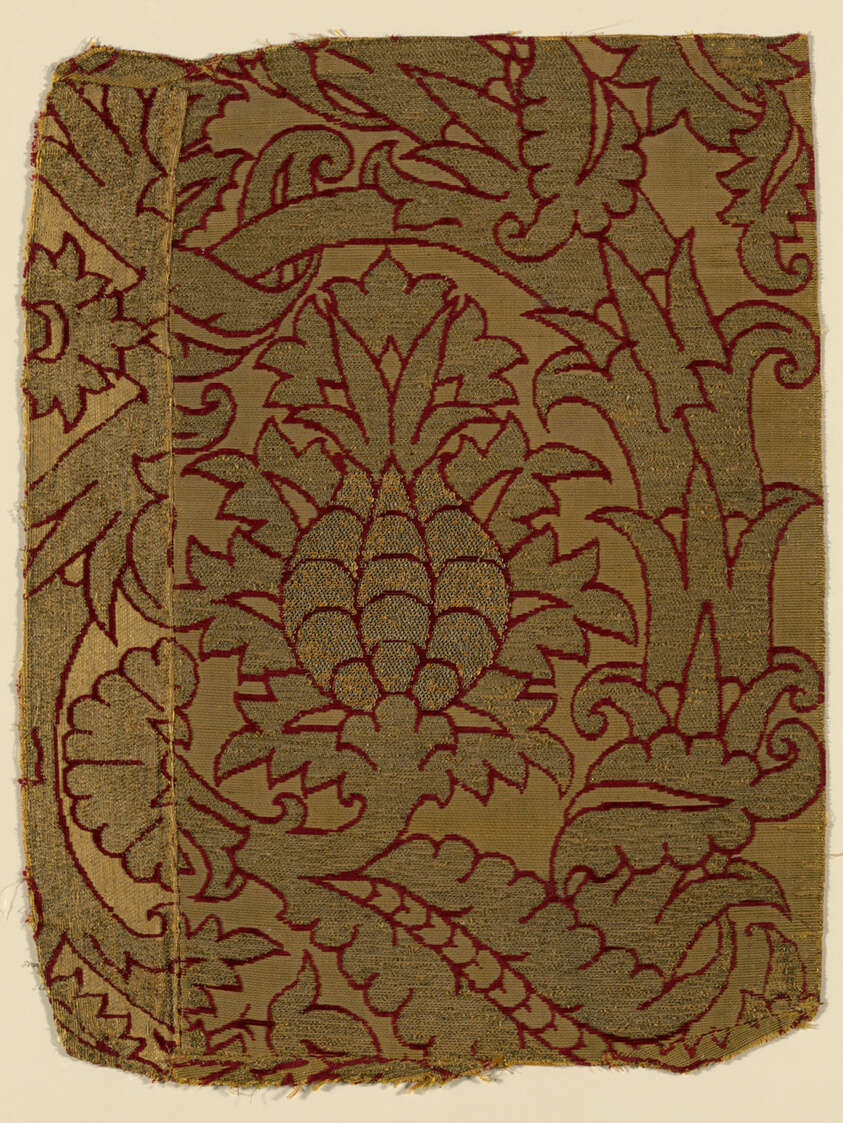
An Examination of the Fragment: Material Complexity as the Foundation of Elegance
In the considered appraisal of sartorial heritage, one must occasionally engage with the partial, the incomplete. The full garment, while instructive, often presents a totality that can obscure the fundamental truths of its construction. It is within the fragment—a discreet, perhaps even damaged, swatch—that the foundational principles of craftsmanship are laid bare, stripped of narrative and reduced to their essential, technical poetry. The presented artifact, a textile fragment, demands such a forensic yet appreciative analysis. Its material specifications—silk, plain weave with supplementary silk facing wefts, secondary binding warps tying supplementary gilt-metal-strip-wrapped silk patterning and brocading wefts forming weft loops in areas and supplementary pile warps forming cut voided velvet—are not merely a list of components. They are, in essence, its complete biography and its claim to distinction.
Structural Integrity: The Unseen Architecture
All enduring elegance is predicated upon a sound structure, a principle as true for a Savile Row canvassed coat as for this specimen of classic silk craftsmanship. Here, the plain weave ground operates as the foundational cloth, the equivalent of a master tailor’s pristine under-canvas. It provides the necessary stability and body, the silent, unseen platform upon which all subsequent ornamentation is built. This is not mere backing; it is the strategic foundation. The introduction of supplementary silk facing wefts further develops this foundation, a subtle reinforcement or modulation of the ground’s character, much like the selective use of haircloth or domette to shape a lapel’s roll or a chest’s drape. It is an early indication that this textile is engineered, not merely woven.
The Grammar of Ornament: Patterning and Texture
Upon this disciplined ground, the narrative of luxury commences. The deployment of supplementary gilt-metal-strip-wrapped silk patterning and brocading wefts represents the first order of applied artistry. This technique, brocading, is the precise, intentional introduction of decorative threads that are integral to the structure yet singular in their purpose: to create a design. The use of gilt-metal strips—likely fine silver thread gilded and wound upon a silk core—introduces a variable luminosity, a play of light dependent on the viewer’s position and the fall of the cloth. The formation of weft loops in areas indicates a deliberate manipulation of these precious threads to create textural relief, a raised, tactile dimension to the pattern. This is not flat decoration; it is topographical.
Concurrently, and representing a pinnacle of the weaver’s art, is the incorporation of supplementary pile warps forming cut voided velvet. This is a separate, immensely complex system of threads introduced to generate a plush, cut-pile surface. The term "voided" is critical: it signifies that this velvet pile does not cover the entire ground, but is selectively placed to create a pattern in contrast to the brocaded and foundation areas. The velvet elements would appear as rich, light-absorbing shapes against the shimmering, reflective brocade and the matte ground. The skill required to coordinate these multiple, independent thread systems—ground, brocading wefts, and pile warps—within a single loom operation is extraordinary. It is the textile equivalent of a master tailor executing complex drape, structure, and hand-stitched embroidery upon a single garment, with each element perfectly harmonised and none compromising the integrity of the other.
Fluid Elegance: The Synthesis of Contradictions
The stated context, classic silk craftsmanship and fluid elegance, finds its full justification in this synthesis. The craftsmanship is evident in the formidable technical orchestration. The elegance, however, is born from the result. This fragment embodies a sophisticated dialogue of contrasts: the structural rigidity of the plain weave against the pliant luxury of cut velvet; the sharp, metallic brilliance of the brocade against the deep, muted shadow of the pile; the flat plane of the ground against the three-dimensional topography of loops and velvet. Yet, these contrasts are resolved into a singular, fluid whole.
The true test of such a textile, as with a bespoke suit, is in its behaviour in motion. The weight, balance, and differential drape of these combined elements would create a dynamic visual and tactile experience. The light would catch the gilt threads differently with each movement, while the velvet portions would provide depth and richness. The fluidity is not in spite of the complex structure, but a direct consequence of its perfect execution. Each thread system, each technical decision, is subservient to the final, holistic effect—a cloth that moves with a sovereign, dignified grace.
Conclusion: The Fragment as Testament
This fragment, therefore, transcends its damaged, incomplete state. It stands as a complete testament to a philosophy of construction where material complexity serves a higher goal of refined effect. Every technical term in its description corresponds to a deliberate choice aimed at achieving a specific aesthetic and haptic sensation. In the world of heritage tailoring, we speak of the "hand" of a cloth—its feel, its drape, its character. This fragment, through its multi-layered construction, possesses a "hand" of profound complexity and intention. It reminds us that ultimate luxury resides not in ostentation, but in the resolved harmony of multiple, perfectly executed disciplines. It is, in its essence, the sartorial principle of "less is more" inverted and proven anew: here, more—infinitely more skill, more material, more forethought—results in a sublime, unified, and ultimately fluid whole. The artifact, though a fragment, speaks volumes of the complete artistry from which it came.