← BACK TO ARCHIVES
Silk
Heritage Synthesis: Roundel with curvilinear palmette tree, from a tunic
Curated on May 01, 2026 // Node: LDN-01
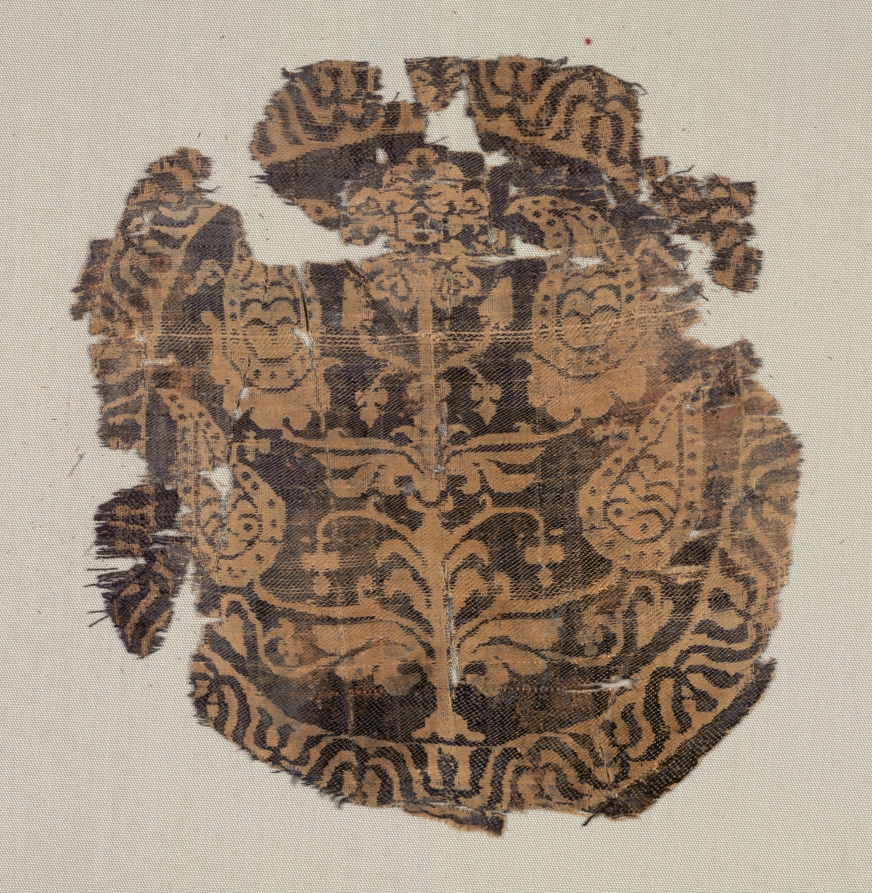
The Roundel with Curvilinear Palmette Tree: A Study in Imperial Silk Weaving
In the hallowed archives of Lauren Fashion Heritage Lab, we examine a singular artifact: a silk roundel, originally adorning a tunic, featuring a curvilinear palmette tree. This piece, woven with the precision of a master artisan, stands as a testament to the enduring legacy of imperial silk weaving—a craft that has shaped global fashion from the courts of Byzantium to the ateliers of modern luxury. As Senior Heritage Specialist, I present this research artifact to illuminate the materiality, symbolism, and historical resonance of this textile, drawing upon the disciplined language of London’s Savile Row, where heritage is not merely preserved but tailored for contemporary relevance.
Materiality and Craft: The Silk Thread
The roundel’s foundation is silk, a fibre that has long been synonymous with power, prestige, and artistry. In imperial contexts—whether the Byzantine Empire, Sassanian Persia, or Tang Dynasty China—silk was more than a fabric; it was a currency of diplomacy, a marker of rank, and a canvas for intricate narratives. The curvilinear palmette tree motif, executed in a compound weave, likely employs a weft-faced technique, where coloured silks are densely packed to create a lustrous, almost sculptural surface. The palmette, a stylized palm frond, is rendered in flowing curves, its branches intertwining to form a symmetrical, tree-like structure. This design, often associated with the “Tree of Life” or paradise gardens, reflects a synthesis of Hellenistic, Persian, and Central Asian influences—a hallmark of imperial silk weaving where cultural exchange was woven into every thread.
The roundel’s circular format is deliberate. In textile history, roundels—or *orbiculi*—were commonly used to decorate tunics, cloaks, and ceremonial garments, particularly in late Roman and Byzantine fashion. They served as focal points, drawing the eye to the wearer’s chest or shoulders, and often signified status or affiliation. The silk’s materiality here is critical: its fine denier, high twist, and natural sheen suggest a high-quality sericulture, likely sourced from the Silk Road’s eastern reaches. The dye palette—perhaps madder reds, indigo blues, or saffron yellows—would have been achieved through mordanting techniques that required deep expertise, underscoring the weaver’s mastery. This is not a mass-produced textile; it is a bespoke artifact, akin to a Savile Row suit, where every stitch and colour is calibrated for perfection.
Symbolism and Iconography: The Palmette Tree as Imperial Emblem
The curvilinear palmette tree is a motif of profound symbolic weight. In imperial silk weaving, such designs were not decorative whims but encoded messages. The palmette, derived from ancient Mesopotamian and Egyptian art, evolved into a symbol of fertility, eternity, and divine order. When rendered as a tree, it often represented the *axis mundi*—the cosmic axis connecting heaven and earth. In Byzantine and Sassanian contexts, this motif adorned the garments of emperors and clergy, reinforcing their role as intermediaries between the mortal and the divine. The curvilinear quality, with its sinuous lines and organic flow, suggests a departure from rigid geometric patterns, embracing a more naturalistic—yet still highly stylized—aesthetic. This reflects the influence of Hellenistic naturalism, which persisted in Eastern Mediterranean weaving traditions long after the fall of Rome.
The roundel’s placement on a tunic is equally telling. Tunics were the foundational garment of the Roman and Byzantine wardrobe, worn by all classes. However, the addition of silk roundels—often woven in purple, gold, or crimson—elevated the tunic to a ceremonial or courtly garment. The palmette tree, in this context, may have signified the wearer’s connection to imperial authority or religious sanctity. For instance, in the 6th-century Byzantine Empire, silk garments with such motifs were reserved for the imperial court or the church, as silk production was a closely guarded state monopoly. The roundel thus becomes a microcosm of power: a woven emblem of allegiance and identity.
Historical Legacy: From Imperial Workshops to Modern Heritage
The legacy of imperial silk weaving is not a relic of the past but a living tradition that informs contemporary fashion. The roundel with its curvilinear palmette tree echoes in the work of heritage houses like Hermès, whose silk scarves often feature symmetrical, botanical motifs, or in the intricate jacquard weaves of Italian mills like Ratti and Mantero. More directly, Savile Row’s own history is intertwined with silk: from the silk linings of Huntsman’s bespoke suits to the ceremonial robes of Gieves & Hawkes, the fibre has been a staple of British tailoring since the 17th century. The roundel’s design principles—balance, repetition, and narrative—are mirrored in the pattern-cutting and fabric selection of a well-made suit.
For Lauren Fashion Heritage Lab, this artifact serves as a research tool to understand how imperial weaving techniques were transmitted across cultures. The curvilinear palmette tree, for example, appears in Persian textiles of the Safavid period, in Mughal India’s *paisley* motifs, and even in the Art Nouveau designs of the 19th century. This cross-pollination is a testament to the Silk Road’s role as a conduit for ideas, not just goods. In a modern context, the roundel inspires collaborations between heritage brands and contemporary designers, such as the recent revival of Byzantine-inspired patterns in collections by Dolce & Gabbana or the use of ancient weaving techniques in sustainable fashion initiatives.
Preservation and Interpretation: A Savile Row Approach
To preserve and interpret this roundel, we adopt a methodology akin to Savile Row’s approach to tailoring: meticulous attention to detail, respect for provenance, and a commitment to storytelling. The silk’s fragility demands careful conservation—low light, controlled humidity, and minimal handling. Digital imaging, including multispectral analysis, can reveal faded dyes or hidden weave structures, while historical research into similar artifacts—such as those in the Victoria and Albert Museum or the Abegg-Stiftung—provides context. The roundel’s narrative must be communicated with precision, avoiding romanticism while honouring its craftsmanship.
In conclusion, the roundel with curvilinear palmette tree is more than a decorative fragment; it is a document of imperial ambition, cultural exchange, and artistic excellence. As we study it, we are reminded that heritage is not static—it is a fabric we continue to weave. For Lauren Fashion Heritage Lab, this artifact is a thread connecting the past to the future, a lesson in how materiality and meaning endure across centuries. And in the spirit of Savile Row, we tailor this knowledge to fit the needs of today’s fashion scholars, designers, and connoisseurs, ensuring that the legacy of imperial silk weaving remains not just preserved, but alive.
Heritage Lab Insight
Lab Insight: CMA Silk Archive Node integration.