A Fragment of Sovereignty: On the Woven Assertion of the Imperial Loom
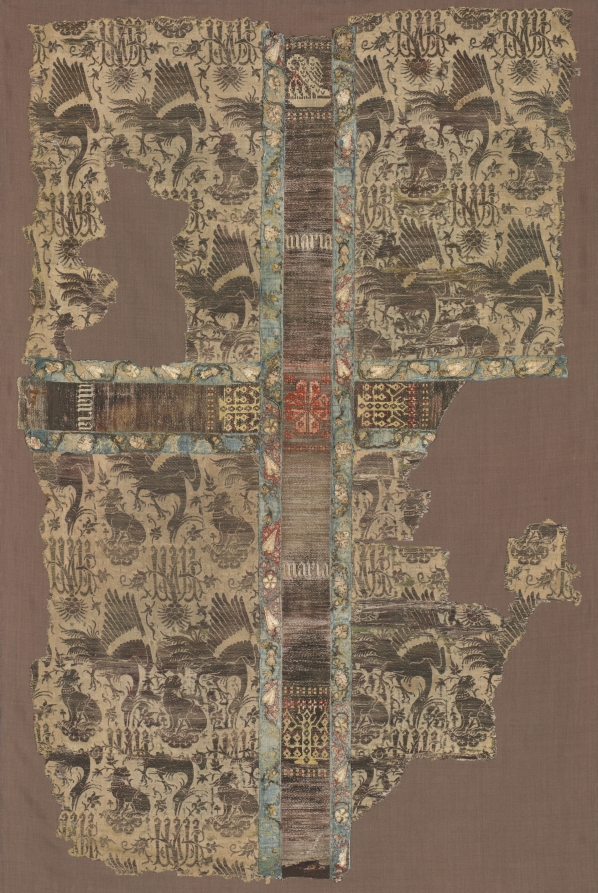
To consider silk is to engage with a material lexicon of power. It is not merely a fibre, but a deliberate articulation of authority, a tangible expression of a civilisation’s technological zenith and its aesthetic ambition. The fragmentary chasuble with its woven orphrey band, presented for our examination, is a profound testament to this truth. It is a relic, yes—a survivor of time’s attrition—but within its warp and weft lies an entire narrative of imperial legacy, a narrative woven not with thread alone, but with intention, orthodoxy, and an unyielding command of the loom.
The Ground: Chasuble as Canvas
First, one must appreciate the foundation: the chasuble itself. As the principal vestment of the Eucharistic celebrant, its form is a sacred silhouette, a garment designed to confer dignity and focus upon the ritual act. In its pristine, whole state, it was a field of colour, often a profound crimson or a celestial blue, upon which the orphrey bands would sit as structured borders. This fragment, however, speaks of a different history. Its survival in piecemeal form is not a mark of neglect, but rather an indicator of its inherent value. These textiles were, quite literally, investments of capital and devotion, too precious to discard. Over centuries, as the main body frayed or was damaged, the orphreys—the most technically accomplished and symbolically dense elements—were carefully excised and often reapplied to newer garments. Thus, our fragment is not a ruin; it is a carefully preserved core, the essence of the garment salvaged for continued veneration.
The Orphrey: A Woven Doctrine
It is the orphrey band that demands, and rewards, the most meticulous scrutiny. Unlike an embroidered band, where needlework is applied to a ground, a woven orphrey is integral to its own structure. Its design is not superimposed; it is born simultaneously with its foundation. This technique, the pinnacle of the draw-loom weaver’s art, represents a formidable assertion of control. Every saintly figure, every foliate scroll, every heraldic emblem is not stitched, but engineered into the very matrix of the fabric. The imperial silk workshops—be they in Byzantium, Lucca, or later, Lyon—operated as closed systems of genius, where pattern books were guarded as state secrets, and the complex machinery required was a monopoly of the crown or the privileged guild. To produce such a band was to demonstrate a mastery that was both artistic and geopolitical. The silk thread itself, likely spun from the finest Italian or Spanish cocoons, dyed with rare and costly pigments—crimson from kermes, blue from lapis lazuli—was a commodity as tracked and taxed as bullion. The resulting orphrey is, therefore, a condensed ribbon of sovereignty, a mobile testament to an empire’s reach, wealth, and doctrinal certainty.
Imperial Legacy: The Loom as an Instrument of State
The context of imperial silk weaving is not a backdrop; it is the very engine of this artifact. From the gynaecea of the late Roman Empire to the sophisticated kesi silks of China, the control of silk production has always been a cornerstone of statecraft. It served a tripartite purpose: economic, through lucrative trade and import substitution; symbolic, through the gifting of silks as tools of diplomacy and markers of favour; and ideological, through the dissemination of approved imagery. In the case of a liturgical orphrey, this imagery is particularly potent. The likely depiction of saints, apostles, or scenes from the Passion does more than decorate; it reinforces orthodoxy. It aligns the wearer—and by extension, the congregation—with a specific, sanctioned visual theology. The imperial workshop, by supplying the Church, wove the very fabric of sacred authority, stitching the spiritual and temporal realms together with golden threads. This fragment, then, is a piece of soft power. It is the aesthetic arm of the state, manifested in a priest’s vestments, proclaiming a unified, hierarchical vision of the cosmos, from the emperor’s court to the parish altar.
Conclusion: The Quiet Authority of the Fragment
To hold this fragment—to observe the precise, unyielding geometry of a saint’s halo executed in silk and metal thread, to note the subtle, enduring lustre of the dyes—is to understand that true authority often speaks in a register just above a whisper. It does not shout. It endures. The Savile Row cutter knows this intimately; the power of a garment lies in its silent confidence, in the integrity of its internal construction, in the legacy of its cloth. This chasuble fragment operates on the same principle, though its purpose is celestial rather than sartorial. It represents the apogee of a regulated, imperial craft, where beauty was systematised, and devotion was given a uniform. It is a shattered tile from a vast mosaic of controlled magnificence. In its survival, we find not just a relic of textile history, but a document of world order—a world where the loom was as potent as the legislature, and a woven band could shoulder the weight of an empire’s faith. Its message, though fragmented, remains impeccably clear.