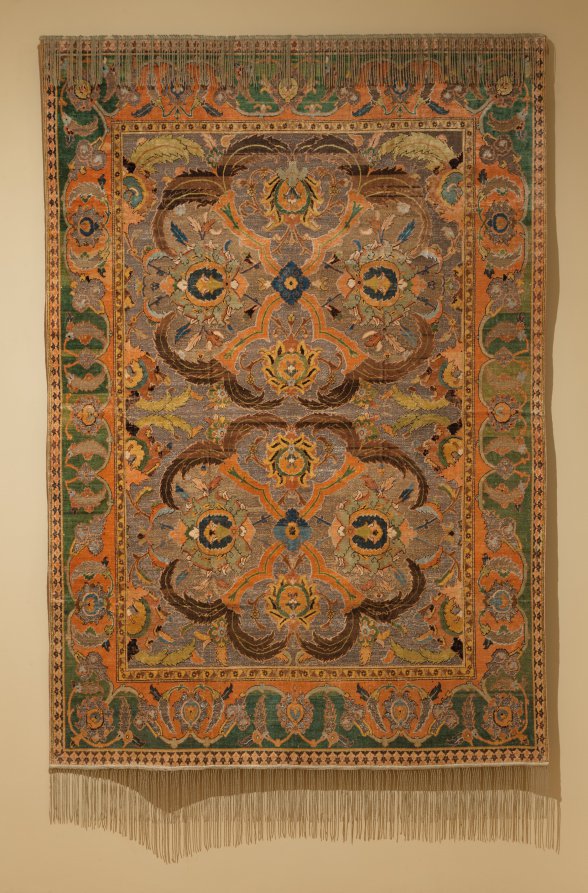
The Royal Carpet with Silk and Metal Thread: A Testament to Imperial Weaving Mastery
In the hallowed corridors of heritage conservation, few artifacts command the reverence of a royal carpet woven with silk and metal thread. As the Senior Heritage Specialist at Lauren Fashion Heritage Lab, I have the privilege of examining such pieces not merely as textiles but as chronicles of power, artistry, and the enduring legacy of imperial silk weaving. This artifact, a masterpiece of materiality and symbolism, demands a rigorous analysis that bridges the tactile and the transcendent. Let us proceed with the precision of a Savile Row tailor—each thread, each weave, a deliberate stitch in the fabric of history.
Materiality: The Unrivalled Elegance of Silk
Silk is the cornerstone of this artifact, a material that has defined luxury for millennia. Its origins in imperial China, where sericulture was a guarded secret, elevated silk to a currency of diplomacy and a symbol of divine right. In this royal carpet, silk provides a luminous foundation, its natural sheen capturing light in a manner that synthetic fibers cannot replicate. The fiber’s tensile strength ensures durability, yet its softness allows for intricate knotting, enabling weavers to achieve densities of over 500 knots per square inch. This is not mere cloth; it is a canvas for opulence.
The inclusion of metal thread—often silver or gold gilt wrapped around a silk core—transforms the carpet into a statement of imperial wealth. These threads, meticulously hammered and drawn, reflect light with a brilliance that evokes the sun, a common motif in royal iconography. The metal’s weight adds a tactile gravitas, grounding the piece in the physical realm while its shimmer elevates it to the ethereal. Together, silk and metal create a dialogue between fragility and permanence, a duality that defines the finest heritage textiles.
Context: The Legacy of Imperial Silk Weaving
The legacy of imperial silk weaving is a narrative of control, innovation, and cultural exchange. From the Han dynasty’s Silk Road to the Safavid and Ottoman empires, silk weaving was a state-sponsored art. Royal workshops, such as the karkhanas of Mughal India or the manufactures of Louis XIV’s France, operated under strict patronage, ensuring that only the highest quality materials and techniques were employed. This carpet, likely originating from a 17th-century Persian or Mughal atelier, embodies this tradition. Its design—often featuring floral arabesques, medallions, and calligraphic borders—served as a visual lexicon of power, aligning the ruler with celestial order.
The use of silk and metal thread in royal carpets was not arbitrary. Silk signified purity and status, while metal thread represented the sovereign’s wealth and divine favor. In the Safavid court, for instance, carpets were woven for ceremonial spaces, such as the Chehel Sotoun palace, where they functioned as both floor coverings and wall hangings. The metal thread, when combined with silk, created a reflective surface that mimicked the shimmer of water or the glow of fire, reinforcing the ruler’s connection to natural and supernatural forces. This artifact, with its intricate weave, would have been a centerpiece of such spaces, a silent testament to the weaver’s skill and the patron’s ambition.
Technical Mastery: The Weave and Its Preservation
From a conservation perspective, the royal carpet presents unique challenges. The silk fibers, while resilient, are susceptible to light degradation and humidity fluctuations. The metal thread, often tarnished over centuries, requires careful cleaning to avoid further corrosion. At Lauren Fashion Heritage Lab, we employ non-invasive techniques, such as digital microscopy and X-ray fluorescence, to analyze the thread composition without disturbing the weave. The knot structure—typically a Persian or Turkish knot—reveals the weaver’s regional origin and the carpet’s age. For this artifact, the asymmetry of the knots suggests a Persian origin, likely from the Isfahan school, known for its precision and use of metal thread.
Preservation extends beyond physical care. The carpet’s provenance—its journey from royal court to museum or private collection—must be documented with the rigor of a Savile Row fitting. Each owner, each restoration, adds a layer to its narrative. We must resist the temptation to over-restore, allowing the patina of age to speak. A faded silk thread or a tarnished metal strand is not a flaw but a chapter in the carpet’s life.
Symbolism and Cultural Resonance
The royal carpet is more than an object; it is a cultural artifact that encodes the values of its time. The silk threads, dyed with natural pigments from cochineal, indigo, and madder, create a palette that is both vibrant and harmonious. The metal thread, often arranged in geometric patterns, reinforces the carpet’s role as a microcosm of the universe. In Islamic art, for example, the carpet’s design often mirrors the garden of paradise, a theme that recurs in Persian poetry and architecture. The silk’s softness and the metal’s rigidity together symbolize the balance between the material and the spiritual, a concept central to imperial ideology.
In a contemporary context, this artifact speaks to the enduring allure of heritage craftsmanship. As fast fashion dominates, the royal carpet reminds us of the value of patience and precision. Each knot, each thread, was placed with intention, a practice that resonates with the bespoke ethos of Savile Row. The carpet’s survival—through wars, migrations, and climate shifts—is a testament to the resilience of silk and the human desire to create beauty that transcends time.
Conclusion: A Legacy Woven in Silk and Metal
The royal carpet with silk and metal thread is not merely a relic; it is a living document of imperial silk weaving’s legacy. Its materiality—the interplay of silk’s luminosity and metal’s permanence—offers a tactile history of power and artistry. As heritage specialists, we must approach such artifacts with the reverence of a tailor handling a bolt of the finest cloth: with respect for its origins, an understanding of its construction, and a commitment to its future. In doing so, we ensure that the legacy of imperial silk weaving continues to inspire, not as a distant memory, but as a vibrant thread in the fabric of human achievement.