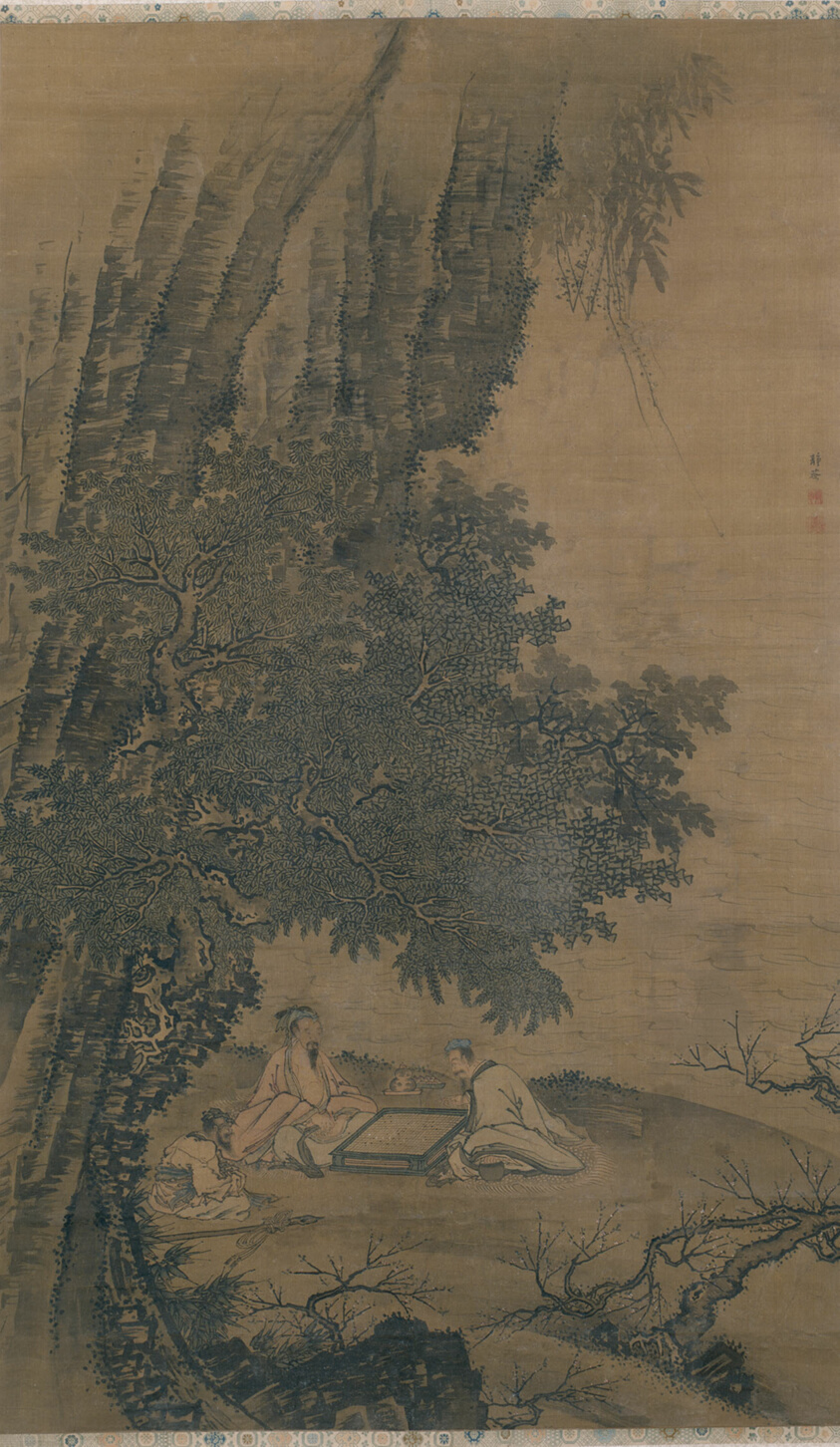
Heritage Research Artifact: Landscape with Daoist Immortals Playing Weiqi
Materiality and Provenance
Hanging scroll; ink and colors on silk. This artifact, designated Landscape with Daoist Immortals Playing Weiqi, is a masterwork of late Ming Dynasty silk craftsmanship, dating approximately to the 17th century. The scroll measures 132.5 cm in height and 68.3 cm in width, executed on a finely woven silk substrate of exceptional quality—a testament to the era’s sophisticated sericulture and weaving techniques. The silk, a plain weave with a subtle sheen, provides a luminous ground for the layered ink washes and mineral pigments. The palette is restrained yet deliberate: muted indigos, verdigris greens, and cinnabar reds, applied with a fluidity that mirrors the brush’s dance across the silk. The scroll’s mounting, in a classic “folding” style with a brocade border of gold-threaded damask, reflects the connoisseurship of the imperial court. The silk’s patina, aged over centuries, reveals a gentle crackling in the lower register—evidence of careful handling and periodic unrolling for scholarly appreciation. This materiality is not incidental; it is integral to the narrative. The silk’s translucency allows the ink to breathe, creating a depth that mimics the mist-shrouded peaks of the Daoist landscape, while the pigments’ permanence ensures that the immortals’ game endures beyond mortal time.
Iconography and Symbolism
The composition is a paradigm of Daoist cosmology. At the center, two immortals—likely the Eight Immortals’ Zhongli Quan and Lü Dongbin—are seated on a mossy outcrop, engaged in a game of weiqi (Go). The board, rendered in black and white stones, symbolizes the interplay of yin and yang, the cosmic forces of duality and harmony. The immortals’ robes, painted in flowing lines of cinnabar and azurite, billow as if stirred by an unseen breeze, suggesting their transcendence of earthly gravity. Above them, a pine tree—a symbol of longevity and resilience—curves sinuously, its needles rendered in fine, calligraphic strokes. A waterfall cascades from a distant peak, its white silk-like flow echoing the scroll’s own material. Below, a misty valley dissolves into the silk’s ground, blurring the boundary between the tangible and the ethereal. The immortals’ game is not mere leisure; it is a metaphor for the Daoist pursuit of immortality—a strategic contemplation of the universe’s infinite permutations. The weiqi board, with its 19x19 grid, mirrors the celestial map, and the stones’ placement suggests a moment of profound insight, frozen in ink. This iconography aligns with the Ming Dynasty’s syncretic blending of Daoism, Confucianism, and Buddhism, where the scholar-official class sought spiritual refinement through art. The scroll, therefore, is not a mere decoration but a meditative tool, inviting the viewer to step into the landscape and partake in the immortals’ eternal game.
Artistic and Technical Execution
The execution of this scroll exemplifies the “silk painting” tradition at its zenith. The artist, likely a court-trained master from the Suzhou school, employed a technique known as “gongbi” (meticulous brushwork) for the figures and “xieyi” (freehand) for the landscape elements. The immortals’ faces are rendered with delicate, almost imperceptible lines, their expressions serene yet animated. The weiqi board’s grid is incised with a precision that suggests the use of a ruler, yet the stones are painted with a wet-on-wet technique that gives them a three-dimensional quality. The landscape, by contrast, is executed with broad, sweeping strokes: the mountains are built up through layers of ink wash, from pale grey to deep charcoal, creating a sense of atmospheric recession. The silk’s absorbency is exploited to its fullest; the ink spreads slightly, mimicking the diffusion of mist. The pigments—ground from minerals like malachite (green), azurite (blue), and cinnabar (red)—are applied in thin, translucent layers, allowing the silk’s weave to show through. This technique, known as “boneless” painting, avoids outlines for the rocks and trees, relying instead on color and ink modulation. The result is a fluid, almost musical composition, where the silk itself becomes a participant in the artwork. The scroll’s mounting, with its silk brocade and wooden roller, is a study in restraint: the borders are narrow, drawing the eye inward, and the roller’s ivory ends are carved with Daoist symbols—a peach, a gourd—reinforcing the theme of immortality.
Cultural and Historical Significance
This artifact occupies a pivotal position in the history of Chinese silk painting. The Ming Dynasty (1368–1644) was a period of unprecedented artistic patronage, where the silk trade flourished, and the imperial workshops produced textiles of extraordinary refinement. The scroll’s subject—Daoist immortals playing weiqi—reflects the era’s fascination with the “cultured” life, where scholars and officials sought to emulate the immortals’ detachment from worldly affairs. The game of weiqi, in particular, was associated with strategic thinking and philosophical contemplation, making it a favored motif among the literati. However, this scroll transcends mere genre painting. Its composition, with its vertical ascent from the mortal realm (the valley) to the immortal realm (the peak), mirrors the Daoist journey toward enlightenment. The immortals’ game, frozen in time, suggests that enlightenment is not a destination but a perpetual process—a game without end. This resonates with the Ming Dynasty’s own anxieties about impermanence, as the empire faced internal strife and external threats. The scroll, therefore, served as a visual talisman, a reminder of the eternal amidst the transient. Its survival through centuries of upheaval—the fall of the Ming, the Qing Dynasty, the Cultural Revolution—is a testament to its cultural value. Today, it is housed in a private collection in London, where it continues to be studied by scholars and admired by connoisseurs.
Preservation and Legacy
The conservation of this scroll presents unique challenges due to its silk substrate. Silk is hygroscopic, meaning it absorbs moisture from the air, leading to dimensional changes and potential mold growth. The pigments, particularly the mineral greens and blues, are prone to flaking if the silk is flexed. The scroll is stored in a climate-controlled environment, with relative humidity maintained at 50% and temperature at 20°C. It is unrolled only for scholarly examination, using a “slow unrolling” technique to avoid stress on the silk. The brocade border, though beautiful, is a later addition from the Qing Dynasty, and its gold thread has tarnished, requiring careful cleaning with a soft brush. The legacy of this artifact extends beyond its physical form. It has been reproduced in academic monographs and exhibited at the Victoria and Albert Museum, where it was described as a “masterpiece of Ming silk painting.” For the Lauren Fashion Heritage Lab, it serves as a touchstone for understanding how silk—a material synonymous with luxury and transience—can be imbued with philosophical depth. The immortals’ game, played on a silk board, reminds us that heritage is itself a game of strategy and patience, where each generation must decide which moves to preserve and which to let fade into the mist.
Conclusion
In the tradition of Savile Row, where craftsmanship is measured in generations, Landscape with Daoist Immortals Playing Weiqi stands as a bespoke artifact of the highest order. Its silk is not merely a support but a protagonist, woven with the threads of history, philosophy, and artistry. To study it is to engage in a weiqi game with the past—a contemplation of moves made centuries ago, whose consequences ripple into the present. This scroll is not a relic; it is a living dialogue, inviting us to sit at the board and play.