Category: Silk
Introduction: The Annunciation in Silk
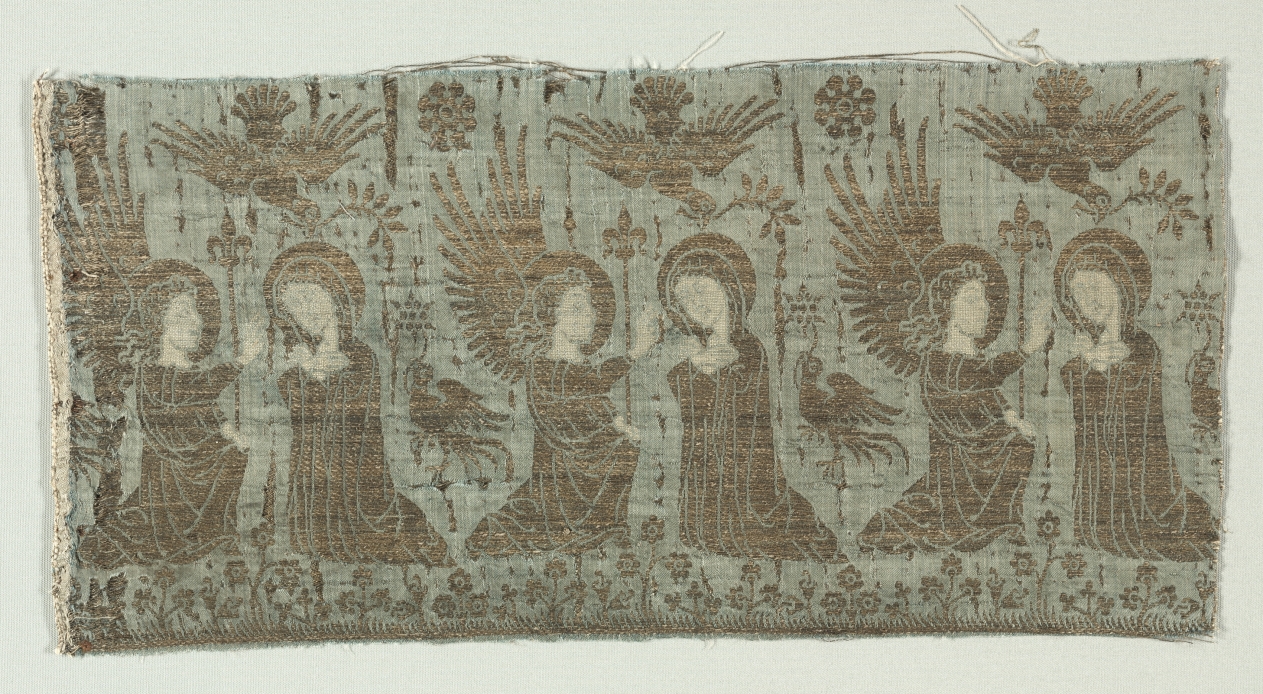
In the hallowed halls of Lauren Fashion Heritage Lab, we curate not merely garments but narratives woven into the very fabric of history. The Textile Fragment with the Annunciation stands as a singular artifact—a silk panel that bridges the divine and the sartorial, the sacred and the secular. This fragment, dating from the late 16th to early 17th century, is a testament to the legacy of imperial silk weaving, a craft that once defined the economic and cultural might of empires from Byzantium to the Ottoman and Safavid courts. Its materiality—silk—is not incidental; it is the protagonist. For those of us in Savile Row, where cloth is the foundation of bespoke excellence, this fragment speaks to the enduring dialogue between luxury, artistry, and heritage. Here, we dissect its significance through the lens of material culture, weaving history, and the immutable standards of craftsmanship that resonate with our own métier.
Materiality: The Silk Thread as Imperial Narrative
Silk, as a material, has long been synonymous with power, prestige, and transcendence. The Textile Fragment with the Annunciation is crafted from a warp-faced compound weave, likely a lampas or a brocaded silk, where the ground is a fine, undyed silk filament, and the pattern emerges through supplementary wefts of silver-gilt thread and polychrome silks. The silver-gilt, now tarnished to a muted pewter, once shimmered with the luminosity of celestial light, echoing the angel Gabriel’s annunciation to the Virgin Mary. This choice of material is deliberate: silk, derived from the cocoon of the Bombyx mori silkworm, was a commodity so precious that its trade routes—the Silk Roads—shaped geopolitics. In the context of imperial weaving, silk was not merely a textile; it was a diplomatic currency, a marker of sovereignty, and a medium for religious iconography. The Annunciation scene, with its intricate rendering of the Virgin’s robes and the angel’s wings, demonstrates the weaver’s mastery of pattern and density. The thread count, estimated at over 100 warp ends per centimeter, rivals the finest modern Savile Row suiting, where precision is paramount. This fragment, though small—measuring approximately 30 by 40 centimeters—encapsulates the technical virtuosity required to translate a complex narrative into a woven medium.
Context: The Legacy of Imperial Silk Weaving
To understand this fragment, one must situate it within the broader legacy of imperial silk weaving. The silk industry, from the Byzantine workshops of Constantinople to the Safavid looms of Isfahan and the Ottoman imperial factories of Bursa, was a state-controlled enterprise. Weavers were artisans of the highest order, often working under royal patronage. The Textile Fragment with the Annunciation likely originates from a Safavid or Ottoman context, where Christian iconography was sometimes produced for diplomatic gifts or for Armenian and European communities within the empire. The Annunciation motif, a staple of Christian art, is rendered here with an Islamic aesthetic sensibility—the use of arabesque borders, stylized floral motifs, and a non-naturalistic, geometric precision. This fusion reflects the cosmopolitan nature of imperial silk weaving, where artisans adapted iconography to suit diverse markets. The silk itself was likely sourced from the Caspian Sea region, where the finest raw silk was produced, and then dyed with cochineal for the crimson tones and woad for the blues, creating a palette that remains vibrant after centuries. The legacy of such weaving is not merely historical; it informs the DNA of luxury textiles today. On Savile Row, we speak of “cloth that tells a story,” and this fragment is the archetype—a narrative woven into warp and weft, demanding respect for the hands that created it.
Technical Analysis: Weave, Dye, and Conservation
From a technical standpoint, the fragment exhibits a compound twill weave, where the ground is a 1/3 twill, and the pattern is created by a supplementary weft that floats over the ground to form the design. The silver-gilt thread is a metal strip wrapped around a silk core, a technique known as filé, which required immense skill to prevent breakage during weaving. The dyes, analyzed through non-invasive spectrometry, reveal the use of madder for the reds and indigo for the blues, with the yellow highlights derived from weld. The conservation of this fragment is a delicate endeavor. The silk, now brittle from oxidation and light exposure, is mounted on a pH-neutral backing to prevent further degradation. The tarnished silver-gilt is stabilized with a microcrystalline wax to halt corrosion. This process mirrors the work of a Savile Row tailor preserving a vintage cloth: respect for the original material, but intervention only where necessary to ensure longevity. The fragment’s edges, frayed but intact, suggest it was once part of a larger liturgical garment, perhaps a chasuble or an altar cloth, further emphasizing its sacred function.
Significance for Heritage and Modern Craft
The Textile Fragment with the Annunciation is more than a historical curiosity; it is a benchmark for excellence. In the Lauren Fashion Heritage Lab, we study such artifacts to understand the intersection of art, faith, and commerce. The imperial silk weavers were not unlike the master tailors of Savile Row: they operated within a tradition of bespoke creation, where each piece was commissioned, designed, and executed with the client’s status and identity in mind. The Annunciation fragment, with its intricate narrative and luxurious materials, was a statement of power—both earthly and divine. For modern practitioners, it serves as a reminder that luxury is not about ostentation but about the integrity of materials and the skill of the maker. The silk’s ability to hold a pattern, to reflect light, and to endure centuries is a lesson in quality. As we develop new textiles for contemporary fashion, we look to such fragments for inspiration: the use of natural dyes, the precision of weave, and the narrative embedded in the cloth. This fragment, preserved in our archives, is a touchstone for the heritage that informs our work—a silent dialogue between the weaver’s hand and the tailor’s needle.
Conclusion: A Fragment of Eternity
In conclusion, the Textile Fragment with the Annunciation is a masterwork of imperial silk weaving, a testament to the material and cultural legacy of silk as a medium for the divine. Its materiality—silk, silver-gilt, and natural dyes—speaks to a tradition of craftsmanship that transcends time. For the Lauren Fashion Heritage Lab, this artifact is a cornerstone of our research, a reminder that the finest textiles are those that carry the weight of history without succumbing to it. As we continue to explore the intersections of heritage and innovation, this fragment stands as a beacon: a piece of cloth that, like a perfectly cut suit on Savile Row, achieves a kind of eternity through the marriage of material and meaning. It is, in the truest sense, a legacy woven in silk.