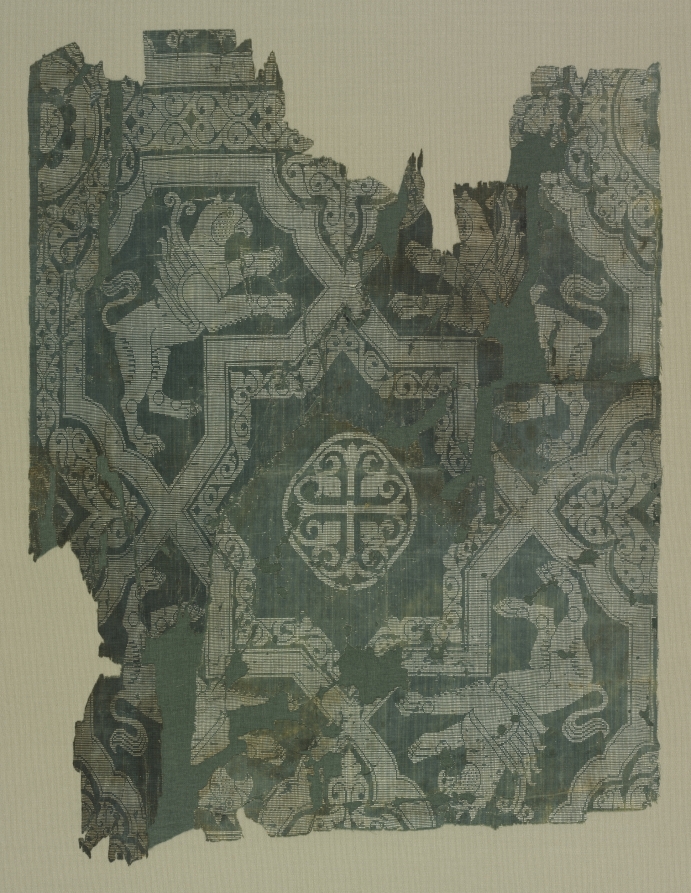
Fragment with Star Pattern and Griffins: A Study in Imperial Silk Weaving
Introduction: The Artifact in Context
This fragment, a surviving piece of a larger textile narrative, represents a pinnacle of imperial silk weaving. Its materiality—silk—speaks to a legacy of luxury, power, and technical mastery that defined the courts of ancient and medieval empires. The fragment features a repeating star pattern interspersed with griffins, mythical creatures that combine the strength of a lion with the vigilance of an eagle. This design is not merely decorative; it is a coded language of authority, protection, and celestial order. As a heritage artifact, it offers a tangible link to the sophisticated workshops of the Silk Road and the imperial ateliers that produced such textiles for elite consumption. The fragment’s condition—frayed edges, faded dyes, and partial weave—adds to its historical gravitas, reminding us of the fragility of even the most opulent creations.
Materiality: The Silk Threads of Empire
Silk is the foundational material of this artifact, and its selection was no accident. In imperial contexts, silk was a currency of status, a diplomatic gift, and a symbol of divine mandate. The fragment’s weave suggests a compound structure, likely a lampas or samite, where the pattern is created by supplementary wefts bound to a ground weave. This technique, perfected in the Tang and Byzantine empires, allowed for intricate, multi-coloured designs. The star pattern, likely woven in gold or silver thread, would have shimmered in candlelight, reinforcing the celestial associations of the motif. The griffins, rendered in a contrasting hue, would have appeared to guard the stars, a visual metaphor for the emperor’s role as protector of cosmic order. The silk’s density and sheen indicate a high thread count, a hallmark of imperial workshops where quality was paramount. The dyes—likely derived from madder, indigo, and kermes—would have been imported from distant lands, further underscoring the global reach of the empire that commissioned this textile.
Design Analysis: Star Pattern and Griffins
The star pattern is a recurring motif in imperial silk weaving, often representing the heavens, eternity, or the emperor’s celestial mandate. In this fragment, the stars are arranged in a repeating, symmetrical grid, creating a sense of infinite order. This geometric precision reflects the influence of Islamic and Byzantine design principles, where mathematics and artistry converged. The griffins, placed within or between the stars, are depicted in a stylized, heraldic pose—wings raised, claws extended, and beaks open. This posture conveys vigilance and power, qualities essential to imperial iconography. The griffin, a hybrid creature, also symbolizes the unification of earthly and divine realms, a concept central to imperial ideology. The interplay between the stars and griffins creates a visual rhythm, where the celestial and the terrestrial are woven into a single, cohesive narrative. The fragment’s design likely covered larger textiles such as robes, wall hangings, or ceremonial banners, where the repetition of the pattern would have reinforced the message of omnipresent authority.
Historical Context: The Legacy of Imperial Silk Weaving
Imperial silk weaving was not merely an industry; it was a state-controlled enterprise that reflected the political and cultural ambitions of empires. From the Tang dynasty to the Byzantine Empire, and later the Islamic caliphates, silk production was centralized in workshops that operated under royal patronage. These ateliers employed master weavers, dyers, and designers, who were often bound by secrecy and loyalty oaths. The fragment with star pattern and griffins likely originated from such a workshop, possibly in the Sogdian cities of Central Asia or the Byzantine capital of Constantinople. The Silk Road, a network of trade routes, facilitated the exchange of materials, techniques, and motifs, leading to a cross-pollination of styles. The star pattern, for instance, appears in Persian, Chinese, and Byzantine textiles, while the griffin is a motif shared across Mediterranean and Asian cultures. This fragment, therefore, is not just a product of one empire but a testament to the interconnectedness of the ancient world.
Preservation and Significance
The fragment’s survival is a triumph of preservation, though it bears the marks of time. The silk, once vibrant, has faded to muted tones, and the edges are frayed, suggesting it was cut from a larger piece. This damage may have occurred during its use, perhaps as a burial shroud or a relic, or through centuries of storage in a tomb or treasury. The fragment’s significance lies in its ability to convey the technical and artistic achievements of imperial silk weaving. For scholars, it offers insights into weaving techniques, dye chemistry, and design evolution. For collectors and connoisseurs, it represents a tangible connection to a lost world of luxury and power. The fragment also serves as a reminder of the fragility of cultural heritage; without careful conservation, such artifacts risk being lost to decay or neglect.
Conclusion: A Legacy Woven in Silk
This fragment with star pattern and griffins is more than a piece of fabric; it is a document of imperial ambition, artistic mastery, and global exchange. Its silk threads carry the weight of history, from the workshops of ancient weavers to the hands of modern conservators. As a heritage artifact, it demands respect and study, offering lessons in materiality, design, and cultural significance. For those who appreciate the finer things in life—the tailored elegance of a Savile Row suit or the precision of a bespoke silk tie—this fragment is a reminder that luxury has always been about more than aesthetics. It is about legacy, power, and the enduring human desire to weave meaning into the fabric of existence.